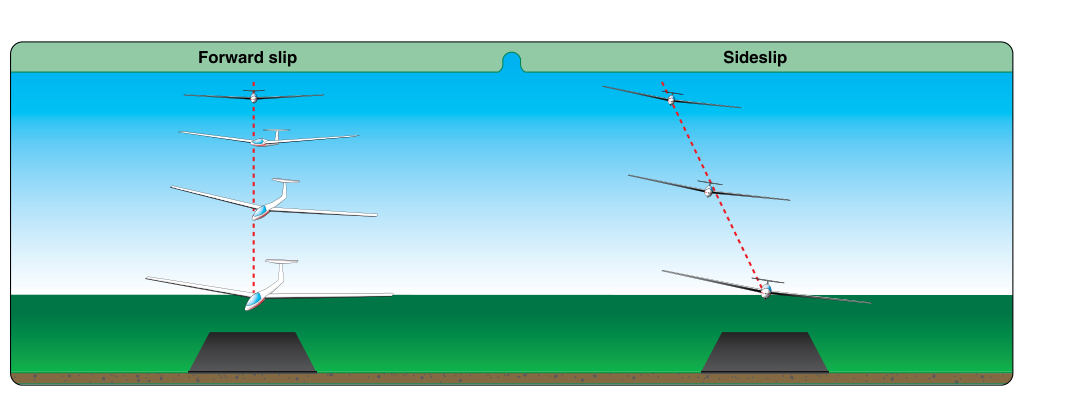
Both the forward slip and the side slip rely on the same fundamental technique: the rudder is displaced toward one wing while opposite aileron is applied to keep the airplane from turning or drifting. That shared DNA is exactly what makes students—and sometimes instructors—mix them up. The key is not the control inputs themselves, but what the pilot is trying to accomplish and how the airplane is oriented relative to the ground track and the runway.
In a forward slip, the pilot intentionally places the airplane's longitudinal axis at an angle to the flight path. Imagine the nose pointing off to one side while the airplane continues tracking straight ahead toward the runway. Because the fuselage is now broadside to the relative wind, the airplane presents a much larger cross-section and creates significantly more drag. This is the point: a forward slip is a deliberate energy-management tool used to dissipate altitude rapidly without increasing airspeed—valuable when you are high on final approach or simulating an engine-out landing where no flaps are available. Control inputs for a forward slip: lower one wing with aileron, then apply opposite (top) rudder to prevent the nose from turning in the direction of the lowered wing. The airplane yaws away from the bank, the longitudinal axis cocks sideways, and drag rises dramatically.
A side slip, by contrast, keeps the airplane's longitudinal axis aligned with—or parallel to—the runway centerline while the flight path is adjusted laterally. It is the foundational technique for a crosswind landing. Here the pilot lowers the upwind wing with aileron (to produce a banking force that cancels the crosswind drift) and applies opposite (downwind) rudder to prevent the nose from yawing away from the runway. The airplane tracks straight down the extended centerline while the fuselage stays aligned with it. Unlike the forward slip, the side slip does not generate nearly as much drag because the fuselage is not presented broadside to the airflow—it is still roughly aligned with the relative wind.
Why It Matters
Confusion between these two maneuvers has real consequences. An instructor who teaches crosswind corrections using the mental image of a forward slip may inadvertently teach students to yaw the nose into the wind (a crab correction) rather than bank into it, leading to side loads on landing gear at touchdown. Conversely, a student who attempts a forward slip when a side slip is needed will misalign the nose with the runway during the flare—a setup for a bad landing. Additionally, some aircraft Pilot's Operating Handbooks (POHs) restrict or prohibit slips with flaps extended because the extended flap surfaces can disturb airflow over the elevator, reducing pitch authority. Always check the POH before teaching either maneuver with flaps.
Memory Aid
Try this simple mental cue: "Forward slip = fuselage Forward into the wind at an angle; Side slip = Stay straight, stop drift." Or think about what each maneuver fixes: a forward slip fixes being too high (altitude problem), while a side slip fixes being too far sideways (drift problem). Another way instructors remember the distinction is: in a forward slip, the nose points somewhere other than where you are going; in a side slip, the nose points exactly where you want to go.
Common Test Traps
- "They use the same inputs, so they must be the same thing." Wrong. The inputs are similar but the aircraft's orientation to the runway and the intended outcome are completely different. FAA knowledge test items on slips test both the control inputs used and the resulting aircraft attitude and orientation—not just the maneuver's purpose in isolation.
- Airspeed in a slip. The airspeed indicator may read erroneously during a forward slip because airflow over the pitot-static system is disturbed. Always use an appropriate slip speed from the POH and treat the ASI reading with caution during the maneuver.
- Flaps-extended restriction. Many POH limitations prohibit slips with flaps fully extended. Test questions may ask about this limitation—it is not universal, so the correct answer is always "refer to the POH."
- Crosswind correction technique. The side slip (wing-low) method is the preferred technique for crosswind landings because it keeps the upwind main wheel touching down first and prevents side loads. Do not confuse this with the crab-and-kick method, which is a separate procedure sometimes combined with the side slip for strong crosswinds.