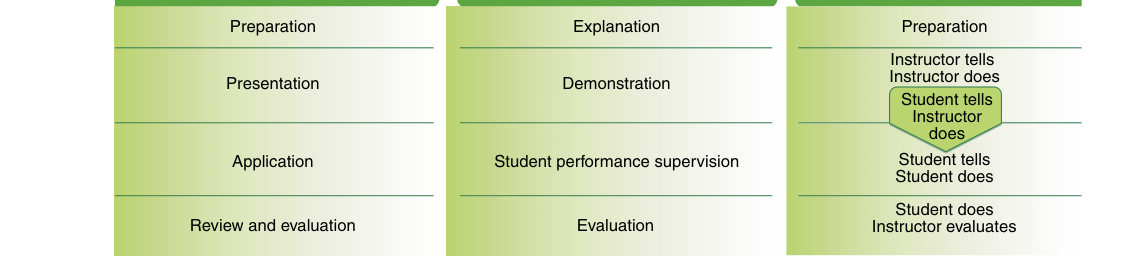
When a flight instructor climbs into the cockpit to teach a new maneuver or procedure, the temptation is to demonstrate it once and then simply hand over the controls. Experience—and FAA research—shows that approach produces inconsistent results. The telling-and-doing technique, described in the Aviation Instructor's Handbook (FAA-H-8083-9), is the FAA-endorsed method for cockpit instruction precisely because it closes the gap between watching and doing, between knowing and performing. It is a structured, four-step sequence designed to build both the cognitive framework and the psychomotor skill a student needs before they can operate independently and safely.
Understanding this technique deeply—not just memorizing its four labels—is essential for anyone preparing for the Flight Instructor Airplane or Flight Instructor Instrument knowledge tests, and more importantly, for anyone who will one day sit in the right seat of a training aircraft.
The Instructional Foundation: Demonstration-Performance Method
The telling-and-doing technique is not a standalone invention. It is the cockpit application of the broader demonstration-performance method, one of the fundamental teaching methods described in FAA-H-8083-9. That method holds that psychomotor skills—the coordinated physical and mental tasks involved in flying—are learned most effectively through a specific progression: the instructor demonstrates while explaining, the student practices under guidance, and the student ultimately performs independently. The telling-and-doing technique operationalizes this progression into four concrete, sequenced steps that can be applied consistently across every maneuver and procedure taught in flight training.
What makes the technique distinctive is that it deliberately separates two dimensions of competence: knowledge (the ability to describe and explain) and skill (the ability to physically perform). Many instructional approaches conflate these two dimensions and only discover the gap when the student fails a checkride or, worse, makes a dangerous error. The telling-and-doing technique surfaces each gap in a controlled, low-risk environment before it can matter operationally.
The Four Steps: What Happens and Why
Step 1 — Instructor Tells, Instructor Does
In the first step, the instructor simultaneously performs the maneuver and narrates every action. This is not just a casual walkthrough. The narration should explain the what, the how, and the why of each input—for example, not merely saying "I'm adding back pressure" but explaining "I'm adding back pressure here to maintain altitude as the bank increases and the vertical component of lift decreases." By coupling the verbal explanation with live physical demonstration, the instructor gives the student a complete picture of the procedure before the student ever touches the controls.
The student is forming an internal understanding of the task—a foundation they will rely on during every subsequent step. A weak or incomplete demonstration in Step 1 propagates errors through all three remaining steps, so thoroughness here has an outsized return on investment.
Step 2 — Instructor Tells, Student Does
In the second step, the student performs the maneuver while the instructor continues to provide verbal guidance. The student's hands and feet are now on the controls, but the instructor is still managing the flow of actions through narration. This scaffolded practice allows the student to focus cognitive resources on connecting the physical sensations of the aircraft to the correct sequence of inputs, without having to simultaneously generate that sequence independently.
A critical point that appears on knowledge tests: this is not independent practice. The instructor is still directing events. The purpose of Step 2 is to give the student an initial kinesthetic experience of the maneuver under a controlled verbal framework. Errors in Step 2 are expected and instructionally valuable—they show the instructor exactly where the student's physical execution diverges from the understanding formed in Step 1.
Step 3 — Student Tells, Instructor Does
Step 3 reverses the roles in a way that often surprises students and reveals surprising gaps. Here, the student narrates each step of the procedure while the instructor performs it. The student must articulate, in correct sequence and with adequate detail, exactly what should happen next—and the instructor executes (or deliberately hesitates) based on that narration.
This step is diagnostically valuable. A student who has a shallow or incomplete understanding of the procedure will immediately be exposed when they cannot generate the correct narration. Crucially, this gap is revealed while the instructor is at the controls, meaning no safety risk is created. If the student in Step 2 was able to perform the maneuver by following the instructor's verbal cues, Step 3 strips away that crutch and asks: does the student actually understand the procedure, or were they just following directions? FAA-H-8083-9 describes this role reversal as an integral part of the telling-and-doing sequence, and it is a common subject of knowledge test questions because of the counterintuitive role reversal it involves.
Step 4 — Student Tells, Student Does
In the final step, the student both narrates the procedure and performs it simultaneously. The instructor observes, evaluates, and intervenes only if safety requires it or if a significant error occurs. This step confirms that the student has integrated knowledge and skill into a unified, repeatable performance. The self-narration is not optional decoration—it serves as a real-time monitor of the student's decision-making process and keeps the cognitive layer of performance visible to both the student and the instructor.
Step 4 also reflects the kind of deliberate, verbalized thinking that supports sound decision-making in the cockpit. A pilot who habitually thinks through procedures aloud (or at least in explicit internal language) is applying a disciplined thought process that helps prevent errors in high-workload situations. By training this habit from the beginning in Step 4, the telling-and-doing technique produces more than just maneuver proficiency—it produces safer cockpit behavior.
Why Sequence Matters: The Risk of Skipping Steps
Each step in the sequence depends on the step before it. Step 1 builds the student's understanding; Step 2 provides the first physical experience within that understanding; Step 3 tests that understanding independently of physical performance; Step 4 integrates both. Skipping Step 3—which is tempting because it requires the instructor to perform again—leaves the instructor unable to confirm that the student's understanding is genuine rather than imitative. Skipping Step 2 throws the student into physical performance without any guided kinesthetic experience. Reordering any steps produces a fundamentally different instructional experience with predictably worse outcomes.
Key Numbers, Rules, and Exam-Focused Points
- Four steps, fixed order: Instructor tells/does → Instructor tells/Student does → Student tells/Instructor does → Student tells/Student does. No step is optional.
- Step 3 is a key diagnostic step. It reveals gaps in understanding before they affect flight safety. Test questions asking which step best exposes incomplete knowledge point to Step 3.
- Step 2 is guided practice, not independent practice. The instructor still controls the verbal flow in Step 2; independence only begins in Step 4.
- The technique applies to psychomotor (hands-on) tasks, most commonly taught in the cockpit setting. It is the standard approach under the demonstration-performance method for procedural and maneuver instruction, and the same structure can apply to hands-on skill instruction more broadly, such as with simulators or other equipment.
- Narration is instructionally functional throughout. In Steps 1–2, the instructor's narration scaffolds learning. In Steps 3–4, the student's narration monitors and confirms understanding.
Common Test Traps
- "Which step is most revealing of student knowledge gaps?" — Step 3 (Student tells – Instructor does), not Step 4. Step 4 combines performance and narration and can mask shallow understanding if the physical performance is successful.
- Confusing Step 2 with independent practice. Many students incorrectly identify Step 2 as the point at which the student works independently. The instructor is still providing verbal guidance in Step 2.
- Assuming Step 3 is unusual or optional. The role reversal in Step 3 feels counterintuitive, but the FAA-H-8083-9 describes it as an integral step in the sequence. Questions about "role reversal" point to Step 3.
- Treating the technique as only about physical skill. The technique addresses both the cognitive (knowledge/narration) and psychomotor (physical performance) dimensions. Its power comes from separating and then recombining these two dimensions across the four steps.
- Assuming the technique applies only to cockpit instruction. The demonstration-performance method and telling-and-doing technique are described generally for hands-on, procedural skill instruction and are not limited strictly to the cockpit; the same structure can be used with simulators or other training equipment. Separate methods—such as the lecture method or guided discussion—are typically used for ground instruction on concepts and regulations.
Memory Aid
Track where the words tell and do live in each step. In Step 1, the instructor owns both. By Step 4, the student owns both. Steps 2 and 3 each hand one of those two words from the instructor to the student—Step 2 hands over do, Step 3 hands back do to the instructor and gives tell to the student. Following the transfer of those two words through the four steps is the most reliable way to reconstruct the entire sequence without memorizing labels.