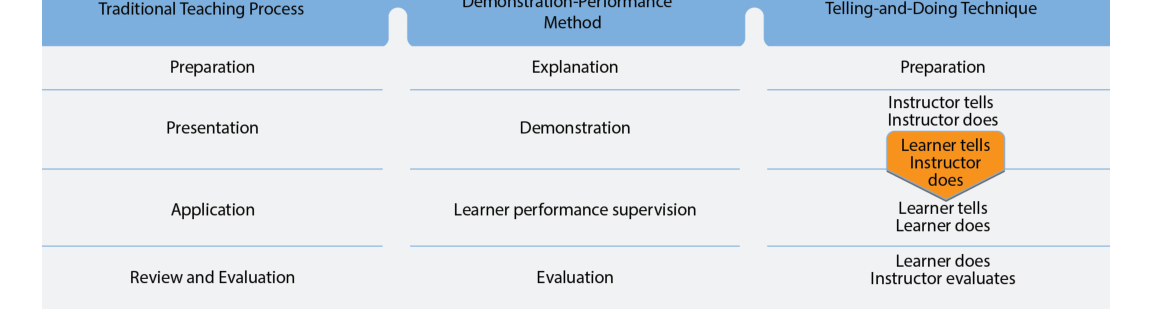
Structured instruction is the backbone of safe, efficient flight training. When a new pilot is learning to land an airplane or a seasoned private pilot is working toward an instrument rating, the quality of the instruction they receive depends heavily on how well the instructor organizes the lesson. The FAA's Aviation Instructor's Handbook (FAA-H-8083-9) outlines a four-step teaching method that gives flight and ground instructors a repeatable, logical framework for delivering any lesson. The four steps are Preparation, Presentation, Application, and Review and Evaluation. Together they mirror the natural arc of human learning and are directly tested on the Flight Instructor Airplane and Flight Instructor Instrument knowledge tests. More importantly, when applied correctly, they reduce the risk of knowledge gaps that could later become airmanship hazards.
Step 1: Preparation
Preparation happens before the student ever arrives. At its core, this step demands that the instructor answer one critical question: What, specifically, should the student know or be able to do by the end of this lesson? Without a precise, measurable objective, neither the instructor nor the student has a clear target. A lesson objective stated as "learn about stalls" is far weaker than one stated as "demonstrate power-off stalls at entry airspeeds and attitudes consistent with the Airman Certification Standards, identifying the onset of the stall and recovering with minimum altitude loss."
Beyond setting the objective, the instructor must assess the student's current level of knowledge and experience. A student on their third lesson needs a different level of assumed background than one preparing for a stage check. This assessment drives the selection of teaching materials, training aids, and the level of complexity the instructor will introduce. The instructor must also arrange the environment—whether that is a quiet briefing room, the ramp beside the aircraft, or a chair at a kitchen table for a distance-learning ground lesson—so that distractions are minimized and learning resources are at hand.
Preparation is largely invisible to the student, yet it is the foundation everything else rests on. An instructor who skips this step may deliver an unfocused lesson, fail to anticipate common points of confusion, or inadvertently overload a student with material that exceeds their current readiness level. The FAA-H-8083-9 emphasizes that effective preparation includes anticipating student questions and pre-identifying the misconceptions that most commonly arise with a given topic.
Step 2: Presentation
Presentation is where the instructor introduces new material. The Aviation Instructor's Handbook stresses the principle of moving from the known to the unknown—anchoring unfamiliar concepts to things the student already understands before building toward more complex ideas. This approach is rooted in learning theory: new information is retained far more effectively when the brain can attach it to an existing mental model.
Instructors have several presentation methods at their disposal. A lecture is efficient for conveying factual background. Guided discussion draws out what students already know and forces them to think critically. Analogy bridges abstract concepts to tangible experience—explaining induced drag by comparing it to trying to walk through waist-deep water is far more memorable than a textbook definition alone. In the cockpit environment, the most common and effective presentation technique is the Demonstration-Performance method, in which the instructor performs the maneuver while narrating each control input, power setting, and visual reference simultaneously. This allows the student to observe the complete sensory picture—sight, sound, and feel—before being asked to replicate it.
Clarity is paramount during presentation. The instructor must guard against information overload. For a first introduction to slow flight, for example, it is better to focus on the concept of flying on the back side of the power curve and the associated control inputs than to simultaneously introduce airspace restrictions, weight-and-balance implications, and carburetor heat requirements. Prioritize the core objective and layer additional context as the student's proficiency grows.
Step 3: Application
Application is the active learning phase—the student performs the task. In the cockpit this means the student takes the controls and attempts the maneuver. In a ground session it might mean working through a complete weight-and-balance calculation, plotting a cross-country course, or interpreting a Skew-T diagram. The instructor's role during application is to observe carefully, give timely corrective feedback, and resist the urge to take over unless safety requires it.
This last point deserves emphasis. An instructor who habitually takes control at the first sign of deviation robs the student of the learning experience that comes from recognizing, analyzing, and correcting their own errors under supervision. The FAA-H-8083-9 is clear that errors during application are not failures; they are expected parts of the learning process. What matters is that the instructor identifies the error, explains the correct technique, and gives the student another opportunity to apply the correction before moving on.
Corrective feedback during application should be specific and constructive. Telling a student "that was a little rough" is far less useful than "your left wing dropped to about 20 degrees during the entry—next time, focus on keeping the horizon level on both sides before you raise the nose." Specific feedback targets the actual error, gives a concrete cue, and sets up the next repetition for improvement.
Step 4: Review and Evaluation
The final step closes the instructional loop. Review revisits the key points of the lesson, reinforcing correct understanding and connecting the lesson content back to the original objective. Evaluation measures whether the student actually met that objective. These two components are treated as a single combined step in the Aviation Instructor's Handbook—not two separate steps—which is a frequently tested distinction.
Evaluation can be informal, such as asking the student to explain the relationship between angle of attack and lift coefficient in their own words, or more formal, such as assessing a maneuver against the tolerances published in the Airman Certification Standards. The ACS specifies performance parameters—airspeed tolerances, altitude deviations, heading limits—for each task, and the instructor's post-flight evaluation should reference those standards explicitly so the student understands the objective benchmark.
An honest, balanced evaluation tells the student two things: what they demonstrated competently and what still requires work. It also drives planning for the next lesson by identifying which objectives need to be revisited before new material can be introduced. In this way, the four-step method creates a continuous improvement cycle rather than a series of disconnected events.
Why the Four-Step Method Matters in Aviation
Flight training is uniquely high-stakes. A gap in a student pilot's knowledge of weather minimums or a technique flaw in crosswind landing technique can have real safety consequences months or years after the lesson is over. The four-step method exists because it is structurally difficult to skip a critical element when you follow it faithfully. If the instructor prepares well, the objective is clear. If the presentation is effective, the student has the mental model needed to attempt the task. If the application phase is properly supervised, errors are corrected before they become habits. If review and evaluation are thorough, neither the instructor nor the student walks away with a false sense of competence.
This structure also aligns with the FAA's broader emphasis on risk management. The Risk Management Handbook (FAA-H-8083-2) notes that training effectiveness directly influences aeronautical decision-making skills. An instructor who shortcuts the teaching process introduces risk into the system before the student ever flies solo.
Key Numbers, Rules, and ACS-Relevant Points
- Four steps, in order: Preparation → Presentation → Application → Review and Evaluation. The sequence is fixed.
- Review and Evaluation is one step (Step 4), not two separate steps. Test questions may try to split them into five total steps.
- Application is student-led: If the instructor is performing the maneuver during the Application phase, the lesson has reverted to Presentation. Application means the student is doing the work.
- Known to unknown: The principle governing the Presentation phase—always build new concepts onto a foundation of what the student already understands.
- Objective must be measurable: A vague objective undermines every subsequent step. The objective should describe what the student will do, under what conditions, and to what standard.
Common Test Traps
- Scrambled order: Knowledge test questions frequently present the steps out of sequence. Know the order cold—Preparation always comes first.
- Instructor re-demonstrates during Application: This signals a return to Presentation, not a feature of the Application step. Recognize it as a lesson design issue.
- Five-step answer choices: If an answer choice lists Review and Evaluation as separate steps, making five total, it is incorrect per the Aviation Instructor's Handbook.
- Preparation described as optional: Some scenarios imply that an experienced instructor can skip formal preparation. The handbook is clear that preparation is always required, regardless of instructor experience level.
- Evaluation timing: Evaluation happens at the end of the lesson cycle (Step 4), not during Application. During Application the instructor gives corrective feedback—evaluation is the structured assessment of whether the objective was met.
Memory Aid
The acronym PPAR captures the sequence: Preparation, Presentation, Application, Review and Evaluation. A phrase that reinforces the purpose of each step: Plan it → Present it → Practice it → Prove it. Each verb reminds you of the instructor's primary activity at that stage and keeps the sequence in the right order.