At high altitudes, the human body depends entirely on a pressurized cabin to maintain adequate oxygen partial pressure. When that pressurization fails—whether from a structural breach, a pressurization system malfunction, or a door seal failure—pilots face one of the most time-critical emergencies in aviation. The combination of a sharply limited window of useful human consciousness and the need to execute a precise, aircraft-limits-respecting emergency descent makes this topic a cornerstone of Airline Transport Pilot (ATP) training and a frequent focus of practical test standards.
Understanding emergency descent profiles and time of useful consciousness (TUC) requires integrating physiology, aerodynamics, aircraft systems knowledge, and crew resource management into a seamless, rehearsed response. This article covers the mechanics of rapid depressurization, the physiological envelope pilots must work within, the structure of an effective emergency descent, and the operational considerations that separate a successful outcome from a catastrophic one.
The Physiology: Time of Useful Consciousness
Time of useful consciousness (TUC)—also called effective performance time (EPT) in some contexts—is the interval between the onset of oxygen deprivation at altitude and the point at which a pilot can no longer take meaningful corrective action. Critically, TUC is not the time until unconsciousness; it is the shorter window during which purposeful, trained activity is still possible. After TUC expires, the pilot may still be conscious but unable to perform useful tasks.
TUC varies dramatically with altitude and with activity level. At rest, the body consumes less oxygen and TUC is longer. Under the physical and psychological stress of an emergency—rapid breathing, elevated heart rate, physical manipulation of controls—TUC can be cut to as little as one-half of the resting value. This halving effect is one of the most dangerous traps in high-altitude emergencies; a pilot who knows the resting TUC figures may still be caught off guard by how quickly cognitive function degrades when adrenaline and exertion are added to the equation.
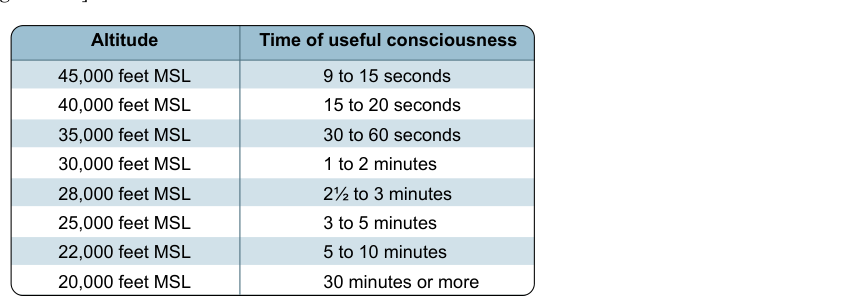
Representative TUC values at altitude (resting, approximate):
- 18,000 ft MSL: 20–30 minutes
- 25,000 ft MSL: 3–5 minutes
- 30,000 ft MSL: 1–2 minutes
- 35,000 ft MSL: 30–60 seconds
- 40,000 ft MSL: 15–20 seconds
- 45,000 ft MSL and above: 9–15 seconds or less
These figures underscore why the emergency descent checklist must be initiated immediately—within the first breath of recognizing depressurization—before hypoxia has time to degrade judgment and motor coordination. Modern air carrier operations at FL350–FL430 leave pilots only seconds to don oxygen, establish communications, and begin the descent profile before TUC may expire.
How Rapid Depressurization Occurs
Pressurized aircraft maintain a cabin altitude significantly lower than the ambient flight altitude. A typical transport-category aircraft cruising at FL380 may maintain a cabin altitude of approximately 6,000–8,000 ft. When the pressure hull is breached or the pressurization system fails, the cabin altitude rises toward ambient altitude. The speed of this rise depends on the size of the breach, the volume of the cabin, and the differential pressure at the time of failure.
An explosive decompression occurs in less than 0.5 seconds—faster than the blink reflex. It is accompanied by a loud bang, a fog of condensing moisture as the air rapidly cools and expands, loose objects becoming projectiles, and immediate hypoxia onset. A rapid decompression takes between 0.5 and 10 seconds. A gradual depressurization unfolds over minutes and is insidious precisely because the slow onset of hypoxia mimics ordinary fatigue—pilots may become incapacitated without ever recognizing the emergency.
In any case, the correct initial response is identical: don oxygen immediately, declare an emergency, and execute the emergency descent profile. Pausing to investigate the source of depressurization before donning oxygen is a fatal mistake at high altitude.
Emergency Descent Profile: Structure and Execution
The emergency descent is a controlled, maximum-rate loss of altitude designed to bring the aircraft below 10,000 ft MSL (or MEA if higher) as quickly as possible while remaining within the aircraft's structural and aerodynamic envelope. The FAA Airplane Flying Handbook (FAA-H-8083-3C, Chapter 13) describes the emergency descent as a maneuver requiring careful attention to aircraft limitations even under extreme time pressure.
Initial Actions
The sequence typically begins with simultaneous actions: the pilot flying dons the oxygen mask and selects 100% oxygen (or emergency flow), the pilot monitoring declares an emergency on 121.5 MHz or the assigned ATC frequency, and ATC is notified of intentions. A squawk of 7700 is set unless otherwise directed. These actions are performed from memory—no checklist reading occurs until oxygen is established and the aircraft is in a stabilized descent.
Power and Configuration
Thrust is reduced to idle. On turboprop and jet aircraft, the specific procedure varies by type, but the goal is to eliminate thrust contribution to airspeed while descending. Speedbrakes or spoilers, if available and approved, are deployed to increase drag and control airspeed during the descent. The aircraft is rolled into a bank (typically 30–45 degrees for transport-category aircraft, though type-specific procedures govern) and the nose is lowered to accelerate toward or maintain the maximum operating speed (VMO) or maximum Mach number (MMO)—whichever is limiting at the flight level. Descending at or near VMO/MMO maximizes the rate of altitude loss while remaining within the certified structural envelope.
The pilot must not exceed VMO/MMO during the descent. At very high altitudes, MMO is typically the limiting factor; as the aircraft descends into denser air, VMO (IAS) becomes the limit. Pilots must monitor both the Mach meter and airspeed indicator and manage the transition. Exceeding these limits risks structural damage or loss of control at a moment when the aircraft and crew are already under maximum stress.
Leveling Off
The target altitude is typically 10,000 ft MSL or the minimum safe/enroute altitude, whichever is higher. ATC provides traffic separation during the descent; pilots should request vectors to avoid conflicting traffic and mountainous terrain, especially during night or IMC operations. At 10,000 ft, supplemental oxygen requirements under 14 CFR Part 91 are generally no longer mandatory. Under 14 CFR 91.211, flight crew must use oxygen for that part of the flight above 12,500 ft MSL up to and including 14,000 ft MSL that exceeds 30 minutes, and must use oxygen continuously at all times above 14,000 ft MSL; above 15,000 ft MSL, each occupant must be provided with supplemental oxygen (though only flight crew are required to use it at that altitude). Passengers should remain on oxygen until the cabin is confirmed pressurized or the aircraft is at a comfortable altitude.
Why It Matters: Operational and Safety Relevance
The emergency descent is one of the few maneuvers in transport aviation where speed of execution directly determines survival probability. Unlike most abnormal procedures that allow a deliberate, checklist-driven response, the brevity of TUC at cruise altitudes means that a crew that hesitates for even 30 seconds at FL400 may be incapacitated before completing the descent initiation. This is why emergency descent procedures are always memory items in air carrier operations—they are drilled to automaticity in the simulator precisely because cognitive function will be degrading during the real event.
Crew Resource Management (CRM) plays a defining role. In a two-pilot crew, one pilot dons oxygen and initiates the descent while the other simultaneously dons oxygen and handles communications. Task saturation must be managed explicitly; the non-flying pilot must resist the urge to diagnose the cause of depressurization and instead focus on completing critical memory items. Passenger briefings, cabin crew notifications, and company communications are deferred until the aircraft is in a stabilized descent and the crew's cognitive resources are no longer fully consumed by the memory sequence.
Key Numbers and Rules
- TUC at FL350: approximately 30–60 seconds at rest; potentially 15–30 seconds under stress
- Target descent altitude: 10,000 ft MSL or MEA/MORA, whichever is higher
- Speed target during descent: VMO/MMO (type-specific; do not exceed)
- Typical bank angle for transport-category emergency descent: 30–45 degrees (per AFM/POH)
- 14 CFR 91.211: Flight crew must use oxygen above 12,500 ft MSL for that portion of flight above 30 minutes' duration up to 14,000 ft MSL, and continuously at all times above 14,000 ft MSL; above 15,000 ft MSL each occupant must be provided supplemental oxygen
- Emergency squawk: 7700
- Guard frequency for ATC emergency declaration: 121.5 MHz
- Stress halving rule: Active TUC ≈ 50% of resting TUC at the same altitude
Common Test Traps
- Confusing TUC with time to unconsciousness. TUC ends when useful performance ceases—the pilot may still appear awake but cannot execute meaningful actions. The exam tests whether you understand this critical distinction.
- Forgetting the stress halving effect. Examiners frequently ask what happens to TUC during an active emergency. The answer is it is reduced by approximately half—this makes fast memory-item execution even more critical.
- Exceeding VMO/MMO during the descent. The goal is to descend at the limit speed, not beyond it. Structural integrity must be preserved even in an emergency.
- Targeting 10,000 ft without checking terrain. In mountainous regions or when operating on airways with high MEAs, 10,000 ft MSL may be below the minimum enroute altitude. The correct target is always the higher of 10,000 ft or the applicable MEA/MORA.
- Treating gradual depressurization as less urgent. The slow onset of hypoxia in a gradual depressurization is more insidious than explosive decompression—the pilot may feel only mild fatigue before losing the ability to act. Any cockpit altitude warning must be treated as an immediate emergency regardless of the rate of pressure loss.