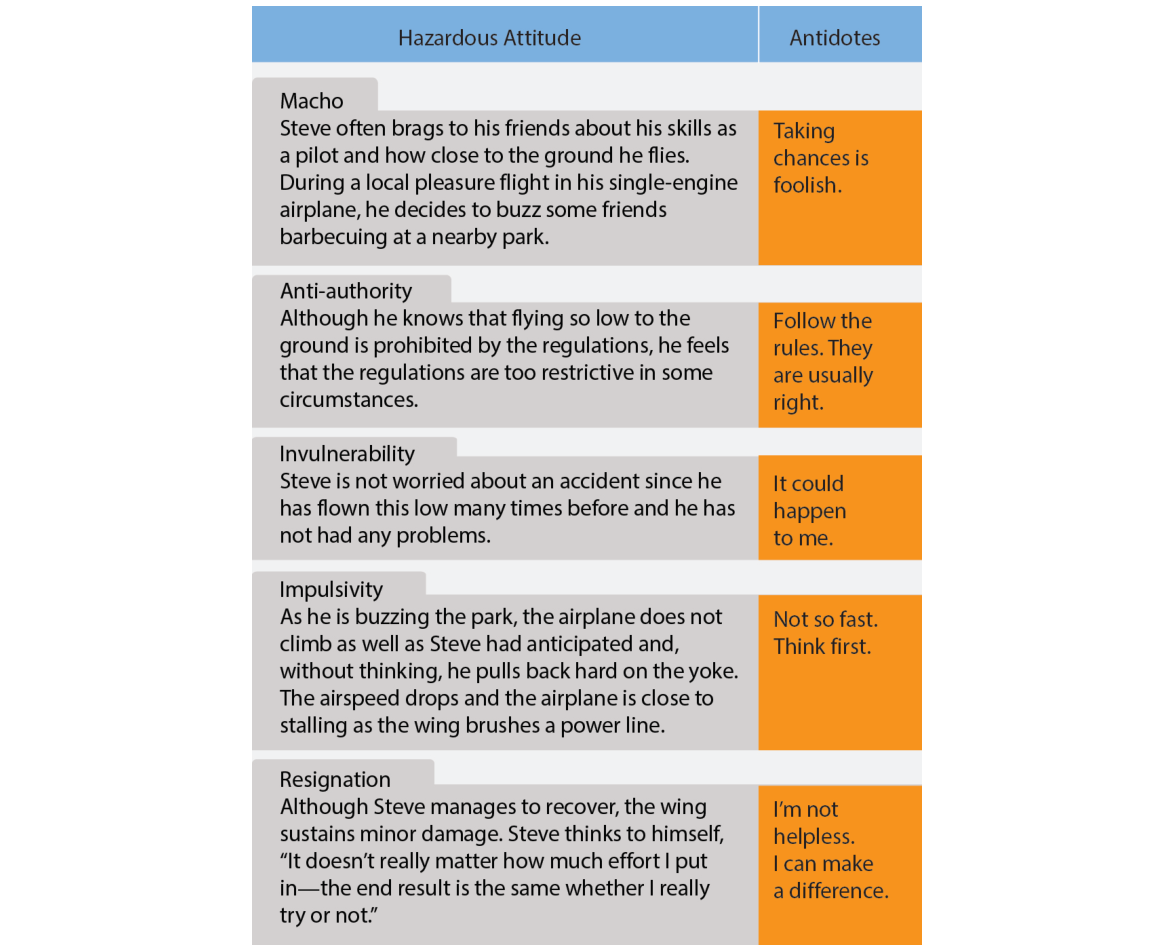
Every pilot — whether sitting in a cockpit at 10,000 feet or standing at a ground control station watching a small UAS climb overhead — is vulnerable to subtle mental traps that quietly erode good judgment. The FAA calls these traps hazardous attitudes: predictable, recurring patterns of flawed thinking that have been directly linked to aviation accidents. Understanding them is not just a knowledge-test requirement; it is one of the most practical safety skills a remote pilot can develop.
The FAA's Risk Management Handbook (FAA-H-8083-2) identifies five specific hazardous attitudes, and for each one it prescribes a direct mental antidote — a short phrase you consciously say to yourself to break the dangerous thought pattern before it influences your actions. Mastering both the attitudes and their antidotes is tested on the FAA Part 107 Aeronautical Knowledge Test and, more importantly, it can prevent you from making the kind of decision that ends in a lost aircraft, an injury, or a violation.
The Five Hazardous Attitudes and Their Antidotes
1. Anti-Authority
The attitude: "Don't tell me what to do." A pilot with an anti-authority attitude resents rules, regulations, and the authority of others to direct their behavior. They may view FAA regulations as bureaucratic nuisances written by people who don't understand real-world flying. In remote pilot operations, this might look like dismissing a NOTAM, ignoring a Temporary Flight Restriction (TFR), or deciding that a waiver requirement is unnecessary red tape.
Why it's dangerous: The rules that govern National Airspace System (NAS) operations exist precisely because experienced professionals — often after studying accidents — identified what margins of safety are needed. Dismissing them removes layers of protection that were deliberately designed in.
The antidote: "Follow the rules. They are usually right." This does not mean blindly following a rule off a cliff; it means giving regulations the benefit of the doubt and seeking to understand the safety logic behind them before deciding to challenge them through proper channels.
2. Impulsivity
The attitude: "Do something — quickly!" When something goes wrong or a time-pressured situation arises, an impulsive pilot acts immediately without pausing to think through the best course of action. For a remote pilot, this could mean instantly pushing full stick input when the aircraft behaves unexpectedly, triggering a worse problem, or rushing a takeoff because a customer is waiting rather than completing a proper preflight.
Why it's dangerous: Fast action in the wrong direction is often more harmful than a brief pause. Most sUAS emergencies unfold over seconds to minutes — there is almost always time to think before acting, and that moment of thought dramatically improves outcomes.
The antidote: "Not so fast — think first." Force yourself to take one breath, identify what is actually happening, consider your options, and then act with intention rather than reflex.
3. Invulnerability
The attitude: "It won't happen to me." A pilot with this attitude acknowledges that accidents happen — they just believe those accidents happen to other, less skilled people. Remote pilots may rationalize flying in deteriorating weather, over congested areas, or beyond visual line of sight without authorization because they have "done it before without problems." Previous success without incident is not evidence of safety; it may simply be evidence of luck.
Why it's dangerous: This attitude leads pilots to stop scanning for threats because they have convinced themselves there are none. Risk is systematically underestimated, and precautions are skipped because they seem unnecessary.
The antidote: "It could happen to me." Actively remind yourself that mechanical failures, unexpected weather, airspace conflicts, and human error do not respect skill level or experience. Healthy humility is a safety asset.
4. Macho
The attitude: "I can do it." The macho attitude drives pilots to take on unnecessary risks to impress others or to prove something to themselves. This is distinct from confidence — it is confidence disconnected from an honest assessment of the situation. A remote pilot might fly a complex urban mission in gusty winds above the aircraft's rated limits, or attempt a cinematic maneuver they have never practiced, simply because they want to demonstrate that they are capable.
Why it's dangerous: The macho attitude tends to suppress internal warning signals. When your gut says "this doesn't feel right," the macho pilot overrides that instinct with ego. It also leads to poor risk communication — you won't tell a client or crew member about concerns because you don't want to appear uncertain.
The antidote: "Taking chances is foolish." True competence includes knowing your limits and the limits of your equipment. The most skilled pilots are often the ones who are most willing to say no to a flight that exceeds those limits.
5. Resignation
The attitude: "What's the use?" A resigned pilot feels that their actions don't matter — that outcomes are determined by fate, luck, or forces beyond their control. If something starts going wrong, this pilot gives up rather than working the problem. In remote pilot operations, resignation might manifest as accepting a drift toward a hazard without corrective input, or deciding not to report a safety concern because "nothing will change anyway."
Why it's dangerous: Resignation is particularly insidious because it looks like calm acceptance when it is actually a dangerous passivity. It eliminates the pilot as an active safety resource at exactly the moment when active intervention is most needed.
The antidote: "I'm not helpless. I can make a difference." Remote pilots have real authority over their aircraft, their preflight decisions, their go/no-go calls, and their emergency responses. Owning that agency is a prerequisite for safe operations.
Why This Matters for Remote Pilots Specifically
Part 107 operations often involve commercial pressure, client expectations, and a public perception that drone flying is "easy." These environmental factors create fertile ground for all five hazardous attitudes. A videographer urging you to fly despite a nearby TFR feeds the anti-authority and macho attitudes. A tight production schedule can trigger impulsivity. Flying the same corridor fifty times without incident can breed invulnerability. And when a motor warning light appears mid-flight with a client watching, resignation can feel like the path of least resistance.
The FAA explicitly recognizes that aeronautical decision-making (ADM) — the systematic, rational approach to choosing a course of action — is just as critical for remote pilots as for manned aircraft pilots. The hazardous attitude framework is one of the foundational ADM tools. It provides a mental interrupt: a way to catch yourself in a dangerous thought pattern, name it, and replace it with the corrective antidote before the thought becomes an action.
Key Numbers and Rules
- Five attitudes, five antidotes: Anti-Authority, Impulsivity, Invulnerability, Macho, and Resignation — each has one specific antidote phrase.
- ADM is required knowledge for the Part 107 Remote Pilot Certificate knowledge test (14 CFR Part 107).
- Hazardous attitudes apply to all pilots regardless of aircraft type, platform, or experience level, per FAA-H-8083-2.
- Multiple attitudes can be present simultaneously — a pilot can be both impulsive and macho in the same decision moment, compounding risk.
- Self-assessment is the first step: The FAA recommends that pilots periodically evaluate themselves for hazardous attitude tendencies, particularly before and during flight.
Memory Aid
A widely used mnemonic to remember all five hazardous attitudes is "A I I M R" — sometimes recalled as "All Idiots In My Rig" (not an FAA phrase, but a common student memory tool):
- A — Anti-Authority
- I — Impulsivity
- I — Invulnerability
- M — Macho
- R — Resignation
For the antidotes, pair each with its attitude: "Follow the rules" (Anti-Authority), "Think first" (Impulsivity), "It could happen to me" (Invulnerability), "Taking chances is foolish" (Macho), and "I can make a difference" (Resignation). Drilling the pairs — not just the attitude names — is what actually builds the in-flight mental habit.
Common Test Traps
- Confusing Macho with Impulsivity: Macho is about ego-driven risk-taking to impress or prove something; Impulsivity is about acting too quickly without thinking. A scenario where a pilot rushes a takeoff is Impulsivity; a scenario where a pilot attempts a maneuver beyond their skill to look capable is Macho.
- Misidentifying Resignation as calm professionalism: The FAA test may present a scenario where a pilot "accepts" an unsafe situation and moves on — this is Resignation, not good airmanship. Look for passive acceptance of danger as the red flag.
- Forgetting that Anti-Authority includes self-generated rules: A pilot who dismisses their own checklist as unnecessary is displaying Anti-Authority, not just one who ignores FAA regulations.
- Thinking the antidote must be elaborate: The antidote is simply the short phrase. The test question will ask you to identify which antidote matches which attitude — memorize the exact pairings.
- Overlooking attitude combinations: A test scenario might describe behavior that reflects more than one attitude. Answer based on the most dominant attitude described, or identify both if the question asks for all present.