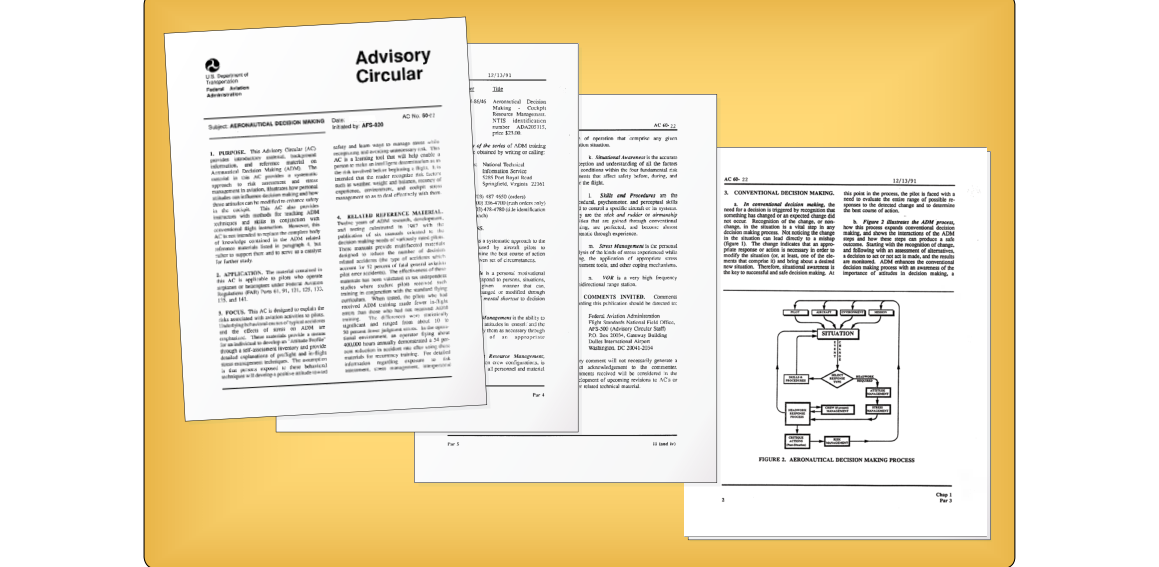
Flying a drone commercially under Part 107 might seem straightforward compared to manned aviation, but the decision-making challenges are just as real. A remote pilot in command (RPIC) must assess weather, airspace, equipment, and human factors—often in a matter of seconds—without the instinctive feedback a cockpit provides. Aeronautical Decision-Making (ADM) is the systematic, rational process of consistently identifying hazards, evaluating risks, and choosing the safest course of action. The FAA considers sound ADM essential for all pilots, manned or unmanned, and tests it directly on the Part 107 aeronautical knowledge exam.
This article walks through the major FAA-recognized ADM models and tools, explains how each one applies specifically to remote pilot operations, and highlights the most commonly tested concepts. Mastering these frameworks will not only help you pass the test—it will make you a genuinely safer operator in the field.
What ADM Really Means
ADM goes beyond simply making a decision. The FAA defines it as a systematic approach to the mental process used by pilots to consistently determine the best course of action in response to a given set of circumstances. Poor ADM is cited as a causal factor in the vast majority of aviation accidents, including UAS incidents. The key insight is that most accidents are not caused by mechanical failure or ignorance of procedures—they are caused by a chain of poor choices, each of which might have seemed minor on its own.
For the remote pilot, ADM starts long before the motors spin up. Preflight planning, site surveys, risk assessment, and go/no-go decisions are all ADM in action. The moment you decide to launch despite deteriorating visibility because "it's just a quick shot" is the moment ADM has broken down.
The PAVE Checklist: Pre-Flight Risk Identification
The PAVE checklist is one of the FAA's primary tools for identifying risk before a flight. Each letter represents a category of potential hazard:
- P — Pilot in Command: Are you personally ready to fly? This means your physical condition, currency, recency of experience, and whether you hold a valid Remote Pilot Certificate with the appropriate endorsements or waivers for the planned operation.
- A — Aircraft (sUAS): Is the aircraft airworthy and in a condition for safe flight? This includes preflight inspections, battery health, firmware status, propeller integrity, and any manufacturer-required maintenance. The FAA requires that an RPIC ensure the sUAS is in a safe condition prior to flight.
- V — enVironment: What are the environmental conditions at the launch site and in the operating area? Consider weather (wind, visibility, ceiling, precipitation), airspace class and any active TFRs, terrain, obstacles, population density, and lighting conditions if flying near twilight.
- E — External Pressures: Are there non-aviation factors pushing you toward a flight you might otherwise cancel? Client deadlines, financial pressure, impatient customers, or social pressure from crew members are all external pressures that can degrade decision quality. Recognizing them is the first step to neutralizing them.
Working through PAVE before every flight creates a mental habit of structured hazard identification. On the Part 107 test, scenarios frequently describe a situation with one PAVE category in distress—recognize which category is at risk and you will answer correctly.
The IMSAFE Checklist: Personal Readiness
IMSAFE digs deeper into the "P" (Pilot) element of PAVE. It is a personal minimums checklist designed to help a pilot honestly assess human factors that could impair performance:
- I — Illness: Am I suffering from any illness or symptom that might affect my abilities? Even a common cold can impair concentration and spatial awareness.
- M — Medication: Am I taking any prescription or over-the-counter drugs that could cause drowsiness, impaired judgment, or other performance-degrading effects?
- S — Stress: Am I under significant psychological pressure—financial, family, work—that could distract me or degrade my decision-making?
- A — Alcohol: Have I consumed alcohol within the past eight hours (the FAA's regulatory minimum), or am I still feeling any effects? The FAA standard is no less than eight hours from bottle to throttle, and blood alcohol content must be below 0.04%.
- F — Fatigue: Am I adequately rested? Fatigue is one of the most insidious human factors because it impairs the very judgment needed to recognize impairment.
- E — Emotion: Am I emotionally stable and focused? Strong emotions—anger, grief, anxiety—can narrow attention and compromise risk assessment.
For remote pilots, IMSAFE is especially relevant because UAS operations often take place during non-standard hours, in physically demanding environments (heat, cold, uneven terrain), or under significant commercial pressure. A "no" answer to any IMSAFE item should trigger serious consideration of whether the flight should proceed.
The 5 Ps: Continuous In-Flight Risk Assessment
While PAVE and IMSAFE are primarily preflight tools, the 5 Ps checklist is designed for ongoing use throughout a flight to catch changing conditions before they become emergencies. The five Ps are:
- Plan: Is the original flight plan still valid given current conditions?
- Plane (sUAS): Is the aircraft performing as expected? Any anomalies in flight characteristics, battery discharge rate, or control response?
- Pilot: How is the RPIC doing? Are fatigue or distraction creeping in?
- Passengers/Crew: For Part 107, this includes visual observers (VOs) and any other crew on site. Are they communicating effectively and maintaining situational awareness?
- Programming/Environment: Has the environment changed—wind increasing, visibility dropping, new aircraft entering the area, bystanders approaching the flight zone?
The 5 Ps remind the remote pilot that ADM is not a one-time preflight checkbox—it is a continuous loop throughout the operation. Conditions change rapidly in the field, and an operation that was safe at launch may require adjustment or termination minutes later.
Hazard and Risk: Understanding the Difference
The FAA draws a clear distinction between a hazard and a risk. A hazard is any real or potential condition, event, or circumstance that could cause injury, illness, or damage. Risk is the assessed likelihood and severity of harm that a hazard presents. ADM requires the pilot to first identify hazards and then evaluate the risk each one poses.
Risk is commonly assessed along two axes: probability (how likely is this hazard to cause harm?) and severity (how bad would the outcome be if it did?). High probability combined with high severity means unacceptable risk; a low-probability, low-severity hazard may be acceptable with simple mitigations in place. The FAA's risk matrix framework, described in the Risk Management Handbook, formalizes this approach and is tested on the Part 107 exam.
Hazardous Attitudes and Their Antidotes
The FAA identifies five hazardous attitudes that undermine good ADM. Every pilot—including remote pilots—should recognize these attitudes in themselves and apply the associated antidote:
- Anti-authority: "Don't tell me what to do." Antidote: Follow the rules—they are usually right.
- Impulsivity: "Do something quickly!" Antidote: Not so fast. Think first.
- Invulnerability: "It won't happen to me." Antidote: It could happen to me.
- Macho: "I can handle it." Antidote: Taking chances is foolish.
- Resignation: "What's the use?" Antidote: I'm not helpless. I can make a difference.
Recognizing a hazardous attitude is itself an ADM skill. The FAA exam frequently presents a scenario where a pilot's behavior clearly maps to one of these five attitudes; your job is to identify which one and select the correct antidote.
Memory aid
Use the phrase "All Individuals In My Radar" to remember the five hazardous attitudes: Anti-authority, Impulsivity, Invulnerability, Macho, and Resignation. Once you can name all five quickly, matching them to exam scenarios becomes straightforward.
The 3P Model: Perceive, Process, Perform
The FAA also describes the 3P model as a practical, repeatable ADM loop: Perceive the hazard, Process the risk it presents, and Perform a risk-management action. The loop then repeats. For a remote pilot, this might look like: perceiving that wind gusts are increasing (Perceive), evaluating whether the sUAS can handle the gusts safely given battery level and remaining flight time (Process), and deciding to return to home immediately (Perform). The 3P model is particularly useful because it is simple enough to execute under pressure.
Why ADM Matters for Part 107
The FAA's data on UAS incidents consistently points to human factors—not hardware—as the dominant cause. Fly-aways, loss of visual line of sight, airspace incursions, and inadvertent flight over people are almost always traceable to a decision made (or not made) by the RPIC. Because a remote pilot cannot feel turbulence, cannot hear unusual engine sounds, and relies entirely on visual and telemetric data, the cognitive workload of maintaining situational awareness is actually higher in some ways than in manned aviation. Structured ADM frameworks provide mental scaffolding that compensates for the reduced sensory feedback of remote operations.
Additionally, Part 107 commercial operations often occur under real business pressure—ADM frameworks give pilots a professional, defensible reason to say no to an unsafe flight. Documenting your PAVE and risk assessments also demonstrates due diligence if an incident is ever investigated.
Key Numbers and Rules
- Alcohol: minimum 8 hours from last consumption to flight; BAC must be below 0.04% (14 CFR 91.17, applied to remote pilots via 14 CFR 107.57).
- Five hazardous attitudes: Anti-authority, Impulsivity, Invulnerability, Macho, Resignation—know all five and their antidotes.
- PAVE covers four risk categories: Pilot, Aircraft, enVironment, External pressures.
- IMSAFE covers six personal readiness factors.
- The 5 Ps are used for ongoing in-flight assessment, not just preflight.
- Risk is assessed by probability × severity; both factors must be evaluated together.
Common Test Traps
- Confusing hazard and risk: A hazard is the condition itself; risk is the evaluated likelihood and severity of harm. The exam may present both terms and ask you to distinguish them.
- Misidentifying hazardous attitudes: "Macho" and "invulnerability" are easy to conflate. Macho is about proving capability ("I can handle this"); invulnerability is about denial of personal susceptibility ("accidents happen to others, not me").
- Assuming IMSAFE is only for certificated pilots: The FAA explicitly applies human factors and ADM requirements to remote pilots. IMSAFE is fair game on the Part 107 exam.
- Treating ADM as preflight-only: Several exam questions describe conditions that change during a flight. The correct answer usually involves applying continuous ADM (the 5 Ps or 3P loop) rather than relying solely on the preflight assessment.
- Underweighting external pressure: The "E" in PAVE is frequently the subtle villain in test scenarios. A description of a client who "really needs this footage today" is a classic external pressure trap—recognize it and treat it as a risk factor, not a reason to fly.