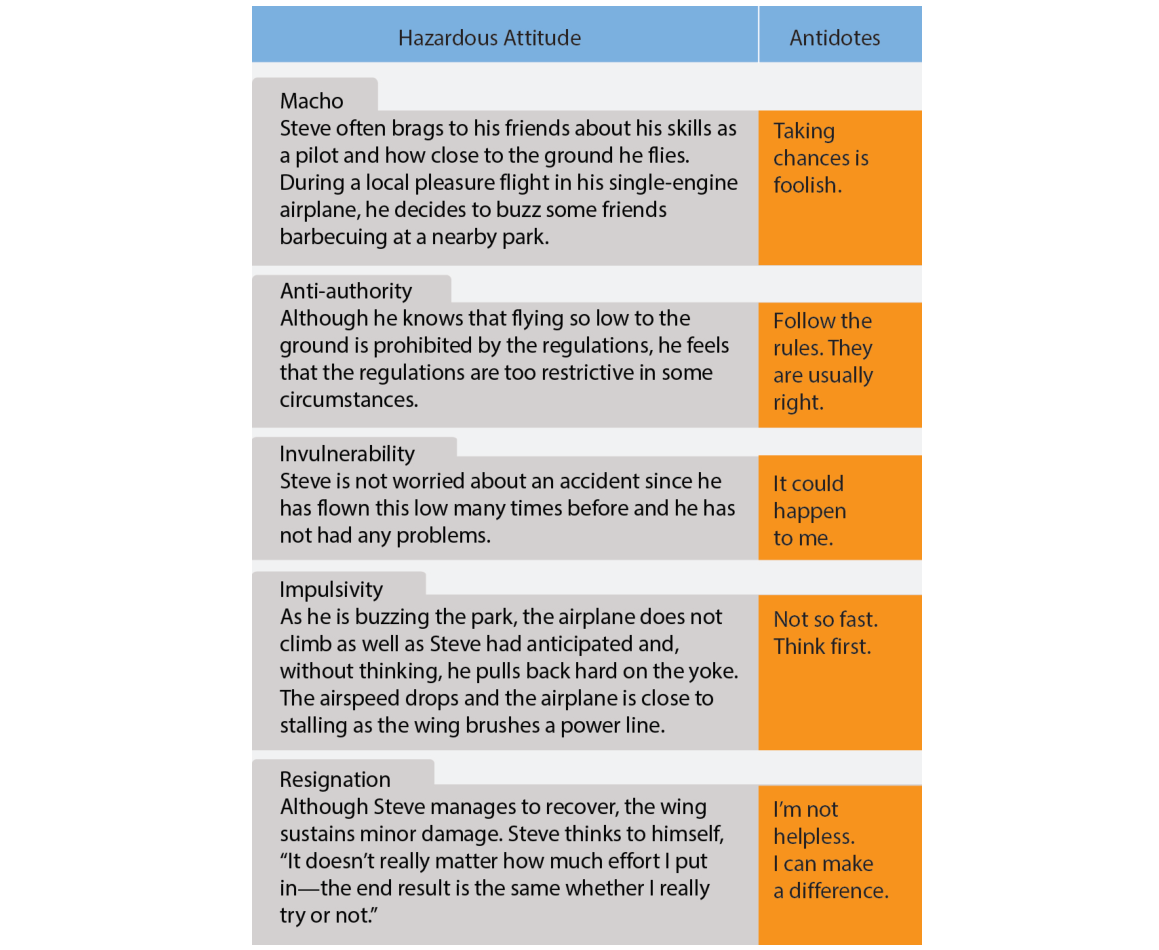
One of the most consequential—and least glamorous—responsibilities a flight instructor carries is serving as a real-time monitor of student thinking patterns. The FAA is explicit: teaching stick-and-rudder skills is only part of the job. The Aviation Instructor's Handbook (FAA-H-8083-9) and the Risk Management Handbook (FAA-H-8083-2) together establish that a certificated flight instructor (CFI) must actively recognize, address, and help students overcome hazardous attitudes before those attitudes calcify into dangerous habits. This is not optional enrichment—it is a core instructional duty grounded in the FAA's Aeronautical Decision-Making (ADM) framework and directly tested on the FAA Flight Instructor Knowledge Test.
What Are Hazardous Attitudes?
The FAA identifies five specific hazardous attitudes that distort a pilot's judgment and elevate accident risk. They are not character flaws in the clinical sense; rather, they are predictable, identifiable patterns of thinking that can affect any pilot at any experience level. The Risk Management Handbook makes clear that recognizing these patterns—first in oneself, then in students—is a foundational layer of sound ADM.
- Anti-authority: A resentment of rules, regulations, or anyone who imposes them. The underlying thought is some version of "Don't tell me what to do." This attitude dismisses the accumulated safety wisdom embedded in the FARs, manufacturer checklists, and ATC procedures.
- Impulsivity: The urge to act immediately without pausing to evaluate options. The internal monologue is "Do something—now!" It is especially dangerous during abnormal or emergency situations, where hasty action can convert a manageable problem into a fatal one.
- Invulnerability: The belief that accidents happen to other pilots—less skilled, less experienced, less careful ones. The thought is "It won't happen to me." This attitude erodes preflight discipline and encourages accepting risks that statistics clearly condemn.
- Macho: A compulsion to take unnecessary risks to demonstrate skill, toughness, or daring. The thought is "I can do this" even when prudent judgment says otherwise. Macho behavior is not limited to young male pilots—it appears across demographics whenever a pilot feels the need to prove something.
- Resignation: A fatalistic belief that outcomes are beyond the pilot's control. The thought is "What's the use?" A resigned pilot stops problem-solving and becomes a passive passenger in their own aircraft. This is perhaps the most insidious attitude because it shuts down the very cognitive process that could save a life.
The FAA-Published Antidotes
The FAA does not simply name these attitudes and leave pilots to their own devices. The Aviation Instructor's Handbook and Risk Management Handbook each provide a specific antidote phrase for each attitude. These are not informal suggestions—they are published corrective thoughts that a pilot should consciously apply the moment they detect a hazardous attitude emerging. Part of your instructional duty is ensuring students can match each attitude to its antidote fluently, not just recite them in sequence.
- Anti-authority → "Follow the rules—they are usually right."
- Impulsivity → "Not so fast. Think first."
- Invulnerability → "It could happen to me."
- Macho → "Taking chances is foolish."
- Resignation → "I am not helpless. I can make a difference."
Teaching students to actually verbalize these phrases—aloud during training or silently in the cockpit—reinforces the mental habit of self-diagnosis. The goal is to make antidote application automatic, not something a pilot has to consciously excavate from memory under stress.
How a CFI Identifies Hazardous Attitudes in Practice
Students almost never announce their hazardous attitudes. No one walks up to a preflight briefing and says, "By the way, I feel invulnerable today." Your job as a CFI is behavioral detection: translating observable actions and reactions into attitude diagnoses. This is a clinical skill that develops with instructional experience, but the Aviation Instructor's Handbook provides the conceptual foundation to start building it deliberately.
Behavioral Cues by Attitude
Anti-authority often surfaces as subtle dismissiveness rather than open defiance. A student who skips a checklist item they privately consider unnecessary, or who argues that a regulation is "outdated," is displaying anti-authority behavior. Watch for eye-rolls, selective compliance, and a pattern of questioning corrections in a way that seeks to avoid rather than understand.
Impulsivity appears most clearly during abnormal situations. If a student's first response to an unexpected engine roughness is to immediately declare an emergency or yank the throttle without running the checklist, that is impulsivity in action. During normal operations, watch for students who skip briefing steps when rushed, or who push back on your pace because they "already know" the procedure.
Invulnerability is often expressed through casualness about known risk factors—launching into marginal VFR conditions with "It'll be fine," accepting a fuel state that would concern any objective evaluator, or conducting a sloppy preflight because "I've never had a problem before." The phrase "never had a problem before" is practically a clinical symptom of invulnerability thinking.
Macho behavior frequently emerges around flight maneuvers and cross-country planning. A student who consistently pushes limits on steep turns, who brags about flying in conditions their certificate doesn't really support, or who is reluctant to divert because it would "look bad" is likely operating under a macho mindset. Be especially alert to competitive dynamics between students.
Resignation can masquerade as calm. The distinction matters enormously: composed airmanship involves accepting what cannot be changed while actively managing what can. Resignation involves stopping the management process entirely. A student who, faced with a simulated partial-panel scenario, goes quiet, stops scanning, and waits for you to intervene is showing resignation. So is a student who says "there's nothing I can do" before systematically ruling out options.
The CFI's Active, Ongoing Role
The Aviation Instructor's Handbook is unambiguous: an instructor's responsibility is not merely to mention hazardous attitudes during ground school and move on. The responsibility is continuous and active—identifying these attitudes as they appear during actual training flights and addressing them with the same professional precision applied to a poorly executed power-off stall. Allowing a hazardous attitude to go unaddressed is itself an instructional failure, because that attitude will accompany the student into solo and post-certificate flight.
Addressing hazardous attitudes requires tact. A heavy-handed accusation—"You're being macho right now"—is likely to produce defensiveness rather than growth. Instead, effective CFIs use Socratic questioning: "Walk me through your thinking there. What options did you consider before you acted?" This approach respects the student's dignity while redirecting the cognitive process. The Aviation Instructor's Handbook specifically endorses the use of guided discovery as a teaching method, and hazardous attitude correction is a natural application of it.
Key Numbers, Rules, and Regulatory Anchors
- The five hazardous attitudes and their antidotes are described in detail in FAA-H-8083-2, Risk Management Handbook and FAA-H-8083-9, Aviation Instructor's Handbook—both are referenced sources for the flight instructor knowledge test.
- ADM, including hazardous attitude recognition, is listed as a required subject area in the FAA's Airman Certification Standards for the practical tests that use ACS documents; some certificates and ratings still use Practical Test Standards rather than ACS.
- 14 CFR part 61 requires aeronautical experience and knowledge that support aeronautical decision-making; the specific treatment of hazardous attitudes and their antidotes is found in FAA handbooks and the ACS rather than spelled out in the regulatory text itself.
- Hazardous attitude recognition and the IMSAFE checklist and risk matrix are presented in FAA risk management materials as complementary self-assessment tools, without a mandated order or hierarchy among them.
Common Test Traps
- Impulsivity vs. Macho: Both can involve rash action, but the motivation differs. Impulsivity is acting without considering options; Macho is taking risks to prove something. Exam questions often present scenarios designed to blur this line—anchor your answer in the pilot's internal motivation.
- Resignation vs. calm acceptance: Resignation means the pilot has stopped problem-solving. Calm, composed airmanship means the pilot is actively managing despite a difficult situation. The behavioral difference is whether the pilot is still generating and evaluating options.
- The CFI's role is active, not informational: Test questions sometimes imply that a CFI's duty is simply to inform students about hazardous attitudes. The correct answer is always that the CFI must identify, address, and correct these attitudes throughout training—an ongoing, lesson-by-lesson responsibility.
- Anti-authority is not always confrontational: Subtle noncompliance—silently skipping a step, quietly ignoring a NOTAM—counts as anti-authority behavior. Do not require open defiance before making the diagnosis.
- All five attitudes can affect experienced pilots: Exam scenarios sometimes place hazardous attitudes in student-pilot contexts, but the FAA is clear that these attitudes are not limited by experience level. A 5,000-hour pilot can display invulnerability just as readily as a student on their third lesson.
Memory Aid
Many instructors use their own memory aids to keep the five attitudes straight—Anti-authority, Impulsivity, Invulnerability, Macho, Resignation. The FAA handbooks do not publish or endorse a specific mnemonic, so treat any classroom acronym as a personal study aid rather than official FAA material. Pair whatever memory device you use with the reminder that each attitude has a specific FAA antidote phrase, and practice matching them until the pairing is reflexive. On the practical test and in the cockpit, reflexive recall is far more valuable than slow retrieval.
Ultimately, your effectiveness as a CFI in this domain depends on treating hazardous attitude identification as a live, lesson-by-lesson diagnostic process—not a one-time ground school lecture item. The students who graduate from your training with calibrated self-awareness are the ones most likely to keep flying safely for decades.