Every certificated flight instructor and ground instructor stands before students with a fundamental challenge: information alone does not produce a safe, competent pilot. The instructor must select the right method to deliver the right content at the right moment. The Aviation Instructor's Handbook (FAA-H-8083-9) identifies four core teaching methods that appear throughout flight and ground training — lecture, guided discussion, demonstration-performance, and scenario-based training (SBT). Mastering each method, understanding its underlying theory, and knowing when to apply it are central competencies tested on the Fundamentals of Instructing knowledge test and evaluated on the Flight Instructor and Ground Instructor Practical Tests under the ACS. More importantly, choosing the correct method is what separates an instructor who produces safe, thinking aviators from one who merely produces pilots who can pass a checkride on a good day.
The Lecture Method
The lecture is the oldest and most recognizable form of instruction. The instructor presents information verbally, typically supported by visual aids, handouts, or a whiteboard. It is the most efficient method for introducing new material to students who have little or no prior exposure to a subject, for conveying regulatory requirements, or for reaching a large group simultaneously. Because communication flows primarily from instructor to student, however, it offers minimal opportunity for students to actively process or apply what they are hearing.
The FAA-H-8083-9 identifies three common lecture formats. The illustrated talk combines verbal explanation with visual aids and is appropriate for introducing technical concepts such as weather systems or aircraft systems. The briefing is a concise, fact-focused presentation — the classic pre-flight weather briefing is a real-world example. The formal lecture is a structured, prepared address often used in an academic or classroom setting. Regardless of format, the handbook recommends that instructors incorporate opportunities for student questions even in formal lectures, because passive listening produces far lower retention than active engagement.
The key limitation of lecture is that it operates at the rote level of learning. Students may memorize facts without understanding, application, or the ability to transfer knowledge to a novel situation. This is why the lecture is almost never sufficient by itself in aviation training — it must be followed by methods that require the student to actively use what was presented.
Guided Discussion
Guided discussion shifts the instructor from information deliverer to facilitator of thinking. Instead of presenting answers, the instructor poses carefully prepared questions that lead students to discover principles through their own reasoning and experience. This method targets the higher levels of learning — understanding and application — because students must retrieve, organize, and analyze information rather than simply receive it.
A critical prerequisite is that guided discussion requires baseline knowledge. Students cannot meaningfully discuss phenomena they have never encountered. This is why lecture or assigned reading typically precedes a guided discussion session. Once students have foundational exposure, discussion unlocks deeper comprehension.
Types of Questions in Guided Discussion
- Lead-off questions open the discussion. They must be open-ended — a question answerable with a simple yes or no kills discussion before it starts. A good lead-off question might be: "What factors would lead you to divert to an alternate airport before reaching your destination?"
- Follow-up questions probe deeper into a student's initial answer, asking for evidence, consequences, or alternative interpretations.
- Overhead questions are directed at the group as a whole, stimulating general thought before the instructor calls on an individual.
- Direct questions are aimed at a specific student to ensure participation or to refocus attention.
The instructor must plan lead-off questions before the session, not improvise them. Weak questions produce shallow discussion. The instructor's job during the discussion is to keep it focused, correct misconceptions gently, and summarize key conclusions so students leave with accurate takeaways.
Demonstration-Performance
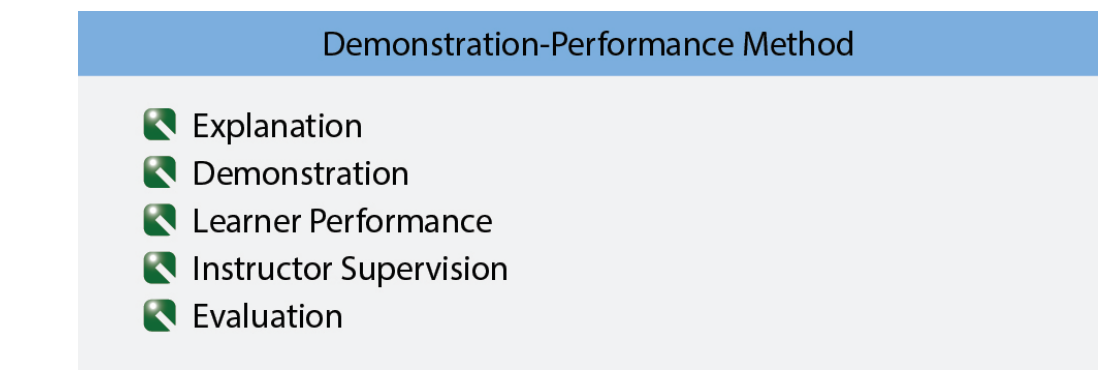
When the learning objective involves a psychomotor skill — controlling the aircraft, performing a preflight inspection, executing a cockpit flow, or using navigational equipment — demonstration-performance is the primary method. It follows a four-step sequence described in the Aviation Instructor's Handbook:
- Explanation. The instructor explains what is about to be demonstrated, identifies the key steps, and clarifies why each step matters. This sets the student's mental model before any action occurs.
- Demonstration. The instructor performs the skill to the standard expected of the student. This point matters: the Aviation Instructor's Handbook teaches that the demonstration should be performed exactly as the student is expected to perform it, as a general instructional principle rather than a lower standard used for convenience. A sloppy demonstration embeds a sloppy mental model. The demonstration should be conducted at normal speed, then broken into elements if the skill is complex.
- Student performance. The student attempts the skill while the instructor observes. The student must actively do, not just watch — this is where actual learning of the motor pattern occurs.
- Instructor evaluation and supervision. The instructor observes, provides immediate feedback, corrects errors before they become habits, and evaluates performance against the stated standard. Praise correct technique; correct errors specifically, not vaguely.
Demonstration-performance is most effective when the instructor avoids taking the controls back without explanation, avoids over-correcting every minor deviation, and uses a debrief after the flight to reinforce learning. The method aligns with the learning principle of primacy — what the student experiences first tends to be remembered most strongly — so a clean, correct first demonstration matters enormously.
Scenario-Based Training
Scenario-based training (SBT) is the most sophisticated of the four methods and the one most directly aligned with the FAA's safety mission. Rather than practicing skills in isolation, the student is placed inside a realistic, story-like problem set — a complete flight with weather decisions, ATC interactions, system anomalies, or deteriorating conditions — and must apply multiple skills simultaneously while making aeronautical decisions under realistic pressure.
The FAA promotes SBT throughout modern training curricula because industry and FAA guidance consistently emphasize that a substantial share of aviation accidents involve failures of aeronautical decision-making (ADM) and risk management rather than purely mechanical stick-and-rudder deficiencies. A pilot who can execute a perfect steep turn in VMC but cannot manage the compulsion to press into deteriorating weather is not fully trained. SBT creates the opportunity to develop that judgment in a low-stakes environment.
Elements of an Effective Scenario
- Realistic context. The scenario should mirror the kind of flying the student will actually do — a cross-country with a realistic weather challenge is more valuable than an abstract hypothetical.
- Clear learning objective. The instructor designs the scenario to exercise a specific decision-making skill, not just to create general complexity.
- Defined completion standards. The instructor knows in advance what a successful outcome looks like and can evaluate the student against it.
- Instructor as guide, not answer-giver. The instructor uses probing questions — "What are your options right now?" "What does the weather trend tell you?" — rather than announcing the correct answer. The student must reason through to a conclusion.
SBT is most effective when the student has enough foundational skill that the scenario does not overwhelm basic aircraft control. Using SBT too early — before a student can maintain coordinated flight — creates cognitive overload that prevents learning. This is why SBT is most powerfully applied in the later stages of training, as the student integrates skills and approaches solo or checkride readiness.
Matching Method to Objective and Learner
The Aviation Instructor's Handbook emphasizes that no single method is universally superior. The skilled instructor diagnoses the learning objective, the student's current stage of learning, and the available training environment, then selects — or blends — methods accordingly.
- New concepts or required knowledge for a student with no background → Lecture
- Existing knowledge that needs to be activated, organized, and deepened → Guided Discussion
- A physical skill such as a maneuver, procedure, or cockpit task → Demonstration-Performance
- Integration of multiple skills with ADM and risk management under realistic pressure → Scenario-Based Training
Common Test Traps
- Guided discussion requires students to already have some knowledge of the topic — it cannot introduce a brand-new subject effectively.
- In demonstration-performance, the instructor must demonstrate to the standard expected of the student, not a higher or lower standard.
- Lecture is most appropriate for introducing new material; it is the least effective method for teaching skills or developing judgment.
- SBT develops ADM and risk management; maneuver practice alone does not — this distinction is heavily tested.
- Lead-off questions in guided discussion must be open-ended; yes/no questions are ineffective and contradict the method's purpose.
- Demonstration-performance follows a specific four-step sequence: explanation → demonstration → student performance → instructor evaluation. Reordering the steps is a common distractor on the knowledge test.