Every solid material you will encounter in aircraft maintenance — aluminum alloy, steel, titanium, copper, even composite laminates — changes its physical dimensions in response to changes in temperature. This phenomenon, known as thermal expansion and contraction, is not a defect or a failure; it is a fundamental property of matter. At the atomic level, heat energy causes atoms to vibrate more vigorously, pushing against their neighbors and forcing the material to occupy a slightly larger volume. Remove that heat, and the vibrations quiet down, the atoms pack closer together, and the material shrinks. For an aircraft technician, understanding and accounting for this behavior is the difference between a properly functioning assembly and one that binds, leaks, cracks, or fails prematurely in service.
This article walks through the underlying physics, introduces the key measurement tool — the coefficient of thermal expansion (CTE) — and then applies the concept to the specific materials, assemblies, and inspections you will encounter as an Aviation Maintenance Technician (AMT).
The Physics of Thermal Expansion
When a material is heated, the increased kinetic energy of its atoms causes them to oscillate about their equilibrium positions with greater amplitude. Because atomic bonds are not perfectly symmetrical, greater oscillation translates into a net increase in the average distance between atoms, meaning the material as a whole gets bigger in all three dimensions. This effect is called thermal expansion. Conversely, cooling reduces atomic motion, the average interatomic distance decreases, and the material contracts.
For most engineering materials, the change in length along one axis is directly proportional to both the original length and the change in temperature. This relationship is expressed as:
ΔL = α × L₀ × ΔT
Where ΔL is the change in length, α (alpha) is the coefficient of linear thermal expansion for that material, L₀ is the original length, and ΔT is the change in temperature. The coefficient α is a material property usually expressed in units of inches per inch per degree Fahrenheit (in/in/°F) or, equivalently, per degree Celsius (in/in/°C or m/m/°C). A higher α means the material is more sensitive to temperature change.
Coefficients of Thermal Expansion for Common Aircraft Materials
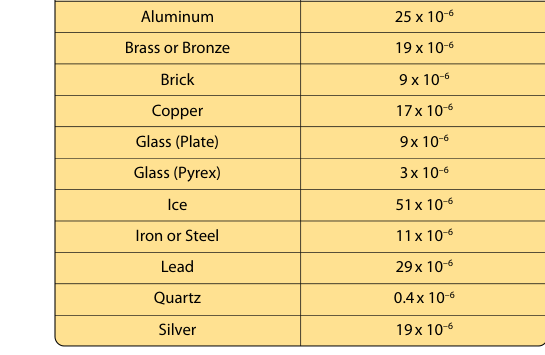
Different materials expand at very different rates. The FAA General Aviation Maintenance handbook family (particularly FAA-H-8083-30) presents these values in the context of airframe and powerplant construction. The approximate linear CTE values below are widely accepted general engineering reference values commonly taught in AMT programs; exact figures vary slightly by specific alloy, temper, and reference source:
- Aluminum alloys (2024, 7075): commonly cited as approximately 12.8 × 10⁻⁶ per °F (roughly 23 × 10⁻⁶ per °C). Aluminum expands about twice as fast as steel for the same temperature rise.
- Steel (low-carbon, alloy steel): commonly cited as approximately 6.0–6.5 × 10⁻⁶ per °F (roughly 11–12 × 10⁻⁶ per °C). Steel's lower CTE is why aluminum-to-steel joints require careful design.
- Titanium alloys (6Al-4V): commonly cited as approximately 4.9–5.0 × 10⁻⁶ per °F (roughly 8.6–9.0 × 10⁻⁶ per °C). Titanium is valued in high-temperature structures partly because its expansion is relatively modest.
- Copper and copper alloys: approximately 9.4–9.8 × 10⁻⁶ per °F (roughly 17 × 10⁻⁶ per °C). Relevant to electrical wiring, fuel and oil lines, and pneumatic fittings.
- Magnesium alloys: approximately 14–14.5 × 10⁻⁶ per °F — even higher than aluminum, which matters for magnesium gearbox housings and accessory cases.
- Carbon fiber reinforced polymer (CFRP) composites: CTE varies significantly with fiber orientation; along the fiber direction, CTE can be near zero or even slightly negative, while across the fibers it can approach that of the resin matrix (~30–50 × 10⁻⁶ per °C). This directional difference is a critical design and repair consideration.
Why Differential Expansion Matters in Aircraft
The real engineering challenge arises not from thermal expansion itself, but from differential thermal expansion — what happens when two or more materials with different CTEs are joined together and subjected to temperature change. If a steel bolt secures an aluminum fitting, the aluminum surrounding the bolt hole expands faster than the bolt during heating. On cooling, the aluminum contracts more, potentially increasing clamping force significantly beyond design limits or, in repeated cycles, loosening the joint as the materials fatigue.
Aircraft operate across an extraordinary temperature range. A jet airliner flying at cruise altitude may expose its fuselage skin to temperatures approaching the standard atmosphere value of roughly −65 °F (−54 °C) or colder at typical cruise altitudes, while the same aircraft parked on a desert ramp in summer may see skin temperatures exceeding 150 °F (66 °C). The resulting ΔT of more than 200 °F means even modest CTEs produce measurable dimensional changes across large structures. Engineers account for this with expansion joints, slip joints, flexible fittings, and carefully selected fit tolerances. Technicians must understand why these features exist in order to preserve them during maintenance.
Practical Applications for the AMT
Interference Fits and Shrink Fits
One deliberate exploitation of thermal expansion is the shrink fit (also called an interference fit). A bearing race, bushing, or sleeve is manufactured slightly larger than its housing bore. By cooling the outer part in dry ice or liquid nitrogen, or by heating it in an oven to a controlled temperature, the technician temporarily creates a gap large enough for assembly. When the temperature equalizes, the parts grip each other with enormous force — no adhesive or fastener required. Conversely, a shaft can be chilled to allow it to slip into a bore. FAA-H-8083-32 (Aviation Maintenance Technician Handbook — Powerplant) discusses these assembly techniques in the context of engine overhaul.
Torque Values and Temperature
Standard torque values published in manufacturer maintenance manuals assume a narrow temperature range. When technicians perform engine reassembly in a cold hangar and the engine subsequently reaches operating temperature, the aluminum case components around steel fasteners will try to expand more than the fastener itself. This changes the effective clamp load. Always apply specified torque values under the conditions the manufacturer assumes, and re-inspect safety-critical fastener torque at appropriate inspection intervals.
Fluid Lines and Fittings
Rigid aluminum or steel fuel, oil, and hydraulic lines must accommodate thermal expansion along their length. Long straight runs use flexible hose segments, loops, or offset bends deliberately designed into the routing so the line can expand and contract without building up stress at fittings. Replacing a flexible segment with a rigid line, or straightening a designed loop during repair, removes this accommodation and creates a fatigue crack risk at the nearest hard attachment point.
Engine Components
Piston engines and turbine engines both rely on precisely engineered clearances that account for differential expansion. In a piston engine, piston-to-cylinder wall clearance is set at room temperature but is designed so that at operating temperature the piston expands to near-perfect fit. Too little cold clearance causes seizure; too much causes blow-by, oil consumption, and power loss. In turbine engines, blade-tip clearances, compressor rotor fits, and turbine disk bore fits all involve materials chosen for compatible CTEs at each temperature zone.
Composite Structures
When repairing CFRP structures bonded to aluminum substructure, the technician must recognize that the two materials will try to move differently with every temperature cycle. Adhesive bond lines must be thick enough and flexible enough to absorb this differential movement. Repairs that deviate from the Structural Repair Manual (SRM) by using stiffer adhesives or incorrect layup orientation can create interlaminar stresses that delaminate the repair after relatively few thermal cycles.
Key Numbers and Rules
- Aluminum expands approximately twice as fast as steel for the same temperature change — the single most testable CTE comparison for the AMT General written exam.
- The linear expansion formula is ΔL = α × L₀ × ΔT; know the meaning of each variable.
- A higher CTE means more expansion per degree — magnesium is higher than aluminum, aluminum is higher than steel, steel is higher than titanium.
- Shrink fits exploit temporary dimensional changes caused by controlled heating or cooling, never by force alone.
- Designed flexibility (loops, flexible segments) in fluid lines must be preserved during repair; removing it violates airworthiness.
- Operating temperature range for typical GA airframes spans roughly −65 °F to +150 °F or more; turbine hot sections can reach temperatures well over 2,000 °F depending on engine design, making CTE management even more critical there.
Common Test Traps
- Confusing CTE ranking: A common distractor reverses the aluminum-steel relationship. Remember — aluminum has roughly twice the CTE of steel, not the other way around.
- Forgetting volumetric vs. linear expansion: For most AMT calculations, linear CTE is used. As a general physics principle, volumetric (cubic) expansion is approximately three times the linear CTE and applies mainly to liquids and gases, not solid structural calculations.
- Assuming expansion only happens on heating: Contraction on cooling is equally important and equally likely to cause joint failure, line cracking, or seal leakage, especially on cold-soaked aircraft.
- Misidentifying shrink-fit assembly: A shrink fit uses controlled temperature change, not excessive mechanical force. Forcing a bearing into a housing without thermal assistance is an improper maintenance practice that risks dimensional damage.
- Ignoring directionality in composites: CTE in CFRP is not a single number; it varies dramatically with fiber orientation. Treating it like a homogeneous isotropic material on the exam or in practice leads to wrong answers and unsafe repairs.