Every time an aircraft rolls down the runway, climbs into the sky, or banks into a turn, it is obeying rules laid down by Sir Isaac Newton in the 17th century. For aviation maintenance technicians and pilots alike, Newton's three laws of motion are not just textbook curiosities — they are the physical language that describes why engines must produce a certain thrust, why a heavier aircraft needs more runway, and why a propeller or jet engine can push an airplane forward at all. The FAA's Aviation Maintenance Technician Handbook — General (FAA-H-8083-30) grounds the study of aircraft physics firmly in these three laws, and questions about them appear regularly on the AMT General knowledge test.
Let's walk through each law in plain English, explain the underlying mechanics, connect it concretely to real aircraft hardware and flight operations, and then highlight the traps that test-writers love to set.
Newton's First Law: The Law of Inertia
Statement: An object at rest stays at rest, and an object in motion stays in motion at the same speed and in the same direction, unless acted upon by an unbalanced (net) external force.
Inertia is simply a body's resistance to any change in its state of motion. The more mass an object has, the more inertia it possesses, and the harder it is to start it moving, stop it, or change its direction. A fully-loaded wide-body transport has enormous inertia compared to a light sport aircraft; that's why its takeoff roll is much longer and its stopping distance after landing is dramatically greater — even with identical braking forces proportionally applied.
In practical terms, the First Law means that an aircraft flying in straight and level flight at a constant airspeed will continue doing exactly that as long as the four forces — lift, weight, thrust, and drag — remain balanced. No net force means no acceleration, and no acceleration means no change in velocity (which includes both speed and direction). The moment a pilot advances the throttle, thrust exceeds drag and that balance is broken; the aircraft accelerates in response. Pull back on the yoke and the aerodynamic force distribution changes — the aircraft pitches up, again because an unbalanced force (a net upward pitching moment) is now acting.
Inertia also explains why aircraft handling feels different at different weights. A lightly loaded aerobatic aircraft responds quickly to control inputs because its low mass means low inertia. A heavily loaded transport responds more sluggishly — its greater mass resists the change in motion that the control surfaces are trying to produce. Technicians must keep inertia in mind when calculating stress loads: the structures of an aircraft must be strong enough to withstand the forces needed to overcome the aircraft's own inertia during maneuvering.
Newton's Second Law: The Law of Acceleration
Statement: The acceleration of an object is directly proportional to the net force acting on it and inversely proportional to its mass. Expressed as the famous equation: F = ma (Force equals mass times acceleration).
This is arguably the most quantitatively useful of the three laws for aircraft design and maintenance. It tells engineers exactly how much force is required to produce a desired acceleration in an aircraft of known mass — or, rearranging the equation, tells us what acceleration to expect from a given thrust-minus-drag force acting on a specific aircraft weight.
Remember that in aviation we almost always work with weight (a force, measured in pounds) rather than mass (measured in slugs in the English system). To find mass from weight, divide weight by the acceleration due to gravity (approximately 32.2 ft/s²). So if an aircraft weighs 3,220 lb, its mass is 100 slugs. If the net forward force (thrust minus drag) is 500 lb, the resulting acceleration is 500 ÷ 100 = 5 ft/s².
The Second Law directly explains performance charts. A heavier aircraft requires more force to achieve the same acceleration, so it needs more runway to reach rotation speed. It also explains why a turbocharged engine that loses some power output at altitude produces less thrust, which translates — through F = ma — into a reduced climb rate and extended takeoff roll. For the AMT, understanding this relationship is essential when evaluating whether an engine is producing rated power and when interpreting performance data in the aircraft flight manual.
The Second Law also applies to rotating masses. When a propeller or turbine disk accelerates rotationally, the same F = ma relationship (in its rotational form, torque = moment of inertia × angular acceleration) governs how quickly it spools up or down. A heavier, larger-diameter propeller has more rotational inertia and takes longer to accelerate — a factor technicians consider when diagnosing engine response issues.
Newton's Third Law: The Law of Action and Reaction
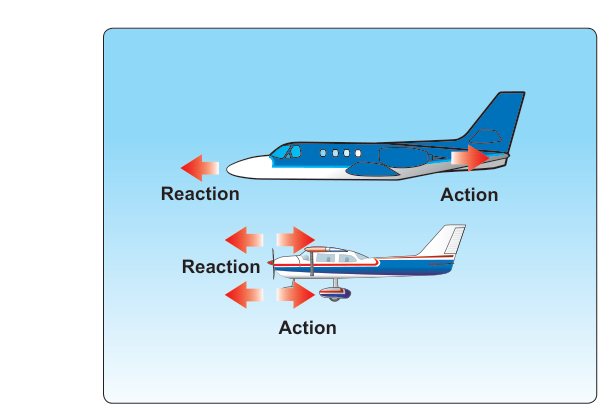
Statement: For every action (force), there is an equal and opposite reaction (force). These two forces act on different objects.
The Third Law is perhaps the most visually dramatic in aviation because it directly explains how thrust is generated. A propeller accelerates a large mass of air rearward (action); that accelerated air pushes the aircraft forward with an equal force (reaction). A jet engine ingests air, burns fuel to add energy to it, and expels the hot gas rearward at high velocity; the reaction is a forward thrust force on the engine — and therefore the airframe. A rocket works on exactly the same principle, which is why it can operate in the vacuum of space where there is no ambient air to push against: it carries both its fuel and its oxidizer, expelling mass rearward to generate forward thrust.
The Third Law also explains several important secondary effects that pilots and technicians must understand. Torque reaction is a prime example: as the engine spins a propeller clockwise (viewed from the cockpit), the reaction tends to roll the entire aircraft in the opposite direction about its longitudinal axis — rolling the left wing down. Aircraft designers counteract this tendency with rigging adjustments such as wing washout or aileron trim, while pilots primarily use rudder input to counteract the yaw-producing left-turning tendencies — P-factor, spiraling slipstream, and gyroscopic precession — especially at high power and low airspeed settings such as during takeoff and go-arounds.
P-factor (asymmetric propeller blade thrust) and gyroscopic precession of the spinning propeller disk are also rooted in Newtonian mechanics. When a pitch input is applied to the spinning propeller disk, gyroscopic precession causes the reactive force to be felt approximately 90 degrees ahead in the direction of rotation, producing a yawing moment — a direct consequence of Newton's laws applied to rotating bodies.
Why These Laws Matter for the AMT
Aircraft structural analysis, engine performance evaluation, propulsion system design, and troubleshooting all require a working understanding of Newton's laws. When calculating whether a fastener can withstand the loads during a high-g maneuver, you are applying the Second Law. When verifying that a thrust reverser deflects exhaust gases properly to generate rearward force (deceleration) on landing, you are applying the Third Law. When explaining why an aircraft sitting on chocks will not move despite the engine running at idle — static friction and inertia (First Law) are in equilibrium with the small thrust produced at idle power.
Key Numbers and Rules
- F = ma: Force (lb or N) = Mass (slugs or kg) × Acceleration (ft/s² or m/s²). The single most testable equation from Newton's Second Law.
- g = 32.2 ft/s² (approximately 9.81 m/s²): the acceleration due to gravity used to convert weight to mass in English units.
- Mass = Weight ÷ g: A 6,440 lb aircraft has a mass of 200 slugs.
- Equal and opposite: The reaction force in Newton's Third Law is always equal in magnitude and opposite in direction — but it acts on the other object in the pair, not the same one.
- Inertia scales with mass, not weight alone: An aircraft in orbit (weightless) still has full inertia and requires force to change its velocity.
- Torque reaction direction: If the propeller turns clockwise (from the cockpit), the torque reaction on the airframe rolls the aircraft counterclockwise about its longitudinal axis — left-rolling tendency on most US single-engine aircraft.
Memory Aid
A classic three-part reminder for Newton's laws in order: "Rest, Rate, React."
- Rest — First Law: objects at rest (or in uniform motion) stay that way without a net force (inertia).
- Rate — Second Law: the rate of acceleration depends on force and mass (F = ma).
- React — Third Law: every action gets an equal and opposite reaction (thrust, torque, lift reaction on the air).
Common Test Traps
- Confusing mass and weight: Weight is a force (gravity acting on mass); mass is the measure of inertia. The Second Law uses mass, not weight directly. Always divide weight by g to get mass before plugging into F = ma.
- Assuming reaction forces cancel: Newton's Third Law pairs always act on different objects. The propeller pushes air back; the air pushes the aircraft forward. These do not cancel each other — they act on separate bodies.
- Forgetting inertia applies to moving objects too: The First Law states that a moving object continues at constant velocity unless a net force acts. Students sometimes think inertia only applies to stationary objects.
- Torque reaction direction: The test may ask which way the aircraft rolls due to propeller torque. Remember the reaction is always opposite to propeller rotation — a clockwise propeller creates a counterclockwise (left-rolling) tendency on the aircraft about its longitudinal axis.
- Net force vs. total force: The Second Law responds to the net (unbalanced) force. In level cruise, thrust and drag are equal, so net force is zero and acceleration is zero — even though both forces are large. A common distractor has students compute acceleration from thrust alone while ignoring drag.