Pressure is one of the most fundamental physical quantities in aviation. From the air entering a reciprocating engine's carburetor to the hydraulic fluid holding landing gear down, nearly every system an aviation maintenance technician (AMT) works on involves pressure measurement of some kind. Yet pressure is not a single, simple number—it depends critically on what reference point you use to measure it. The three systems every AMT must understand are absolute pressure, gauge pressure, and differential pressure. Confusing them is not merely an academic error; it can lead to misread instruments, incorrectly adjusted systems, and potentially catastrophic failures.
This article explains how each measurement type is defined, how it is used in real aircraft systems, the key numbers that appear on the FAA knowledge test, and the traps that catch unprepared students.
The Concept of a Pressure Reference
Before diving into the three types, it helps to understand why a reference matters. Pressure, by definition, is a force applied over an area. But when we state a pressure value, we are always comparing that force to something else. Is the comparison point a perfect vacuum? The local atmosphere? The pressure on the other side of a membrane? The answer determines which type of measurement you are making and, therefore, which instruments and formulas apply.
Absolute Pressure
Absolute pressure is measured relative to a perfect vacuum—a space containing no matter and therefore no pressure whatsoever. Because a true vacuum is the lowest possible pressure, absolute pressure values can never be negative. The unit most commonly used in aviation for absolute pressure is inches of mercury absolute (in. Hg absolute) or, in the SI system, pascals (Pa). On a standard day at sea level, the absolute pressure of the atmosphere is approximately 29.92 in. Hg, or 1,013.25 millibars (hPa).
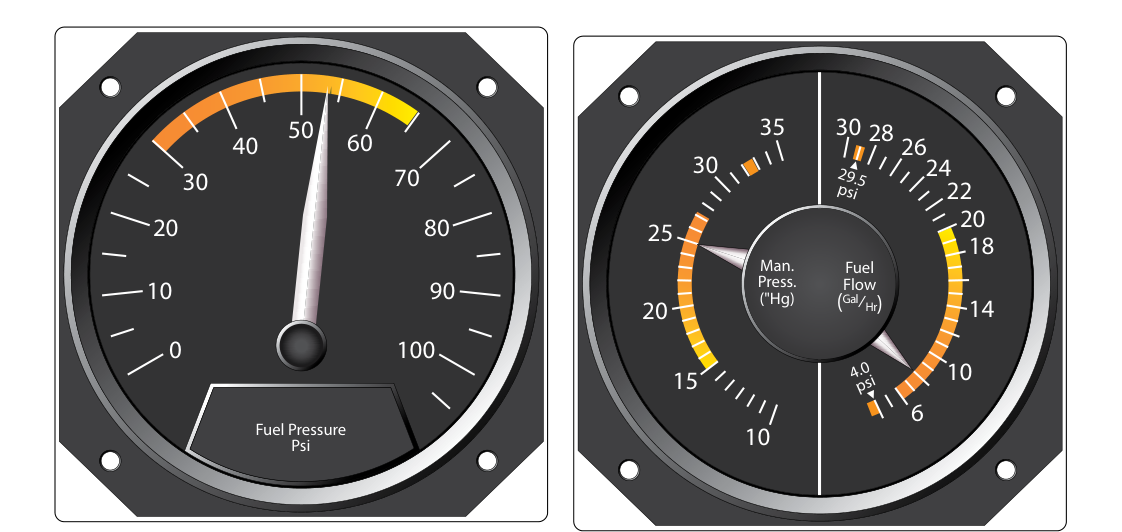
Absolute pressure is the reference used in aircraft altimeters and in manifold pressure (MP) gauges found on reciprocating aircraft engines. The manifold pressure gauge measures the absolute pressure of the air/fuel mixture inside the intake manifold. At full throttle on the ground, the reading approaches ambient atmospheric pressure—around 29–30 in. Hg on a standard sea-level day. At altitude with a normally aspirated engine, manifold pressure drops with the atmosphere. On a turbocharged or supercharged engine, the manifold pressure can actually exceed ambient, sometimes reaching 40 in. Hg or more, which is why turbocharged engine manufacturers specify manifold pressure limits in absolute terms.
Why use absolute pressure here? Because the engine's power output depends on the actual density of the charge entering the cylinder—not on how much higher or lower that pressure is than the ambient air. Using absolute pressure gives an unambiguous, atmosphere-independent reference that is consistent regardless of altitude or weather.
Gauge Pressure
Gauge pressure is measured relative to the local ambient atmospheric pressure. It is the most familiar type in everyday life—a car tire gauge reads gauge pressure. If the gauge reads zero, it means the pressure inside equals atmospheric, not that a vacuum exists. Gauge pressure can be negative when the measured pressure is below atmospheric (a partial vacuum), and in aviation maintenance that condition is sometimes called a suction or vacuum reading.
The relationship is straightforward: Absolute Pressure = Gauge Pressure + Atmospheric Pressure. Rearranging: Gauge Pressure = Absolute Pressure − Atmospheric Pressure. On a standard sea-level day, a gauge reading of 0 psi (pounds per square inch gauge, written psig) corresponds to an absolute pressure of 14.696 psia (pounds per square inch absolute).
In aircraft, gauge pressure appears frequently in hydraulic systems, pneumatic systems, tire inflation, and oxygen system servicing. A main gear strut may be serviced to a specific psig value, and that value assumes you are working at roughly sea-level atmospheric pressure. Oil pressure gauges in reciprocating engines also typically read in gauge pressure, because what matters operationally is how much above ambient the oil pump is driving the lubricant—that pressure differential is what forces oil through bearings.
One important nuance: because gauge pressure uses local atmospheric pressure as its zero point, the same gauge reading at sea level and at a high-elevation airport represents different absolute pressures. For most hydraulic and tire applications this is inconsequential, but for engine manifold pressure it would be deeply misleading—which is exactly why manifold pressure gauges are calibrated in absolute terms instead.
Differential Pressure
Differential pressure is the difference between any two pressures, neither of which needs to be a vacuum or the local atmosphere. It is the most general form of pressure comparison. Mathematically: ΔP = P₁ − P₂, where P₁ and P₂ are any two pressures in the same units.
Differential pressure is the workhorse of many critical aviation instruments and systems:
- Airspeed indicators (ASI): The pitot-static system feeds total (ram) pressure from the pitot tube to one side of the ASI's diaphragm and static pressure from the static port to the other. The instrument measures the difference—dynamic pressure (q)—and converts it to indicated airspeed. Neither the total pressure alone nor the static pressure alone gives airspeed; only their difference does.
- Vertical speed indicators (VSI): The VSI compares static pressure inside a calibrated leak chamber to the static pressure in the instrument case. As the aircraft climbs or descends, the pressure difference drives the needle.
- Engine oil filter differential pressure indicators: Many turbine and reciprocating engines use a differential pressure switch or indicator across the oil filter. If the filter begins to clog, upstream pressure rises while downstream pressure drops. When the differential exceeds a threshold, a bypass valve opens and/or a cockpit warning light illuminates—alerting the crew that filter maintenance is required.
- Fuel filter and fuel boost pump monitoring: Similar differential pressure sensing is used to detect clogged fuel filters, protecting the engine from fuel starvation.
- Cabin differential pressure: In pressurized aircraft, the pressurization system is controlled partly by a differential pressure controller that maintains a specific ΔP between cabin pressure and outside air pressure. Exceeding the maximum differential pressure limit can stress the airframe structure, so this is a safety-critical measurement.
Differential pressure instruments are particularly valuable because they automatically account for changes in both pressures simultaneously. An airspeed indicator does not need to know absolute altitude or local weather; it only needs to sense how much greater total pressure is than static pressure, and that difference is exactly proportional to the dynamic pressure creating aerodynamic lift and drag.
Why It Matters for AMTs
Understanding which type of pressure is being measured is essential when inspecting, calibrating, or replacing instruments and sensors. An AMT who replaces an oil pressure sensor must verify that the replacement is rated and calibrated in the same units and reference (gauge, in most cases). Installing a sensor calibrated in absolute pressure where a gauge-pressure sensor is required will produce readings that are wrong by approximately one atmosphere—about 14.7 psi—which could cause a pilot to believe oil pressure is dangerously high when it is actually normal, or vice versa.
Similarly, when servicing oxygen systems, the high-pressure storage cylinders are charged to values often expressed in gauge pressure (psig). The technician must ensure the gauge being used is appropriate for the service pressure range and is reading gauge, not absolute. At the pressures used in aviator oxygen cylinders (commonly around 1,800–2,000 psig when full), the difference between absolute and gauge readings is only about 15 psi—small in relative terms, but an error of that kind in documentation could still affect dispatch decisions.
For turbine engine work, compressor inlet and outlet pressures, turbine section pressures, and bleed air pressures may all be expressed as absolute, gauge, or differential depending on the test specification. AMTs performing borescope inspections, trimming engines, or interpreting engine performance data must read the applicable maintenance manual carefully and apply the correct measurement framework.
Key Numbers and Rules
- Standard sea-level atmospheric pressure: 29.92 in. Hg absolute, 1,013.25 mb (hPa), or 14.696 psia.
- Absolute Pressure = Gauge Pressure + Atmospheric Pressure (at the measurement location).
- Gauge pressure of zero does NOT mean a vacuum—it means pressure equals ambient.
- Differential pressure = P₁ − P₂; either value can be absolute or gauge, as long as both are in the same units and reference.
- Manifold pressure gauges read in absolute pressure (in. Hg absolute).
- Most hydraulic, pneumatic, tire, oil, and fuel pressure gauges in aircraft read gauge pressure (psig).
- Airspeed indicators sense differential pressure (pitot total minus static).
- Cabin pressurization controllers typically regulate to a maximum differential pressure limit specified in the Aircraft Flight Manual.
Common Test Traps
- Manifold pressure units: Students often confuse manifold pressure with boost pressure or think it is read in psig. The FAA expects you to know it is measured in inches of mercury absolute.
- Zero gauge pressure is not zero absolute pressure: A gauge reading of 0 psig equals approximately 14.7 psia at sea level—not a vacuum. This is a classic distractor in knowledge test questions about pressure relationships.
- Airspeed is differential, not absolute or gauge: The ASI does not measure static pressure alone or pitot pressure alone; it measures the difference. Questions that ask what the airspeed indicator measures are testing whether you know this distinction.
- Altitude effects on gauge pressure servicing: If a question describes servicing a strut or tire at a high-elevation airport, remember that gauge pressure is referenced to local ambient. The strut specification in the maintenance manual is typically given for standard conditions—always consult the manual for any altitude correction guidance rather than assuming gauge readings are interchangeable across elevations.
- Differential pressure across filters: Questions about oil filter bypass valves test whether you understand that the bypass is triggered by differential pressure across the filter element, not by an absolute oil pressure value. A high absolute oil pressure with a clean filter does not trigger the bypass; only an excessive pressure drop across the filter does.