Every fluid aboard an aircraft — jet fuel, aviation gasoline, hydraulic fluid, engine oil, coolant — has a unique set of physical properties that determine how it behaves under pressure, temperature, and gravity. Two of the most fundamental of those properties are density and specific gravity. For an Aviation Maintenance Technician (AMT), understanding these concepts is not merely academic. Misidentifying a fluid, misjudging its weight contribution to an aircraft, or misreading a hydrometer can lead to system failures, incorrect weight-and-balance calculations, or dangerous misfueling. This article explains both concepts thoroughly, connects them to everyday maintenance tasks, and highlights the testable details you need to master for the FAA AMT General Knowledge exam.
What Is Density?
Density is defined as the mass of a substance per unit of volume. In the English system used widely in U.S. aviation maintenance, density is commonly expressed in pounds per cubic foot (lb/ft³) or pounds per gallon (lb/gal). In SI units it is expressed in kilograms per cubic meter (kg/m³). The formula is straightforward:
Density = Mass ÷ Volume
Pure water at 39.2 °F (4 °C) — the temperature at which it is densest — has a density of approximately 62.4 lb/ft³, or about 8.34 lb/gal. This value is the cornerstone reference point for nearly all density-related work in aviation, because specific gravity is always measured relative to water.
It is critical to appreciate that density is temperature-dependent. As temperature rises, most liquids expand, increasing in volume while mass stays constant — so density falls. This is why fuel density varies with ambient temperature, and why fuel quantity is sometimes measured by mass (or weight) rather than volume in turbine aircraft fuel systems. A gallon of Jet-A at 40 °F contains more mass than a gallon at 100 °F, even though the volume is identical.
What Is Specific Gravity?
Specific gravity (SG) is a dimensionless ratio that compares the density of a substance to the density of pure water at a standard temperature (usually 39.2 °F / 4 °C for liquids). Because it is a ratio, specific gravity has no units — it simply tells you whether a fluid is heavier or lighter than water, and by how much.
Specific Gravity = Density of substance ÷ Density of water
If a substance has an SG greater than 1.0, it is denser than water and will sink. If SG is less than 1.0, it is less dense than water and will float. Water itself, by definition, has an SG of exactly 1.0.
Once you know a fluid's specific gravity, you can quickly calculate its density in any unit system:
Density of fluid = SG × Density of water in desired units
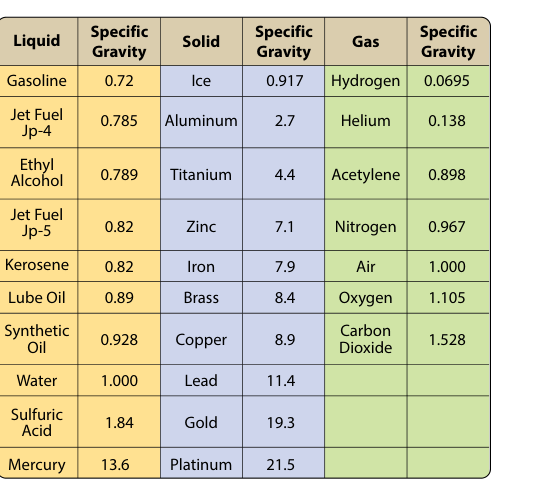
For example, if aviation gasoline (avgas) has an SG of approximately 0.72, its density in lb/ft³ is roughly 0.72 × 62.4 = 44.9 lb/ft³, and in lb/gal it is approximately 0.72 × 8.34 = 6.0 lb/gal. This is why avgas is commonly quoted at about 6 lb/gal for weight-and-balance purposes.
Specific Gravity of Common Aviation Fluids
The FAA General Handbook (FAA-H-8083-30) lists specific gravity values for a range of aviation fluids. While exact values can vary slightly by grade, temperature, and manufacturer, the following approximate values are important reference points for the AMT knowledge test and for practical maintenance work:
- Aviation gasoline (Avgas 100LL): SG ≈ 0.72, approximately 6.0 lb/gal. Avgas is noticeably lighter than water, which is relevant when checking for water contamination — water will settle to the bottom of a fuel tank or sump because it is denser.
- Jet-A / Jet-A1 turbine fuel: SG ≈ 0.80–0.81, approximately 6.7 lb/gal. Jet fuel is denser than avgas, partly because of its higher aromatic content and longer hydrocarbon chains.
- MIL-PRF-5606 hydraulic fluid (mineral-based, red): SG ≈ 0.87–0.89, roughly 7.3–7.4 lb/gal.
- MIL-PRF-83282 hydraulic fluid (synthetic hydrocarbon, red): SG ≈ 0.87, similar to 5606.
- Skydrol / phosphate ester hydraulic fluid (purple/lavender): SG ≈ 1.00–1.06, making it approximately as heavy as or slightly heavier than water. This is notably different from mineral-based hydraulic fluids and reinforces why these fluid types must never be mixed.
- Engine oil (MIL-PRF-23699 turbine oil): SG ≈ 0.97–1.00, depending on grade and temperature.
- Water: SG = 1.0 exactly (the reference standard).
Knowing these approximate values allows a technician to cross-check a fluid's identity with a hydrometer or refractometer before adding it to a system — a critical step in preventing fluid contamination incidents.
How Density and Specific Gravity Are Measured
The standard shop tool for measuring specific gravity of liquids is the hydrometer. A hydrometer is a sealed glass or plastic tube with a weighted bulb at the bottom. When placed in a fluid sample, it floats at a depth determined by the fluid's density — the denser the fluid, the higher the hydrometer floats. A graduated scale on the stem is read at the fluid surface to give the SG directly. Hydrometers are commonly used in aviation to check battery electrolyte (sulfuric acid/water solution) specific gravity, which indicates the state of charge of a lead-acid aircraft battery. A fully charged cell typically shows an SG of about 1.275–1.300, while a fully discharged cell may read as low as approximately 1.150–1.200.
For fuel and other petroleum products, a refractometer or calibrated density meter may also be used in quality control testing.
Why Density and Specific Gravity Matter in Aviation Maintenance
Understanding these properties is not just theoretical — it directly affects maintenance safety and airworthiness in several ways:
Weight and balance calculations: Fuel weight directly affects the aircraft's center of gravity and gross weight. Because avgas weighs approximately 6 lb/gal and Jet-A approximately 6.7 lb/gal, using the wrong figure leads to significant errors in weight-and-balance computations. On a large turbine aircraft, even a small error per gallon multiplied over thousands of gallons can exceed structural or CG limits.
Fluid identification and contamination prevention: Many aviation fluids look similar in color and viscosity. Specific gravity testing provides a quick, quantitative check. For example, accidentally adding Skydrol (SG ≈ 1.0) to a system designed for MIL-PRF-5606 (SG ≈ 0.87) will not only damage seals and components — because phosphate esters attack nitrile rubber used in mineral-oil systems — but could be detected early by a simple SG check.
Fuel contamination by water: Because water (SG = 1.0) is denser than either avgas (SG ≈ 0.72) or Jet-A (SG ≈ 0.80), water contamination always settles to the lowest point of a fuel tank or sump. This is why fuel sumping — draining a small sample from each low point — is a required preflight check. The presence of water is visible as a distinct, clear layer below the fuel, sometimes with a sharp interface line.
Battery maintenance: Checking electrolyte specific gravity with a hydrometer is the primary method for assessing lead-acid battery charge state. A technician who misreads the hydrometer or fails to correct for electrolyte temperature can clear a battery as airworthy when it is actually significantly discharged.
Fuel system design and flow calculations: Engineers and technicians working on fuel boost pump capacity, pressure drop calculations, and fuel flow meters must account for fluid density. Flow meters calibrated for one fluid density may read inaccurately when used with a different fluid.
Temperature Corrections
Because density changes with temperature, specific gravity measurements taken in the field should be corrected to a standard reference temperature if precise values are required. Most hydrometers are calibrated at 60 °F (15.6 °C). Many come with a correction chart or built-in thermometer. For battery electrolyte, a commonly cited correction factor is approximately 0.001 SG per 1 °F of deviation from the standard calibration temperature (roughly 0.004 per 4 °F) — add the correction if the electrolyte is warmer than standard (density reads low), subtract it if cooler.
Key Numbers and Rules
- Density of water: 62.4 lb/ft³ or 8.34 lb/gal — the universal reference.
- Avgas SG ≈ 0.72; weight ≈ 6.0 lb/gal.
- Jet-A SG ≈ 0.80–0.81; weight ≈ 6.7 lb/gal.
- Skydrol SG ≈ 1.0–1.06 — nearly as heavy as water.
- Fully charged lead-acid battery electrolyte SG ≈ 1.275–1.300.
- Specific gravity is dimensionless — it has no units.
- SG > 1.0: fluid is denser than water and sinks in water.
- SG < 1.0: fluid is less dense than water and floats on water.
- Density decreases as temperature increases (for most liquids).
Common Test Traps
- Confusing mass and weight with volume: A gallon is a unit of volume, not mass. Always apply the fluid's density or SG to convert gallons to pounds.
- Assuming all aviation fluids are lighter than water: Skydrol and some turbine oils have SG at or above 1.0 — do not assume every aircraft fluid floats on water.
- Ignoring temperature effects on density: The FAA exam and practical tasks may ask about temperature correction for hydrometer readings. Remember: warmer fluid is less dense, so the hydrometer floats lower, giving a falsely low SG reading that must be corrected upward.
- Treating specific gravity as having units: SG is a pure ratio and is always unitless. Exam distractors may present answers with units attached to SG values — those are incorrect.
- Using avgas weight (6 lb/gal) for turbine fuel calculations: Jet-A is significantly heavier per gallon. Mixing up these values on a fuel load calculation can result in a meaningful weight-and-balance error.