Volume calculations are a foundational skill for Aviation Maintenance Technicians (AMTs). Whether you are determining how much hydraulic fluid a cylindrical reservoir holds, calculating the internal capacity of a fuel tank shaped like a rectangular box, or figuring out how much gas a spherical pressure vessel can contain, the ability to compute volume accurately is essential to safe aircraft maintenance. The FAA General test expects you to apply these formulas confidently, and understanding why each formula works will help you adapt it correctly to real-world scenarios rather than just memorizing numbers.
In aviation maintenance, volume is typically expressed in cubic inches (in³), cubic feet (ft³), or converted to gallons and quarts for fluid measurements. Keeping track of units throughout every calculation is as important as applying the right formula — a mistake in unit conversion can lead to seriously incorrect results in the shop or on the test.
Rectangular Solids
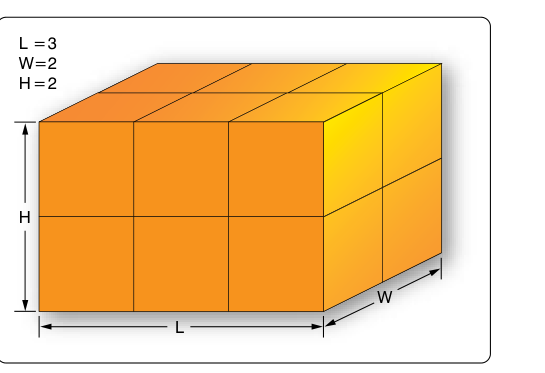
A rectangular solid — also called a rectangular prism — is the simplest three-dimensional shape you will encounter. Think of a standard fuel tank with flat sides, a cargo bay, or a simple toolbox. Every surface is a rectangle, and all corners form right angles.
The formula for the volume of a rectangular solid is straightforward:
Volume = Length × Width × Height
For example, imagine a rectangular fuel tank that measures 24 inches long, 12 inches wide, and 10 inches tall. The volume is 24 × 12 × 10 = 2,880 cubic inches. If you need to convert that to gallons, remember that one U.S. gallon equals 231 cubic inches. Dividing 2,880 by 231 gives approximately 12.47 gallons.
A critical point: every dimension must be in the same unit before you multiply. If the length is given in feet and the width and height in inches, convert everything to one unit first. Mixing feet and inches is one of the most common errors students make on the knowledge test.
Cylinders
Cylinders appear constantly in aviation — engine cylinders, hydraulic actuator barrels, oxygen bottles, and fuel lines are all cylindrical or partially cylindrical. The volume of a cylinder depends on two measurements: the radius of its circular cross-section (or its diameter), and its length (or height).
The formula is:
Volume = π × r² × h
Where π (pi) is approximately 3.1416, r is the radius of the circle (half the diameter), and h is the height or length of the cylinder.
Let's walk through a worked example. Suppose a hydraulic cylinder has an inside diameter of 4 inches and a stroke length of 8 inches. First, find the radius: 4 ÷ 2 = 2 inches. Now apply the formula: π × 2² × 8 = 3.1416 × 4 × 8 = 3.1416 × 32 = 100.53 cubic inches.
Notice that you square the radius, not the diameter. This is the single most common mistake students make with the cylinder formula. If you are given a diameter, always divide by two before squaring. Squaring the full diameter and then multiplying by π gives you a result that is four times too large — a catastrophic error when calculating fluid capacity or piston displacement.
Another practical application is calculating the displacement of an engine cylinder. An aircraft engine's total displacement is the volume swept by all pistons through their full stroke, and this figure directly relates to engine power output and fuel requirements. The same formula applies: find the bore radius, square it, multiply by π and by the stroke length, then multiply by the number of cylinders.
Spheres
Spherical shapes appear in aviation as pressure vessels — oxygen spheres, nitrogen accumulators for landing gear systems, and fire-suppression agent bottles are examples. A sphere is perfectly round in every direction, defined entirely by its radius.
The formula for the volume of a sphere is:
Volume = (4/3) × π × r³
Where r is the radius (again, half the diameter), and the fraction 4/3 is approximately 1.3333.
For example, suppose a spherical oxygen bottle has an outside diameter of 10 inches. (In practice you would use the inside diameter to find internal volume, but the math is identical.) The radius is 5 inches. Calculate: (4/3) × 3.1416 × 5³ = 1.3333 × 3.1416 × 125 = 1.3333 × 392.70 = 523.60 cubic inches.
Notice that the radius is cubed (raised to the third power) in the sphere formula — not squared as in the cylinder formula. This means that even a small increase in radius produces a large increase in volume. Doubling the radius of a sphere increases its volume by a factor of eight (2³ = 8), not just four. This principle is important when evaluating pressure vessel replacement specifications — a slightly larger sphere holds dramatically more gas.
Why These Calculations Matter
Accurate volume calculations directly affect aircraft safety and airworthiness. Overestimating the capacity of a fuel tank could cause a technician to overfill it, risking fuel venting or structural damage from excess weight. Underestimating hydraulic reservoir volume could result in insufficient fluid for system operation. When recharging a pneumatic or oxygen system, incorrect volume data leads to improper servicing pressures, which can be hazardous to personnel and the aircraft alike.
Volume calculations also appear in weight-and-balance contexts. Because the weight of a liquid equals its volume multiplied by its density (weight per unit volume), knowing the volume of a tank lets you compute how much weight is added when it is filled. For aviation fuel (AVGAS), the FAA standard weight is 6 pounds per gallon. For jet fuel (Jet-A), the standard is approximately 6.7 pounds per gallon. These conversions tie volume directly to the weight-and-balance problem.
Key Numbers and Rules
- Rectangular solid: V = L × W × H. All dimensions must be in the same unit.
- Cylinder: V = π × r² × h. Always use the radius (diameter ÷ 2), never the full diameter.
- Sphere: V = (4/3) × π × r³. Radius is cubed, not squared.
- π = 3.1416 for all calculations (use this value on the FAA test unless otherwise specified).
- 1 U.S. gallon = 231 cubic inches — the essential conversion for fluid volume.
- 1 cubic foot = 1,728 cubic inches (12³) — needed when dimensions are in feet.
- AVGAS weighs approximately 6 lb/gal; Jet-A weighs approximately 6.7 lb/gal — used to convert volume to weight.
- Always confirm whether a problem gives you a radius or a diameter before substituting into any formula.
Common Test Traps
- Diameter vs. radius confusion: FAA test problems frequently give you a diameter and expect you to halve it before applying the cylinder or sphere formula. Forgetting this step is the number-one error in volume problems.
- Forgetting to cube the radius in the sphere formula: Students sometimes square the radius (as they do for a cylinder) instead of cubing it, producing a significantly wrong answer.
- Mixed units: A problem may give one dimension in feet and others in inches. You must convert all measurements to a single unit before multiplying. Failing to do so produces answers that are wildly off.
- Using π = 3.14 vs. 3.1416: The FAA knowledge test uses 3.1416. Using a rounded value of 3.14 may cause your answer to differ slightly from the listed correct answer, especially when the result is close to a wrong-answer choice designed as a distractor.
- Forgetting the 4/3 factor in the sphere formula: Some students recall that spheres involve π and r³ but drop the 4/3 multiplier, giving a result that is 25% too small. Write the complete formula before you calculate.