Understanding how much power a reciprocating engine produces—and why—is fundamental to every powerplant technician's skillset. Three interconnected concepts anchor this knowledge: brake horsepower (BHP), brake mean effective pressure (BMEP), and manifold pressure (MP). Together they form a diagnostic language that lets you evaluate engine health, interpret flight manual data, and troubleshoot power-loss complaints with precision. A technician who understands the relationships among these three values can often identify whether a power problem originates in the induction system, the fuel system, the ignition system, or the mechanical condition of the engine itself.
This article walks through each concept individually, explains the physics that ties them together, and translates that theory into practical, shop-floor knowledge grounded in the FAA's Aviation Maintenance Handbook series.
Brake Horsepower: Measuring Useful Power at the Crankshaft
Horsepower is the rate at which work is performed. The classic engineering definition—one horsepower equals 33,000 foot-pounds of work per minute—gives us a measurable benchmark. When we specifically measure the power available at the crankshaft output flange (after all internal friction losses have been subtracted), we call it brake horsepower. The term "brake" comes from the prony brake or dynamometer originally used to load and measure engine output. In modern testing, an engine is coupled to a calibrated dynamometer that absorbs the torque and converts measurements of rotational speed and torque into horsepower.
The formula is straightforward: BHP = (Torque × RPM) ÷ 5,252 when torque is measured in pound-feet and RPM is revolutions per minute. This relationship reveals immediately that BHP is not just about how hard the engine pushes (torque), but also how fast it turns. A high-torque engine turning slowly may produce less BHP than a lower-torque engine spinning faster. This is why large, slow-turning radial engines and smaller, higher-revving horizontally opposed engines can both achieve useful horsepower ratings through different combinations of torque and speed.
BHP is always less than indicated horsepower (the theoretical power of combustion calculated from cylinder pressure) because friction, pumping losses, and accessory loads all consume energy before it reaches the propeller flange. The difference is called friction horsepower. A well-maintained engine in good mechanical condition will have a smaller friction-horsepower penalty than one with worn rings, tight valve clearances, or insufficient lubrication.
Brake Mean Effective Pressure: The Pressure Behind the Power
BMEP is a calculated, theoretical average pressure that, if it acted uniformly throughout every power stroke, would produce the measured BHP. It is not a pressure you can directly read on a gauge—it is derived mathematically—but it is an extraordinarily useful diagnostic tool because it normalizes power output across different engine sizes. By expressing output in terms of pressure per unit of piston displacement, engineers and technicians can compare engines of different cylinder volumes on an equal footing.
The general BMEP formula relates BHP, engine displacement, and RPM. For a four-stroke engine: BMEP (in psi) = (BHP × 792,000) ÷ (Displacement in cubic inches × RPM). The constant 792,000 accounts for the fact that each cylinder fires once every two revolutions and incorporates the unit conversion from foot-pounds to the psi format. While you rarely perform this calculation in the field, understanding the formula shows why BMEP rises when BHP increases without a proportional rise in RPM or displacement—meaning the engine is squeezing more work out of each firing event.
Typical BMEP values for normally aspirated aircraft engines fall in the range of roughly 120 to 150 psi at rated power. Turbocharged or supercharged engines can push BMEP higher because forced induction packs more air-fuel charge into each cylinder, generating greater combustion pressure per stroke. When BMEP climbs too high—through over-boosting, for example—peak cylinder pressures can exceed structural limits, causing detonation, pre-ignition, or mechanical failure. This is why BMEP is a critical constraint in engine design and in establishing power limits published in the Type Certificate Data Sheet.
Manifold Pressure: The Pilot's and Technician's Window Into Induction
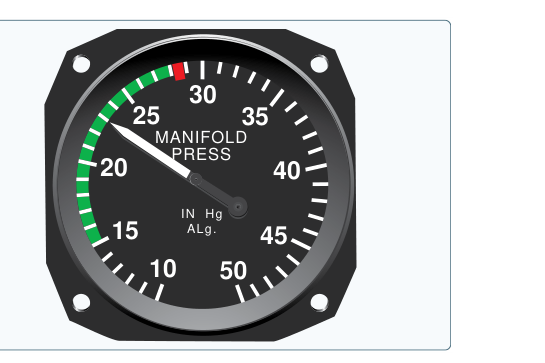
Manifold pressure is the absolute pressure measured in the engine's induction manifold, downstream of the throttle valve and upstream of the intake ports. It is displayed in inches of mercury (in. Hg) on the cockpit manifold pressure gauge and is the primary power-control reference for constant-speed propeller installations. Unlike tachometer readings alone, MP tells you directly how much air (and therefore how much air-fuel mixture) is being delivered to the cylinders.
With the engine stopped, the manifold pressure gauge reads ambient atmospheric pressure—approximately 29.92 in. Hg at sea level on a standard day. When the engine is running at idle with the throttle nearly closed, MP drops well below ambient—typically to somewhere around 10–15 in. Hg depending on the specific engine and altitude—because the pistons create suction against a nearly closed throttle plate. As the throttle opens, MP rises toward ambient. On a normally aspirated engine, wide-open throttle (WOT) at sea level will produce a MP reading slightly below ambient due to induction system pressure losses. On a turbocharged engine, a controller or waste gate allows MP to be maintained at or above ambient pressure—with rated upper limits varying considerably by engine model, commonly ranging from the high-20s into the mid-40s in. Hg—enabling rated power to be maintained to a higher altitude.
How BHP, BMEP, and Manifold Pressure Relate
The three parameters are linked in a logical chain: manifold pressure determines the density of the charge entering the cylinders; charge density drives combustion pressure, which is what BMEP represents on an averaged, normalized basis; and the cumulative effect of those combustion events, multiplied by RPM and constrained by friction, produces BHP at the crankshaft.
Increase MP (by opening the throttle or adding boost) → more air-fuel mass per cylinder → higher peak and average combustion pressure → higher BMEP → higher BHP, assuming RPM is held constant. This is why the Pilot's Operating Handbook and engine operator's manual publish power-setting tables that list MP and RPM combinations for specific percentages of rated power. A technician reading these tables can verify that the engine's actual MP at a given RPM and altitude matches what the manufacturer specifies—a mismatch is diagnostic of an induction leak, a miscalibrated MP gauge, or a malfunctioning turbocharger system.
Why These Relationships Matter for Maintenance
During a maintenance run-up or engine test cell evaluation, you are essentially validating all three parameters simultaneously. If static RPM at full throttle is below the manufacturer's specification, the problem could be aerodynamic (wrong pitch propeller), mechanical (high internal friction), or induction-related (low MP). Checking the MP reading first isolates the induction system. If MP is correct and RPM is still low, the issue shifts toward mechanical or propeller causes. If MP is low, the technician looks upstream: blocked air filter, induction air leak, misrigged throttle linkage, or turbocharger malfunction.
BMEP thinking helps diagnose cylinder-specific issues. If a differential compression test shows one cylinder is mechanically compromised, that cylinder contributes less to average combustion pressure, reducing effective BMEP and therefore BHP even if the other cylinders are healthy. This is why a 10–15% power loss complaint often correlates with a single bad cylinder that an EGT spread or compression test will reveal.
Key Numbers and Rules
- 1 HP = 33,000 ft-lb/min — the foundational definition of horsepower.
- BHP = (Torque × RPM) ÷ 5,252 — standard formula with torque in lb-ft.
- Typical normally aspirated BMEP: 120–150 psi at rated power.
- Standard sea-level atmospheric pressure: 29.92 in. Hg — the baseline for MP interpretation.
- Idle MP: approximately 10–15 in. Hg — well below ambient due to throttle restriction, varying with engine and altitude.
- Turbocharger critical altitude — the highest altitude at which the turbo can maintain rated MP; above this, MP and BHP begin to fall off.
- Over-boost risk — exceeding MP limits drives BMEP above design values, risking detonation and structural damage; always consult the engine manufacturer's limitations.
- Friction horsepower increases with engine wear, reducing BHP even when indicated horsepower is unchanged.
Common Test Traps
- Confusing BMEP with a directly measured pressure. BMEP is a calculated average—there is no BMEP gauge. The FAA knowledge test may describe it as a "theoretical" or "computed" value; do not select answer choices implying it is read directly from instrumentation.
- Assuming wide-open throttle always equals ambient MP. Induction system losses mean WOT on a normally aspirated engine reads slightly below ambient. Only a turbocharged engine at or below critical altitude can equal or exceed ambient pressure in the manifold.
- Mixing up BHP and IHP. Indicated horsepower is the theoretical maximum from combustion; BHP is what you actually get after friction losses. Questions sometimes describe a scenario where both values appear—remember BHP is always the lower number.
- Forgetting that both MP and RPM must be considered together. A high MP reading with low RPM does not guarantee high BHP; the power formula requires both terms. Test questions may give you only one variable and expect you to recognize the information is incomplete.
- Ignoring altitude effects on normally aspirated engines. As altitude increases, ambient air density falls, so WOT MP decreases, BMEP decreases, and BHP decreases—even at the same RPM. This is a frequently tested concept in powerplant performance questions.