Introduction
The rectangular course is one of the most practical and instructive maneuvers in the private pilot syllabus. At its core, it is a low-altitude exercise in which the pilot flies a rectangular path over the ground — typically following the edges of a farm field or other clearly defined rectangular landmark — while maintaining a constant distance from each side. The challenge is deceptively simple: the wind is almost always blowing from some direction, which means the airplane's ground track will drift away from the intended path unless the pilot continuously corrects for it. Mastering this maneuver is not merely a box to check for the checkride; it builds the precise, habit-level skills that every pilot uses on every traffic pattern approach at every airport for the rest of their flying career.
The Airplane Flying Handbook (FAA-H-8083-3) introduces the rectangular course as a ground reference maneuver, a category of exercises designed specifically to teach pilots to divide their attention between the airplane and the ground reference point while making accurate corrections for wind. The rectangular course is the most directly applicable of these maneuvers because the airport traffic pattern is itself a rectangle.
How the Rectangular Course Works
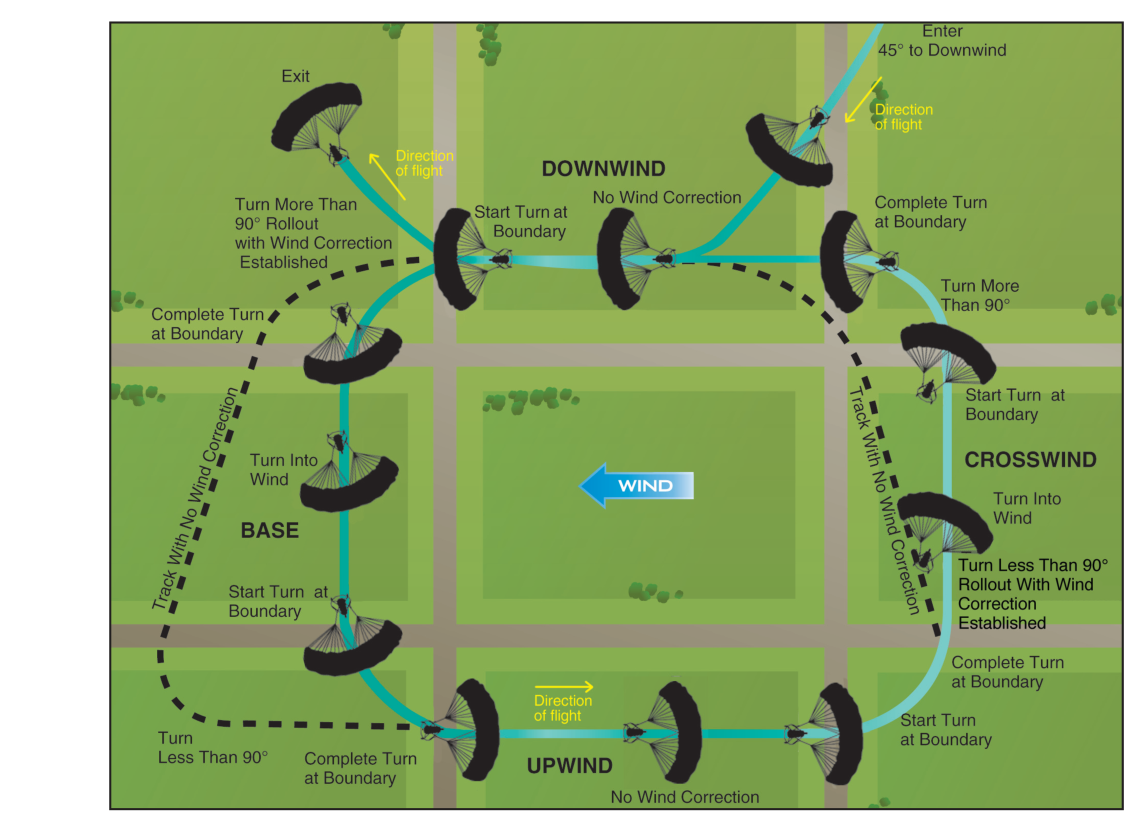
The pilot selects a large, clearly defined rectangular field and begins the maneuver by entering on a downwind leg — flying parallel to one of the long sides of the field with the wind at the airplane's back. Entry altitude is typically 600 to 1,000 feet above ground level (AGL), and the airplane should be at a constant airspeed appropriate for maneuvering. The pilot flies the rectangle by making four 90-degree turns, one at each corner of the field, and the goal is to keep the ground track equidistant from each side of the field throughout the entire maneuver.
The fundamental skill being practiced is the crab angle — pointing the airplane's nose into the wind to compensate for drift, so the actual path over the ground remains parallel to the field boundaries. On a leg where the wind is directly on the nose or directly behind, no crab is needed. On a crosswind leg (flying perpendicular to the wind), the pilot must establish a crab angle into the wind to prevent the airplane from drifting away from or toward the field.
The Four Legs and Bank Adjustments
The rectangular course teaches not just crab angle corrections but also varied bank angles in the turns. This is the aspect most students initially overlook, and it is the key to truly understanding the maneuver.
- Downwind leg: The aircraft has a tailwind, so its groundspeed is highest on this leg. When turning from downwind to the base leg (a crosswind turn), the airplane is moving rapidly across the ground. If the pilot uses the same bank angle as on all other turns, the airplane will overshoot the desired ground track and end up too close to — or crossing over — the field boundary. The correction is to use a steeper bank angle on the downwind-to-base turn.
- Base leg: On the crosswind base leg, the pilot crabs into the wind to maintain a ground track perpendicular to the field. Groundspeed is moderate on this leg.
- Upwind leg (headwind): Flying directly into the wind, the airplane has its lowest groundspeed. When turning from upwind to the base leg or from base to downwind, the airplane moves slowly across the ground, so a shallower bank angle is required to avoid turning inside the desired track and ending up too close to the field.
- Crosswind legs: The airplane crabs into the wind to prevent drifting toward or away from the field boundary. The amount of crab angle depends on wind speed — more wind, more crab.
The general rule, therefore, is: when turning with the wind at your back (tailwind), use a steeper bank; when turning into the wind (headwind), use a shallower bank. This accounts for the higher groundspeed and greater turning radius when the airplane is moving rapidly over the ground, and the lower groundspeed and tighter natural turn radius when moving into the wind.
The Relationship to the Traffic Pattern
The traffic pattern flown at most airports is exactly a rectangular course. The downwind leg corresponds to the longest straight segment, flown parallel to the runway with the wind behind. The base leg is perpendicular to the runway, and the final approach is the fourth side. The same wind-correction principles apply: steeper banks turning from downwind to base (with the wind helping push the airplane through the turn), and shallower banks turning from base to final (turning into or across the wind). Student pilots who truly internalize the rectangular course find that their traffic patterns immediately become more consistent and accurate.
Why the Rectangular Course Matters
Beyond the traffic pattern, this maneuver develops several habits critical to safe flight. First, it teaches outside reference flying — the pilot must look outside at the ground reference, not fixate on the instruments. This reinforces the foundational principle that VFR pilots navigate and maneuver by visual reference to the outside world. Second, it builds the habit of divided attention: scanning the ground reference for drift while simultaneously monitoring airspeed, altitude, and coordination of the controls. Third, it demonstrates in a visceral, hands-on way how wind affects navigation — a lesson that applies every time the pilot plots a cross-country course or tries to land in a crosswind.
The FAA also emphasizes that the purpose of ground reference maneuvers is to develop the pilot's ability to subconsciously maintain coordination and make control inputs while the conscious attention is directed at the ground reference. When this becomes automatic, the pilot is safer in the traffic pattern environment, where managing radios, checklists, and traffic awareness compete for attention.
Key Numbers and Rules
- Entry altitude: 600–1,000 feet AGL (per the Airplane Flying Handbook)
- Wind on the tail → steeper bank in the turn
- Wind on the nose → shallower bank in the turn
- Entry is typically on the downwind leg, positioned so the field boundary is 45 degrees to the rear of the wing tip at entry — similar to a standard traffic pattern entry
- Bank angles should typically not exceed approximately 45 degrees to avoid excessive load factor; in practice, most banks in this maneuver range from about 15 to 30 degrees depending on wind conditions
- Constant altitude and airspeed must be maintained throughout; altitude deviations are a primary grading point on the checkride
- The pilot should remain aware of the minimum safe altitude regulations in 14 CFR 91.119, which state that over congested areas the minimum is 1,000 feet above the highest obstacle within a 2,000-foot horizontal radius of the aircraft, and over other than congested areas an aircraft may not be operated closer than 500 feet to any person, vessel, vehicle, or structure
Common Test Traps
- Confusing groundspeed with airspeed: The bank angle adjustments in the rectangular course are based on groundspeed (how fast you're moving over the ground), not indicated airspeed. Airspeed stays constant throughout; it is the groundspeed that changes with the wind, and that change is what drives the need for varied bank angles in each turn.
- Forgetting to crab on the crosswind legs: Many students focus so much on the turns that they fly straight crosswind legs without establishing a crab angle. If there is any crosswind component, a crab is necessary on those legs to maintain the desired ground track parallel or perpendicular to the field.
- Treating all four turns equally: A classic exam scenario presents a situation — such as wind from the south during a rectangular course — and asks which turn requires the steepest bank. Students who memorize the principle rather than understanding it sometimes get this backward. Remember: steeper when groundspeed is highest (downwind turn), shallower when groundspeed is lowest (upwind turn).
- Neglecting altitude control: During the turns, particularly when changing bank angle, students often inadvertently gain or lose altitude. On the practical test, the examiner expects altitude to be held within ±100 feet throughout the maneuver.
- Starting too close to the field: If entry is too close to the field boundary, the pilot runs out of room to establish the crab angle before needing to turn, and the first turn is rushed. Entry should be far enough away to establish a proper parallel ground track before the first corner.
Putting It All Together
The rectangular course is not an arbitrary training exercise — it is a carefully designed simulation of the real-world task pilots perform dozens of times per flying hour: flying a planned ground track in the presence of wind. When you practice this maneuver, think of each leg as a mini navigation problem and each turn as a problem in energy management and timing. Ask yourself before each turn: am I going with the wind or against it? How fast am I moving over the ground? How much bank do I need to roll out on the correct track without overshooting or undershooting the next leg?
With enough practice, these questions answer themselves automatically — and that is exactly the point. The rectangular course trains autopilot-level habit formation for the traffic pattern so that when you are flying a real approach at a busy airport, your brain is free to focus on traffic, communication, and checklists rather than basic wind correction. Nail the rectangular course, and the traffic pattern takes care of itself.