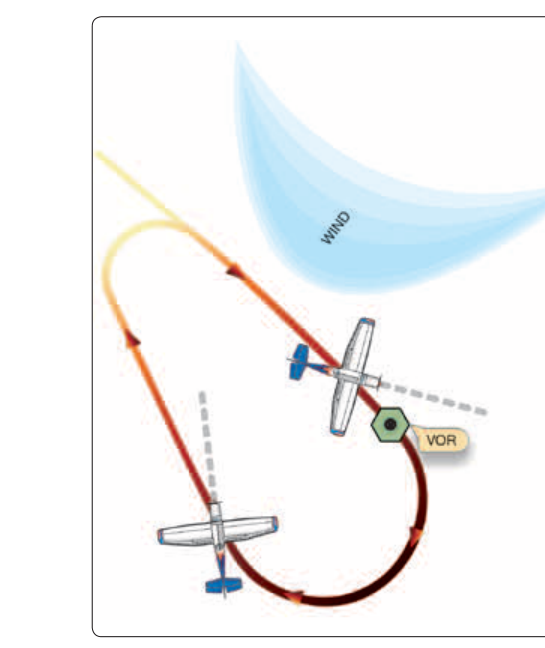
What Is the Rectangular Course?
The rectangular course is a ground reference maneuver in which the pilot flies a rectangular ground track around a selected field or section of land, keeping a uniform distance from each side of the rectangle at all times. It is introduced early in primary training because it simultaneously develops two fundamental skills: wind drift correction and coordinated bank angle management. According to the Airplane Flying Handbook (FAA-H-8083-3), the objective is to develop the pilot's ability to divide attention between controlling the airplane and maintaining an awareness of the ground track, wind effect, and traffic pattern procedures.
The maneuver is typically performed at an altitude of 600 to 1,000 feet AGL — low enough for wind drift to be clearly visible against the ground, but high enough for safety. The selected reference field should have clearly defined boundaries, such as roads or fence lines, and the pilot should be able to see all four sides of the rectangle from the cockpit.
Relationship to the Airport Traffic Pattern
Understanding the rectangular course becomes much more meaningful when you see it as a direct analog to the airport traffic pattern. The standard traffic pattern actually has five legs — departure (upwind), crosswind, downwind, base, and final — while the rectangle has four sides. The turns at each corner of the rectangle correspond to the turns between traffic pattern legs, with the rectangle's short sides representing the crosswind and departure/upwind legs and the long sides representing the downwind and final legs.
- Downwind leg: The pilot flies parallel to the longest side of the rectangle (or the runway), with the wind at or near the tail. This leg corresponds to flying the rectangle's downwind side.
- Base leg: A turn across the short end of the field, perpendicular to the wind. Drift correction is required to track perpendicular to the wind.
- Final approach: Flying directly into the wind along the upwind side of the field. If corrected properly, no crab angle is required here because the headwind is directly on the nose.
- Crosswind leg (departure): The other short side of the rectangle, again requiring drift correction.
The FAA specifically designs the rectangular course to teach pilots the mental habits and muscle memory needed to fly a consistent traffic pattern. A pilot who cannot maintain a rectangular ground track around a field will struggle to keep a consistent traffic pattern around an airport — and inconsistent patterns lead to poor energy management on final approach, unstabilized approaches, and increased risk of runway excursions or go-around situations.
Wind Drift and How It Affects Each Leg
Wind drift is the displacement of the aircraft's ground track caused by a crosswind component. Even though the nose of the airplane may point straight ahead, the actual path over the ground drifts in the direction of the wind unless the pilot applies a crab correction — pointing the nose slightly into the wind so that the horizontal component of the airplane's movement cancels the wind drift.
On any leg where the wind is a crosswind, the pilot must establish a crab angle. The stronger the wind and the slower the airspeed, the larger the required crab angle. During the rectangular course, each of the four legs presents a different wind relationship:
- Downwind side: Wind is a tailwind, which increases groundspeed. No crab is needed for drift, but the pilot must anticipate a tighter (steeper-banked) turn onto the next leg because the groundspeed is higher.
- Base leg (into or away from the wind, short side): A crosswind component exists. The pilot crabs into the wind. Because the wind pushes the aircraft away from the field on one short side and toward the field on the other, the crab direction reverses between the two short sides.
- Upwind side: Wind is a headwind, which decreases groundspeed. The turn onto this leg must be shallower (less bank) because groundspeed is slower. No crab correction needed for drift on this leg itself.
- Crosswind leg (departure side): A crosswind again, mirror image of the other short side.
The key insight is that bank angle in the turns must vary with groundspeed. On the downwind-to-base turn, groundspeed is highest, so the bank must be steeper to complete the turn in the correct amount of space. On the base-to-final (upwind) turn, groundspeed is lowest, so a shallower bank is appropriate. Failing to vary bank angle results in either overshooting or undershooting the desired ground track — exactly what happens in a sloppy traffic pattern.
Establishing the Correct Crab Angle
There is no single formula for the exact crab angle because it depends on the wind velocity and the airplane's true airspeed. Instead, the pilot develops this skill through visual reference. On each straight leg, if the aircraft begins drifting toward the field boundary, the pilot turns slightly toward the field (into the wind) and holds that heading until the ground track runs parallel to the boundary again. If the aircraft drifts away from the boundary, the nose is turned slightly away from the field to recapture the correct distance.
A useful mental habit is to pick a specific reference distance from the field boundary — approximately one-quarter to one-half mile is typical for the rectangular course — and maintain that distance throughout. If the distance is widening or narrowing on a straight leg, a crab correction is required. The pilot should establish the crab early after rolling out of each turn rather than waiting until significant drift has occurred.
Turn Technique at Each Corner
The turns at each corner of the rectangle are not all the same. The Airplane Flying Handbook specifies that:
- Turns from the downwind leg should use a steeper bank because groundspeed is highest.
- Turns from the upwind leg should use a shallower bank because groundspeed is lowest.
- Turns on the two crosswind legs will require intermediate bank angles, and the pilot must also roll out on a heading that immediately establishes the correct crab angle for the next leg.
The rollout from each turn should result in the aircraft already established on the new leg's ground track — not drifting toward or away from the field boundary. This requires the pilot to anticipate the rollout heading, accounting for the crab angle needed on the new leg. On a left rectangular course with a left crosswind (wind from the left), rolling out of the base-to-final turn means pointing slightly left of the boundary to crab into the wind on the upwind leg.
Altitude and Coordination
The rectangular course is normally flown at a constant altitude. Any altitude deviation indicates the pilot is allowing the maneuver to distract attention from basic pitch control — a sign of divided-attention deficiency. All banks should be coordinated (ball centered), and climbs or descents during the maneuver are considered errors. Steep uncoordinated turns at low altitude carry meaningful risk, which is why the maneuver reinforces the habit of flying coordinated at all times.
Common Errors in the Rectangular Course
Instructors should be alert for the following typical student mistakes, as described in the Airplane Flying Handbook:
- Failing to establish a crab correction early after rollout, allowing drift to build before correcting.
- Using the same bank angle in all four turns instead of varying it with groundspeed.
- Losing altitude during turns due to failure to maintain back pressure.
- Flying too close to the field (inside the planned ground track), especially on the downwind side where groundspeed is highest and visual perception is accelerated.
- Fixating on the ground reference at the expense of airspeed and altitude monitoring.
Memory Aid
To remember the bank-angle rule, use the phrase