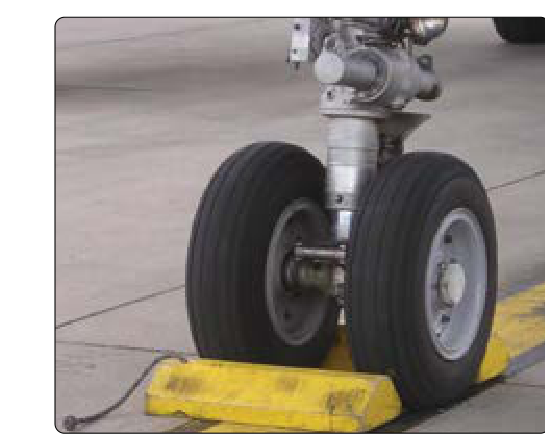
Every aircraft maintenance technician (AMT) works around aircraft that are parked, being serviced, or awaiting inspection — and every one of those situations carries the risk of unintended movement. Even on seemingly level ramps, subtle slopes, vibration from engine run-ups nearby, or the inadvertent release of parking brakes can send an aircraft rolling into personnel, fuel trucks, hangars, or other aircraft. Wheel chocks are the simplest and most reliable mechanical means of preventing that movement, and understanding how to use them correctly is a foundational skill for any AMT.
Chocking procedures are covered in FAA maintenance guidance and reinforced throughout ground-handling best practices described in the FAA Aviation Maintenance Technician Handbooks. While they may seem straightforward, improper chock placement is a recurring factor in ground damage incidents. This article explains what chocks are, how they work, where and how to place them, and what the FAA knowledge test expects you to know.
What Wheel Chocks Are and How They Work
A wheel chock is a wedge-shaped or block-shaped device placed firmly against a tire to prevent rolling. The geometry of a proper chock is critical: the contact face is angled so that as the tire attempts to roll in one direction, it rides up onto the chock face and the chock is pressed more firmly into the ground rather than being pushed away. This self-locking wedge effect means a correctly placed chock becomes more effective as the load increases — the weight of the aircraft works for the chock rather than against it.
Common chock materials include solid hardwood, high-density polyethylene (HDPE) plastic, aluminum, and rubber. Each material has trade-offs. Wood is inexpensive and grippy on concrete but can split, absorb moisture, and rot over time. Plastic chocks are lightweight, weather-resistant, and common on flight lines, but some smooth plastics can skid on wet or oily surfaces. Aluminum chocks are durable but can scratch ramp surfaces and conduct heat. Rubber chocks conform slightly to uneven pavement and provide excellent friction. The best chock for a given situation balances grip against the ramp surface, durability, and the weight of the aircraft involved — a chock sized for a Cessna 172 is inadequate for a large turboprop or jet.
Standard Chock Placement Procedures
The basic rule is that chocks must be placed on both the fore and aft sides of at least one main gear tire to prevent rolling in either direction. For most light aircraft, chocks are placed on the main landing gear wheels. For large or heavy aircraft, chocks may also be placed on nose gear or additional main gear positions depending on the operation and the ground slope.
Placement Against the Tire
The chock must be in firm, flush contact with the tire tread — not the sidewall. Contact against the sidewall can damage the tire and does not provide reliable resistance because the curved sidewall allows the chock to slip sideways. The base of the chock should sit flat on the ramp surface with no rocking. If the ramp is rough or has expansion joints, position the chock so its full base contacts solid pavement. Some chocks have a rope or strap connecting the fore and aft pair; this keeps them together as a unit and makes retrieval easier, but it does not substitute for correct individual placement of each chock piece.
Slope Considerations
On a level surface, chocks on both sides of the tire are equally important. On a sloped surface, the downhill chock becomes the primary safety device and must be placed with extra care. The uphill chock acts as a backup in case of a bounce or brake release. When parking on a slope, always verify that the downhill chock is firmly seated and the tire is pressing against it before walking away from the aircraft. Never rely solely on the parking brake — hydraulic brake systems can leak, and parking brake cables can slip. Chocks provide a passive, mechanical backup that does not depend on any aircraft system remaining functional.
Multiple Chock Points for Large Aircraft
Turbine-powered transport category aircraft and large piston aircraft require chocks on multiple gear positions. Ground handling manuals (which AMTs must consult for type-specific guidance) specify exactly which wheels require chocking for each phase of operation — engine run, refueling, jacking, etc. During engine run-up, for example, thrust from turboprops and jets can exceed the force the parking brake alone can resist, so chocking becomes part of the approved run procedure. During jacking, chocks prevent any rolling of the gear still on the ground, which could destabilize the jack points.
Chocking Sequence: Moving Aircraft In and Out
The sequence in which chocks are placed and removed matters for safety. When parking an aircraft, chocks should be placed as the primary restraint against unintended movement, since chocks provide a passive mechanical safeguard that does not depend on the parking brake remaining set or functional. This prevents any rolling during the moment the technician is bending near the tire to place the chock. When removing chocks to move an aircraft, the person clearing the area should confirm all personnel are clear of the prop arc, exhaust, and movement path before signaling the pilot or tow crew, removing chocks, and stepping clear of the wheel path. Chocks should never be kicked out from under a tire while the aircraft's engines are running without explicit clearance in the approved procedure, because a loose chock can become a foreign object debris (FOD) hazard ingested by an engine.
Why Chocking Matters for Safety
Unintended aircraft movement on the ground has resulted in serious injuries and fatalities to ground personnel, as well as substantial aircraft damage. An aircraft that rolls into a person can cause crushing injuries or death. An aircraft that rolls into another aircraft or a fuel truck can cause a fuel spill and fire. These risks are present even at idle power or with engines off, because even small slopes combined with a released brake can allow a multi-ton aircraft to accelerate quickly.
From a regulatory standpoint, 14 CFR Part 43 places responsibility for airworthy condition and proper maintenance on certificated mechanics. While chocking is a ground-handling procedure rather than a maintenance action in the traditional sense, it directly protects both the aircraft and personnel during maintenance, making it a core competency for any AMT. Additionally, facilities operating under 14 CFR Part 145 are expected to have ground-handling procedures that protect aircraft and personnel — proper chocking is part of that expectation.
Key Numbers and Rules
- Minimum chock placement: At least one chock on each side (fore and aft) of at least one main gear wheel — always both directions of travel.
- Slope priority: On any slope, the downhill chock is the primary restraint; the uphill chock is a backup.
- Chocks as primary restraint: Chocks are a passive mechanical safeguard that should not depend on the parking brake; place chocks as the primary means of preventing movement, and remove chocks before engine start or aircraft movement per approved procedure.
- Correct contact surface: Chock face contacts the tire tread, never the sidewall.
- Size matching: Chock height should be approximately one-quarter to one-third of the tire diameter for effective restraint — undersized chocks can be overridden by a rolling tire.
- FOD awareness: Chocks must be removed before any engine start or aircraft movement; a forgotten chock is an immediate safety and FOD hazard.
- Type-specific guidance: Always consult the aircraft's maintenance manual or ground-handling manual for chock requirements on complex, large, or transport category aircraft.
Common Test Traps
- Sidewall vs. tread contact: A common distractor question asks where the chock contacts the tire. The correct answer is the tread — sidewall contact is incorrect and potentially damaging.
- One chock vs. two: Test questions may offer placing a single chock as an answer. A single chock only prevents movement in one direction; always two chocks (fore and aft) are required for full restraint.
- Brake alone is sufficient: This is a false premise. Parking brakes can fail; chocks are the required backup, not an optional extra.
- Chock size doesn't matter: Incorrect — an undersized chock can be rolled over. Chock height relative to tire diameter is a real engineering consideration, not a trivial detail.
- Remove chocks after engine start: This is dangerous practice and incorrect procedure. Chocks should be removed before engine start (or per the specific approved procedure), and never removed haphazardly with engines running due to FOD risk and prop/jet blast hazard to the person removing them.