Every time fuel flows through a hose, nozzle, or aircraft fuel system, friction between moving fuel molecules and the walls of pipes and hoses generates an electrical charge. Under the right conditions — particularly when fuel vapors are present in the air — this static charge can jump as a spark and ignite a catastrophic fire. For aviation maintenance technicians (AMTs), understanding how static electricity is generated, how it moves, and how bonding and grounding neutralize the hazard is both a regulatory requirement and a life-safety essential.
The good news is that static electricity during fueling is a completely preventable hazard. The procedures are straightforward, but they must be followed in the correct sequence and with the right equipment. A single skipped step can create the voltage difference needed to produce a spark at the worst possible moment — when fuel vapors are at their most concentrated.
How Static Electricity Builds Up
Static electricity is the accumulation of electric charge on the surface of a material. When two dissimilar materials come into contact and then separate — or when a fluid moves through a conduit — electrons are transferred from one surface to the other. One object becomes positively charged (electron-deficient) and the other becomes negatively charged (electron-rich). This is called triboelectric charging, and it happens continuously during fueling.
Aviation fuel, especially jet fuel, is a particularly poor conductor of electricity. Because charge cannot easily flow through the fuel itself, any static charge that builds up on the fuel stream or on the aircraft structure tends to stay put rather than dissipate harmlessly. A large aircraft receiving fuel rapidly through a high-flow hose can accumulate thousands of volts of static potential in a matter of seconds.
The danger is not the high voltage itself — it is the difference in voltage (potential difference) between two objects. When a charged fuel nozzle approaches an aircraft fitting that is at a different electrical potential, electrons will jump across the gap as a spark. If fuel vapor concentration is in the flammable range (generally between the lower explosive limit and upper explosive limit of the specific fuel), that spark provides more than enough energy to cause ignition.
Bonding vs. Grounding: Critical Distinction
AMTs must clearly understand the difference between bonding and grounding because they serve different purposes and neither alone is sufficient.
Bonding is the process of electrically connecting two or more conductive objects together with a conductor (a bonding wire or cable) so that they share the same electrical potential. When the fueling truck and the aircraft are bonded together, any charge that builds up is shared equally between them. Because both objects are now at the same potential, there is no voltage difference between them, and therefore no spark can jump between them.
Grounding is connecting an object to the Earth, which acts as an infinite reservoir of charge. The Earth can absorb or supply electrons as needed to keep a grounded object at zero (or near-zero) electrical potential. When an aircraft is grounded, accumulated static charge is continuously drained away to the Earth. When a fueling vehicle is grounded, the same effect occurs.
The key insight: bonding alone prevents a spark between the two bonded objects, but it does not prevent charge from accumulating on the system as a whole. Grounding drains that accumulated charge away. During fueling, both bonding and grounding together provide complete protection. Bonding equalizes potential between the aircraft and the fuel source; grounding keeps the entire bonded system at Earth potential.
The Correct Sequence of Bonding and Grounding
Sequence matters enormously. The connections must be made before fuel caps are opened and the fuel system is disturbed, because opening a fuel cap can immediately release vapors. Connections must be broken only after caps are secured and the fueling hose is removed. Here is the standard procedure sequence:
- Ground the fueling vehicle to a designated airport ground point before moving it near the aircraft.
- Bond the fueling vehicle to the aircraft using a bonding cable, connecting metal to metal (not through paint). The aircraft structure is the reference point.
- Bond the fuel nozzle to the aircraft at the fuel port before opening any fuel cap or vent. This is the most critical individual step — the nozzle bond eliminates the potential difference at the exact point where fuel and vapors are present.
- Open the fuel caps or access panels and begin fueling.
- When fueling is complete, close and secure all fuel caps.
- Disconnect in reverse order: nozzle bond first, then aircraft-to-truck bond, then ground connection last.
Breaking the connections in reverse order ensures that the entire system remains equalized in potential until the last possible moment. If the ground were removed while the nozzle bond remained, the truck and aircraft could float to a high and unpredictable potential together — making the eventual disconnection of the nozzle bond dangerous.
Equipment Requirements and Inspection
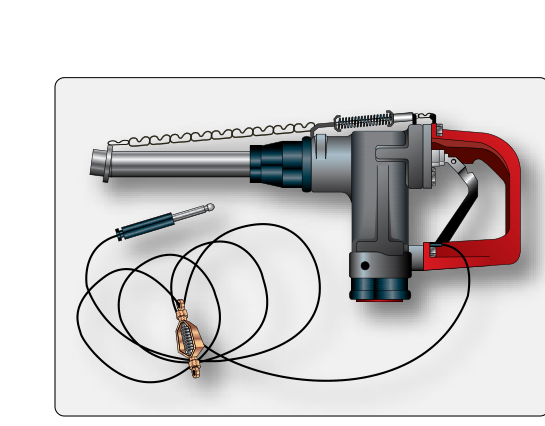
A bonding cable is only effective if it provides a low-resistance electrical path. AMTs and fuel service personnel must inspect bonding cables regularly for the following defects:
- Broken or corroded wire strands — even a few broken strands can dramatically increase resistance, limiting the cable's ability to equalize charge quickly.
- Defective clamps or alligator clips — the clip must make firm metal-to-metal contact. Paint, grease, or anodizing on the aircraft skin at the contact point can act as an insulator and defeat the bond.
- Excessive length — a very long, coiled bonding cable has significant inductance and may not equalize potential quickly enough during dynamic charge buildup.
- Frayed or damaged insulation on the cable jacket — while the outer jacket is not critical to the electrical function, damage is an indicator of mechanical abuse that may have broken internal conductors.
Most airports designate specific bonding points on the aircraft — typically bare metal fittings or lugs near the fuel ports — specifically to ensure consistent, low-resistance contact. AMTs should be familiar with these points on the aircraft types they service.
Why This Matters: Real-World Consequences
The flammable vapor cloud around an open fuel port during fueling exists for only a short time, but that window is precisely when the most sparking risk exists — when the nozzle approaches or departs the filler neck. A very small spark is sufficient to ignite aviation gasoline or jet fuel vapors — hydrocarbon fuel-air mixtures typically require only a fraction of a millijoule of ignition energy. Static electricity discharges routinely carry energy far above this threshold.
Beyond direct fire risk, improperly bonded aircraft can also damage sensitive avionics. A static discharge through the airframe can induce transient voltages in wiring bundles, damaging or destroying solid-state electronics. While fire is the primary fueling concern, AMTs working in hangar environments with fuel-wetted components should also be aware of this secondary risk.
Certain environmental conditions amplify the hazard: low humidity reduces the atmosphere's natural ability to dissipate charge; high fuel flow rates increase triboelectric generation; and fueling during or after a dust storm or precipitation event can pre-charge the aircraft structure. In these conditions, strict adherence to bonding and grounding procedure is even more critical.
Key Numbers and Rules
- Flammable limits for aviation gasoline (avgas) are commonly cited as approximately 1.4% to 7.6% fuel vapor by volume in air — any concentration in this range can be ignited by a static spark.
- Jet fuel (Jet-A) has a higher flash point than avgas, but fuel vapors at ambient temperatures near and above the flash point are still within the flammable range and represent a real ignition hazard.
- Bonding cables should have resistance of no more than a few ohms end-to-end to be effective; cables with resistance in the kilohm range provide inadequate protection.
- Per general aviation safety practice and manufacturer guidance, bonding must be established before fuel caps are opened and broken after caps are secured.
- 14 CFR Part 139.321 (general safety provisions for certificated airports) and NFPA 407 (the industry standard for aircraft fuel servicing) both support bonding and grounding requirements for fuel servicing operations.
Common Test Traps
- Confusing bonding with grounding. The FAA knowledge test frequently presents these as interchangeable. They are not. Bonding equalizes potential between objects; grounding drains charge to Earth. Both are required.
- Wrong sequence — grounding the aircraft before bonding the nozzle. The nozzle must be bonded to the aircraft before fuel caps are opened, regardless of whether the truck is already grounded.
- Assuming paint provides an adequate connection. Paint is an insulator. Bonding clamps must contact bare metal. A clamp on painted skin provides essentially no protection.
- Believing low humidity is safe because charge dissipates faster. In fact, the opposite is true — low humidity reduces natural charge dissipation and increases static buildup risk. High humidity allows charge to leak away through moisture on surfaces.
- Thinking jet fuel is safe because it has a higher flash point. In warm conditions, or when fuel is agitated and vapors are present near the filler neck, Jet-A vapors can absolutely be in the flammable range. Never treat any aviation fuel as safe from static ignition during fueling.