Every time you preflight an airplane, you are implicitly asking a fundamental aerodynamic question: is this aircraft properly balanced? Two invisible points — the Center of Gravity (CG) and the Center of Pressure (CP) — govern whether your airplane will fly predictably, respond correctly to control inputs, and recover from upsets on its own. Mixing up these concepts, or misunderstanding how they interact, is a fast track to both a failed knowledge test and a genuinely dangerous flight. This article builds a complete, exam-ready picture of both points and explains why every weight-and-balance calculation you do matters for more than just paperwork.
At its core, the difference is this: CG is where the aircraft's entire weight appears to act, and CP is where the net aerodynamic lift force appears to act. When these two points are properly positioned relative to each other, the airplane flies in a stable, controllable manner. When they are not, the consequences range from sluggish controls to an unrecoverable pitch departure.
Center of Gravity: The Balance Point of Weight
The Center of Gravity is the single point through which the total weight of the aircraft — airframe, fuel, occupants, cargo — acts downward due to gravity. Think of it as the fulcrum of a seesaw: if you could suspend the entire airplane from a hook at exactly the CG location, it would hang level. In practice, the CG is not a fixed point. It moves forward and aft (and slightly laterally) as fuel burns, passengers shift, or cargo is loaded differently.
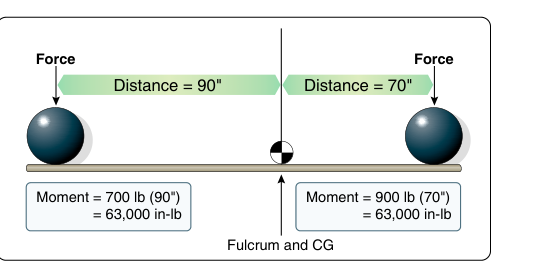
The FAA defines a CG envelope — a range of allowable CG positions — in every aircraft's Pilot's Operating Handbook (POH) or Approved Flight Manual (AFM). This envelope is typically expressed in inches measured from a reference point called the datum, an imaginary vertical plane the manufacturer selects (often the firewall, the nose, or the leading edge of the wing). The product of a component's weight and its distance from the datum is called its moment, and the CG is found by dividing total moment by total weight. This is the weight-and-balance calculation you will perform on the FAA knowledge test.
Forward vs. Aft CG
The CG envelope has a forward limit and an aft limit, and flying outside either boundary creates distinct hazards. With a forward CG, the nose is heavy. More elevator back-pressure is required to maintain level flight, and the elevator may not have sufficient authority to rotate during takeoff or to flare during landing. Stall speed also increases because the extra download from the horizontal tail — needed to keep the nose up — requires more lift from the wing, demanding a higher angle of attack. The airplane is more stable but harder to control at low speeds.
With an aft CG, the tail is effectively heavy, and the nose pitches up more readily. This reduces the amount of elevator authority needed, which sounds like a benefit but is actually dangerous. An aft CG reduces static longitudinal stability — the aircraft's natural tendency to return to a trimmed pitch attitude after a disturbance. At the extreme aft limit, the airplane may become neutrally stable or even unstable, meaning a pitch upset will not self-correct and may accelerate. Recovery from a stall or spin also becomes significantly more difficult with an aft CG, and in some configurations, a spin may become unrecoverable. This is why aft CG is considered the more dangerous of the two extremes.
Center of Pressure: The Balance Point of Lift
The Center of Pressure is the single point on an airfoil or wing through which the resultant of all aerodynamic forces — primarily lift, acting upward and perpendicular to the relative wind — is considered to act. Unlike CG, the CP does not stay in one place. It migrates along the chord line as the angle of attack changes. On a classic cambered airfoil, as angle of attack increases, the CP moves forward toward the leading edge. As angle of attack decreases, it moves aft. This movement is a major source of aerodynamic instability in aircraft that rely solely on CP for balance.
Early aircraft designers discovered that placing the CG ahead of the CP provided a measure of natural stability: the weight acting downward ahead of the lift acting upward creates a nose-down pitching moment. A horizontal tail generating a small downward force (a download) then completes the balance, holding the nose at the desired pitch attitude. If anything disturbs the pitch, the tail restores equilibrium. This arrangement — CG forward of CP with a stabilizing tail — is the fundamental balance architecture of virtually every conventional airplane you will fly.
The Aerodynamic Center and Why It Simplifies Everything
In practice, modern aerodynamicists use a related but more stable concept called the aerodynamic center (AC) rather than the CP when analyzing stability. The aerodynamic center is the point on the airfoil about which the pitching moment coefficient remains essentially constant regardless of angle of attack. For most subsonic airfoils, the AC is located approximately 25 percent of the chord length back from the leading edge — the quarter-chord point. Because the AC does not migrate with angle of attack the way the CP does, it provides a fixed reference for stability analysis.
For your FAA knowledge test, you will not be asked to calculate AC positions, but understanding why CG must remain forward of the AC (the neutral point of the whole aircraft) is key: if CG moves aft of the neutral point, any increase in angle of attack produces more lift behind the CG, which pitches the nose up further, which increases angle of attack — a divergent, unstable loop. This is why the aft CG limit exists and must never be exceeded.
Why It Matters: Safety and Handling Consequences
The interaction between CG and CP/AC has direct, cockpit-level consequences. An airplane loaded within its CG envelope will respond predictably to control inputs, recover from stalls in the expected manner, and require normal trim forces. An airplane loaded outside the envelope may exhibit subtle clues — unusual trim settings, sluggish or over-sensitive pitch response — but may also fail catastrophically without warning during a stall, spin entry, or dynamic maneuver.
It is also important to remember that the CG envelope can be exceeded even when the aircraft is within its maximum gross weight. A light airplane loaded with all passengers in the rear seats and a full baggage compartment may weigh less than max gross but still have an aft CG beyond the approved limit. Weight alone does not guarantee safe balance; distribution of that weight is equally important.
Key Numbers and Rules
- Forward CG effects: higher stall speed, reduced elevator effectiveness, increased stability, possible inability to rotate or flare.
- Aft CG effects: reduced stability, lighter control forces, increased stall/spin danger, possible unrecoverable spin.
- Aerodynamic center location: approximately 25% of the mean aerodynamic chord for subsonic airfoils.
- CP movement: moves forward as angle of attack increases; moves aft as angle of attack decreases.
- Datum: manufacturer-selected reference plane for all moment arm measurements; defined in the POH/AFM.
- Moment = Weight × Arm: CG = Total Moment ÷ Total Weight. This formula is directly tested on the FAA knowledge exam.
- CG envelope: both a forward and aft limit expressed in inches from datum; must be checked at takeoff weight and, where required, at landing weight.
Memory Aid
"Heavy Nose is Slow, Light Tail is Deadly." Forward CG makes the nose heavy — the airplane is slow to rotate and has higher stall speeds, but it remains stable. Aft CG makes the tail light relative to the nose — it feels nimble but becomes unstable and potentially unrecoverable in a stall or spin. When in doubt, a slightly forward CG is the safer direction, but neither extreme beyond the published limits is acceptable.
Common Test Traps
- Confusing CG with CP. CG is purely a function of where weight is distributed; CP (and AC) are purely aerodynamic. They interact, but they are calculated and defined completely differently.
- Assuming max gross weight means you are in the CG envelope. You can be under max gross weight and still have an out-of-limits CG. Always complete a full weight-and-balance calculation — not just a weight check.
- Thinking forward CG is always safer. Forward CG does increase stability, but beyond the forward limit it creates serious control authority problems at low speeds. Both limits exist for safety reasons.
- Forgetting that CG moves as fuel burns. Some aircraft have a CG that starts within limits but migrates out of the aft limit as fuel burns from wing tanks. Check the POH to determine if a fuel-burn CG analysis is required.
- Mixing up CP movement direction. The CP moves forward (toward the leading edge) as angle of attack increases — the opposite of what many students intuitively expect. This is a favorite FAA question twist.