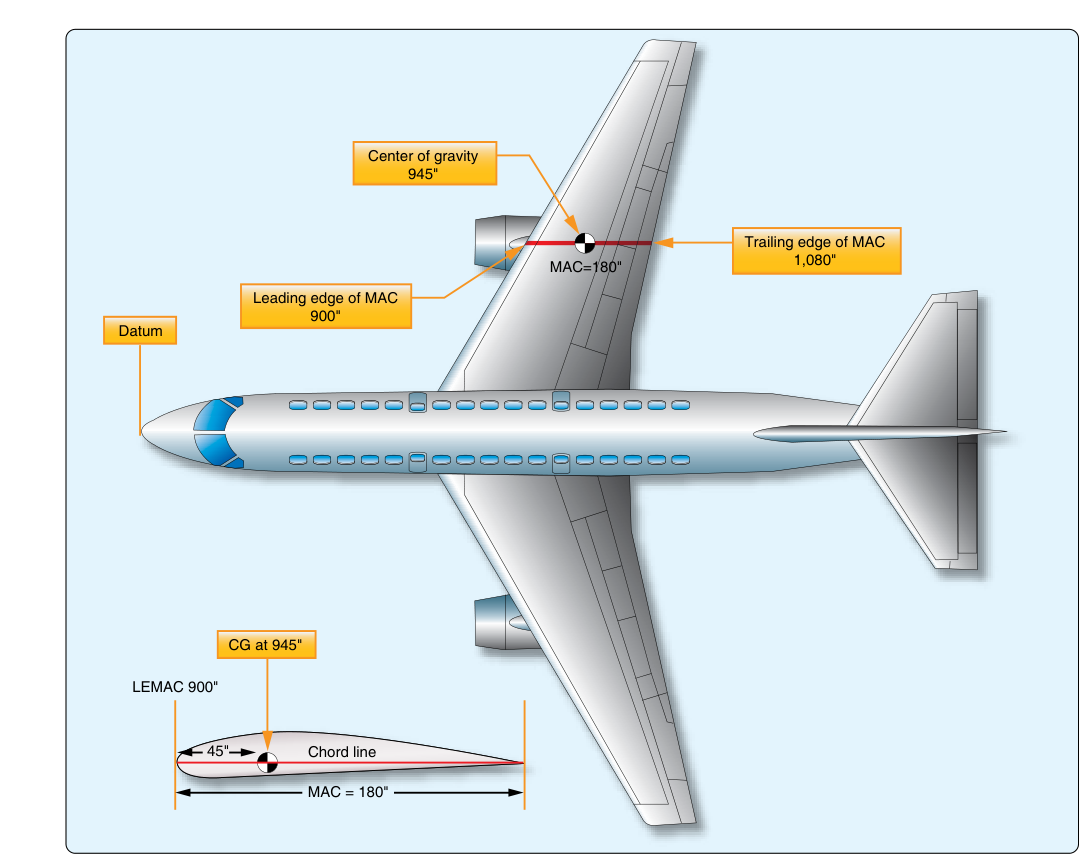
Every aircraft — whether a manned Cessna or a five-pound quadcopter — flies around a single invisible point called the center of gravity (CG). The CG is the theoretical point at which the entire weight of the aircraft can be considered to act straight downward. Where that point sits relative to the drone's frame determines whether the aircraft is stable, sluggish, or dangerously out of control. For Part 107 remote pilots, understanding CG is not just a test topic; it is a practical safety skill you will apply every time you load a payload, swap a battery, or mount a camera.
This article explains what CG is, how its location along the fore-and-aft and lateral axes affects flight behavior, what happens when CG moves outside its allowable limits, and how to recognize and correct loading problems before they become accidents.
What Is Center of Gravity?
The CG is essentially the balance point of the aircraft in three dimensions. In practice, the most safety-critical axis is the longitudinal axis (nose-to-tail), because shifts along this axis most dramatically change pitch stability and control effectiveness. Lateral CG (left-to-right) and vertical CG (up-and-down) also matter for multi-rotor sUAS, but the front-to-back position is where most loading errors occur.
For a fixed-wing sUAS, CG must fall within a specific range measured from a reference point called the datum — an arbitrary reference point chosen by the manufacturer for measuring arm, which can be located at the nose, the leading edge of the wing, or another point such as the firewall, depending on the airframe. The manufacturer publishes a forward CG limit and an aft CG limit; the range between them is the CG envelope. The aircraft is only certified to be airworthy when loaded so that the CG falls within this envelope.
Multi-rotor sUAS (quadcopters, hexacopters, octocopters) use active flight controller algorithms to compensate for some CG offset, but they still have physical limits. If the CG shifts too far from the geometric center, the motors on one side must run harder and longer to hold attitude, consuming more power, generating more heat, and leaving less margin for maneuvers or gusts.
How CG Location Affects Flight Stability
Forward CG
When the CG sits near the forward limit, the nose of the aircraft tends to pitch down. In a fixed-wing sUAS this creates a nose-heavy condition. The aircraft is generally more stable — it wants to return to level flight on its own because the weight out front acts like a pendulum. However, that stability comes at a cost:
- Reduced pitch authority: The elevator or elevon must deflect more to raise the nose, especially during low-speed flight and landing. At some point the control surface simply cannot generate enough lift to flare the aircraft, causing a hard nose-first landing.
- Higher stall speed: Because more elevator back-pressure (and thus more drag) is needed to maintain level flight, the aircraft must fly faster to stay aloft, raising effective stall speed.
- Increased drag and reduced endurance: The continuous elevator deflection needed to hold level flight increases induced drag, burning energy faster.
Aft CG
When the CG moves toward the aft limit, the tail becomes heavy relative to the nose. This is the more dangerous condition. An aft-CG fixed-wing sUAS becomes increasingly unstable in pitch — any nose-up disturbance tends to continue rotating nose-up rather than self-correcting. The key dangers include:
- Reduced static stability: The aircraft no longer naturally returns to level flight after a disturbance. Small gusts can trigger divergent pitch oscillations.
- Lighter control feel leading to over-control: Pitch inputs feel very sensitive; a small stick movement produces a large attitude change, making precise flight difficult.
- Stall and spin susceptibility: An aft-CG aircraft can reach a high angle of attack with very little control input, and if it stalls, recovery may be impossible because the elevator may not be able to push the nose down against the aft-heavy weight distribution.
Lateral and Vertical CG
On multi-rotor sUAS, lateral CG offset causes the aircraft to roll to one side continuously. The flight controller compensates by commanding the motors on the heavy side to spin faster, but this asymmetric power demand reduces the total available thrust margin and shortens battery life. A significant lateral offset can also make the aircraft difficult to control in a strong crosswind.
Vertical CG affects pendulum stability. A CG that is lower than the thrust plane (e.g., a heavy battery mounted beneath the frame) is generally understood to improve pendulum-type stability in rolling and pitching motions, based on general aerodynamic principles. A CG above the thrust plane has the opposite effect, reducing stability. Many professional multi-rotor designs deliberately mount the heaviest component (battery) low for this reason.
Why CG Matters for sUAS Operations
Unlike a manned aircraft where the pilot feels CG problems through control pressure and seat-of-the-pants sensation, a remote pilot gets no direct physical feedback. You are watching a small object dozens or hundreds of feet away. By the time abnormal flight behavior is obvious — a constant nose-down trim, a persistent roll, sluggish pitch response — the aircraft may already be in a dangerous condition with little altitude or airspeed margin for recovery.
Payload operations are the single biggest source of CG problems in commercial Part 107 work. Adding a camera, a sensor pod, a water-drop system, or even a different battery pack changes the CG. Even a payload that seems small — say, a 200-gram thermal camera — can shift the CG significantly on a 1.5-kilogram airframe. Operators must always calculate or verify CG after any loading change before the first flight of the day.
Battery depletion also affects CG on fixed-wing sUAS if the battery is not located at the CG. As the battery discharges, total aircraft weight decreases, but if the remaining structure and payload are not balanced around the CG, the effective balance point shifts. This is particularly important for long-endurance flights.
Key Numbers and Rules
- CG envelope: Always published by the sUAS manufacturer in the aircraft flight manual or operator's manual. Operating outside this envelope is unsafe and disregards manufacturer loading guidance; remote pilots have a general duty under 14 CFR Part 107 to avoid careless or reckless operation (107.23) and to complete a preflight inspection appropriate to the aircraft (107.49), both of which support the need to verify CG before flight.
- Maximum gross weight: Must not be exceeded; CG calculations are only valid at legal weights. Even if CG is within limits, exceeding max gross weight degrades performance, increases stall speed, and reduces climb rate.
- Pre-flight weight-and-balance check: Required practice before every flight involving payload changes or battery swaps. Most manufacturers provide a simple loading table or CG calculator; use it.
- Aft CG is more dangerous than forward CG: A forward CG produces controllability challenges; an aft CG can produce an unrecoverable loss of control. When in doubt, keep the CG slightly forward of center.
- Lateral balance tolerances are airframe-specific: There is no standardized FAA or industry-wide numeric tolerance for lateral CG on multi-rotor sUAS. Consult your specific airframe manual for exact limits.
Practical Loading Tips for Remote Pilots
Before attaching any payload, identify the aircraft's CG reference point from the manual. Place the payload and battery, then physically check balance — many pilots use a simple fingertip or pencil balance test on a small fixed-wing airframe to confirm the CG is close to the specified location. On multi-rotors, a level surface and a bubble level on the frame can reveal lateral tilt caused by asymmetric loading.
When mounting cameras or sensors, use mounting plates that allow fore-and-aft sliding adjustment so you can fine-tune the CG without permanently modifying the airframe. Always secure all payload connections before calculating final CG — a loose connector that shifts in flight changes the CG dynamically and unpredictably.
Document your loading configuration in a flight log. If the aircraft exhibits unusual flight characteristics on a subsequent flight with the same configuration, you have a baseline to compare against.
Common Test Traps
- Confusing stability with safety: A forward CG is more stable but is not always safer — it can prevent adequate pitch control during landing or lead to a nose-first crash. The test may present forward CG as universally good; remember it has its own risks.
- Assuming flight controllers eliminate all CG concerns: Multi-rotor autopilots compensate for moderate CG offset, but they do not eliminate the problem. Power consumption increases, and the aircraft may not have enough thrust headroom to handle a gust or perform an emergency climb.
- Forgetting that CG can shift in flight: Dropping a payload (like a search-and-rescue package), consuming fuel on a gas-powered UAS, or even a battery sliding in a loose tray changes CG mid-flight.
- Mixing up aft and forward CG effects: The FAA knowledge test commonly asks which condition — nose heavy or tail heavy — is more dangerous. Aft (tail-heavy) CG is more dangerous because it reduces stability and can make stall recovery impossible.
- Ignoring lateral and vertical CG: Test questions sometimes focus only on the longitudinal axis. Remember that lateral imbalance on a multi-rotor causes asymmetric motor loading and reduced performance margins, and that vertical CG placement affects pendulum stability.