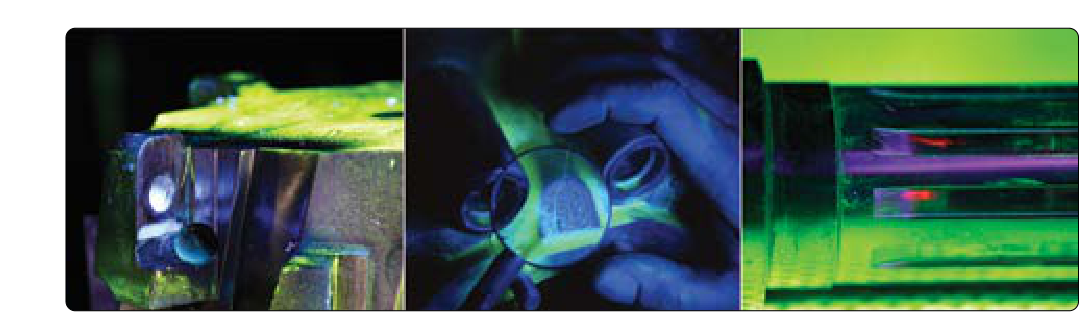
Liquid penetrant inspection (LPI) is one of the most widely used nondestructive testing (NDT) methods in aviation maintenance. It can reveal cracks, porosity, seams, laps, and other discontinuities that break the surface of a part — without harming the component in any way. Two distinct families of penetrant exist: fluorescent penetrant and visible dye penetrant (sometimes called color-contrast penetrant). Although both rely on the same fundamental principle of capillary action, they differ substantially in sensitivity, required equipment, lighting conditions, and the types of inspections for which each is FAA-appropriate. Understanding these differences is essential knowledge for any Aviation Maintenance Technician (AMT) preparing for the FAA General written exam and, more importantly, for making sound inspection decisions on the shop floor.
Both methods are governed by the principles described in the FAA Aviation Maintenance Technician Handbook — General (FAA-H-8083-30) and must be performed in accordance with the aircraft or component manufacturer's approved data, 14 CFR Part 43, and any applicable airworthiness directives. The AMT must always consult the applicable maintenance manual or inspection process specification before choosing a penetrant type.
How Liquid Penetrant Inspection Works
The underlying physics is the same for both penetrant types. A liquid with very low surface tension and high capillary action is applied to the cleaned surface of the part. Given sufficient dwell time (also called penetration time), the liquid seeps into any surface-breaking discontinuities by capillary action. After dwell time, excess penetrant is carefully removed from the surface — without drawing penetrant back out of the defects — and a developer is applied. The developer acts like a blotter: it draws residual penetrant up out of the crack and spreads it on the surface, creating an indication that is wider and more visible than the crack itself. The AMT then examines the part under appropriate lighting for those indications.
The five basic steps apply to both methods: (1) pre-cleaning, (2) penetrant application and dwell, (3) excess penetrant removal, (4) developer application, and (5) inspection and interpretation. A sixth step — post-cleaning — follows to remove developer residue, especially important on parts that will return to service.
Fluorescent Penetrant Inspection
Fluorescent penetrant contains dyes that emit visible light — typically a bright yellow-green — when excited by ultraviolet (UV-A) light, commonly called a black light. The inspection must be performed in a darkened environment so that the fluorescent indications glow brilliantly against the dark background of the part. This high contrast is the key to the method's superior sensitivity.
Because the human eye is extremely sensitive to the yellow-green glow produced against a dark background, even very small or tight discontinuities produce noticeable indications. This makes fluorescent penetrant the higher-sensitivity method of the two and the preferred choice for fracture-critical components such as turbine engine parts, landing gear, and highly stressed structural members. Industry process specifications such as ASTM E1417 and SAE AMS 2644 classify fluorescent penetrants into sensitivity levels ½, 1, 2, 3, and 4 (from lowest to ultra-high sensitivity), and aviation maintenance manuals will specify which sensitivity level is required for a given part.
The trade-off is equipment. Fluorescent penetrant inspection requires a UV-A light source of adequate intensity, a darkened inspection booth or area, and careful control of ambient white light. Common industry process specifications such as ASTM E1417 call for a minimum UV-A intensity around 1,000 microwatts per square centimeter at the inspection surface, though FAA-H-8083-30 does not itself mandate a fixed numeric value — the applicable process specification governs. Portable UV lamps exist, but the controlled environment requirement can complicate field inspections. The UV lamp itself must be checked periodically to verify adequate output, and the inspector's eyes need a short adaptation period after entering the darkened area.
Visible Dye Penetrant Inspection
Visible dye penetrant — most commonly a vivid red dye — is designed to be seen under ordinary white light, without any special lighting equipment. After development, a red indication appears against the white background of the developer coating, providing good contrast that is easy to see in a well-lit environment. Because no UV light source or darkened booth is required, visible dye penetrant inspection is far more portable and straightforward to perform in field conditions, on the flight line, or in areas where a full NDT facility is not available.
This portability comes at a cost: visible dye penetrant is less sensitive than fluorescent penetrant. The color contrast between a red indication and a white developer background is simply not as stark as the glow of fluorescent dye against a black field. As a result, very tight or shallow cracks that would fluoresce brilliantly under UV light may not produce a clear red indication. For this reason, visible penetrant is typically reserved for general-purpose inspections on less critically stressed components, or as a field screening tool, not for primary inspection of fracture-critical aviation parts where the maintenance manual specifies fluorescent penetrant.
Key Differences Side by Side
- Sensitivity: Fluorescent penetrant is significantly more sensitive. It detects smaller and tighter defects that visible dye may miss entirely.
- Lighting requirements: Fluorescent penetrant requires a UV-A black light and a darkened environment. Visible dye penetrant requires only adequate white light, with industry process specifications commonly citing a minimum illuminance around 100 foot-candles at the part surface.
- Equipment complexity: Fluorescent inspection requires a UV lamp, darkened booth, and lamp intensity verification equipment. Visible dye inspection needs only the penetrant kit — penetrant, remover, and developer — often packaged as aerosol cans.
- Contrast mechanism: Fluorescent — bright yellow-green glow on a dark background. Visible — red indication on a white developer background.
- Typical applications: Fluorescent is used on turbine blades, discs, landing gear components, and other fracture-critical or highly stressed parts. Visible dye is used for general-purpose maintenance inspections and field checks on lower-criticality parts.
- Cost and portability: Visible dye penetrant kits are inexpensive and highly portable. Fluorescent penetrant systems, especially automated lines, involve significant capital investment.
- Penetrant removal method: Both types come in water-washable, post-emulsifiable, and solvent-removable variants. The removal method affects sensitivity as well and must match the manufacturer's process specification.
Why It Matters for Aviation Safety
Choosing the wrong penetrant type is not merely a test-prep concern — it is a genuine safety issue. If a technician uses visible dye penetrant on a landing gear component that the maintenance manual requires to be inspected with a Level 3 fluorescent penetrant, a fatigue crack could go undetected and result in catastrophic failure. The FAA requires that maintenance be performed in accordance with the manufacturer's maintenance manual or other FAA-approved data (14 CFR §43.13). Substituting a less sensitive method without approved data to support it is a regulatory violation as well as a safety hazard.
Post-cleaning is equally safety-relevant. Developer residue that is not removed can trap moisture, promote corrosion, or interfere with subsequent inspections. Both penetrant types require thorough post-cleaning of the part before return to service.
Key Numbers and Rules
- UV-A light intensity: Industry process specifications such as ASTM E1417 commonly call for a minimum of around 1,000 µW/cm² at the part surface for fluorescent penetrant inspection; this is a process-spec value rather than a fixed numeric mandate found in FAA-H-8083-30, so always confirm the applicable specification.
- Darkened area: Industry process specifications commonly limit ambient white light in the inspection area to around 2 foot-candles during fluorescent inspection so that faint indications are not washed out; this figure comes from specs such as ASTM E1417 rather than a numeric FAA standard.
- White light for visible dye: Industry process specifications commonly cite a minimum of around 100 foot-candles at the inspection surface for reliable detection of red indications; this value is drawn from specs such as ASTM E1417 rather than stated as a fixed FAA number.
- Dwell time: Varies by material, penetrant type, and defect type — always specified in the maintenance manual or process specification, commonly ranging from a few minutes to 30 minutes or more for tight cracks in certain alloys.
- Regulatory authority: 14 CFR §43.13 requires maintenance be performed using methods, techniques, and practices acceptable to the FAA; for NDT, this means following the aircraft manufacturer's maintenance manual or an FAA-approved NDT process specification.
- Non-porous materials only: Both visible and fluorescent penetrant inspection are suitable only for non-porous materials. Porous materials (such as uncoated castings or ceramics) will retain penetrant throughout the surface, masking real indications.
Common Test Traps
- Confusing sensitivity ranking: Students sometimes assume that because visible dye is simpler, it must be equivalent in capability. The FAA exam exploits this — fluorescent penetrant is always the higher-sensitivity method. When a question asks which is more sensitive, the answer is fluorescent.
- Forgetting the lighting requirement: A common distractor is suggesting that fluorescent penetrant can be used in normal lighting. It cannot — indications will be invisible without UV-A light and a darkened environment.
- Pre-cleaning omission: Any contamination (oil, paint, scale, or plating) in a crack will block penetrant entry and cause a false-negative result. Pre-cleaning is not optional, and both methods require it. Questions may ask about the consequence of skipping this step.
- Mixing penetrant families: Fluorescent and visible dye penetrant materials must never be mixed. Residual fluorescent penetrant on a part can contaminate a visible dye inspection and vice versa. The exam may present a scenario about changing penetrant types without proper cleaning.
- Porous vs. non-porous: Penetrant inspection (either type) is not appropriate for porous materials. The FAA exam may present porous or coated parts and ask whether LPI is applicable — if a part is porous or has an intact paint or anodize coating covering defects, LPI is not the correct method.