Every aircraft that carries an electrical system depends on a battery as a primary or emergency power source. For the airframe technician, choosing the right battery type is only half the job — maintaining it correctly and recognizing when it is failing is equally critical. The two dominant chemistries found in certificated aircraft are lead-acid and nickel-cadmium (NiCd). Although both store and deliver electrical energy, their internal chemistry, construction, voltage behavior, maintenance demands, and failure modes differ enough that mixing up knowledge of the two can lead to costly or dangerous errors in the field.
This article covers the construction, operating characteristics, testing procedures, and real-world maintenance considerations for each battery type, grounded in FAA guidance from the Aviation Maintenance Handbook — Airframe (FAA-H-8083-31) and the Pilot's Handbook of Aeronautical Knowledge (FAA-H-8083-25). Understanding these differences is a recurring theme on the Aviation Mechanic Airframe knowledge test and is fundamental to safe electrical system maintenance.
Basic Chemistry and Construction
Lead-Acid Batteries
A lead-acid battery consists of a series of cells, each containing a positive plate made of lead dioxide (PbO₂) and a negative plate made of sponge lead (Pb), both immersed in a liquid electrolyte of sulfuric acid and distilled water. Each cell produces approximately 2.0 volts when fully charged, so a standard 12-volt aircraft battery contains six cells, and a 24-volt battery contains twelve cells. The cells are housed in hard-rubber or polypropylene cases, and the battery is typically vented to allow hydrogen and oxygen gases — produced during charging — to escape.
During discharge, both plates gradually convert toward lead sulfate and the electrolyte becomes more dilute (lower specific gravity). During charging, this process reverses. The specific gravity of the electrolyte is the primary indicator of state of charge in a lead-acid battery; a fully charged cell typically reads approximately 1.275–1.300 on a hydrometer, while a discharged cell may read as low as 1.150.
Nickel-Cadmium Batteries
A NiCd battery uses a positive plate of nickel hydroxide and a negative plate of cadmium hydroxide, with a liquid or paste electrolyte of potassium hydroxide (KOH) — an alkaline solution, as opposed to the acidic electrolyte in lead-acid cells. Each NiCd cell produces approximately 1.2 volts nominal, so a 24-volt aircraft NiCd battery typically contains 19 or 20 cells. NiCd batteries are available in both vented (flooded) and sealed configurations, though most aircraft applications use the vented type.
A critical and unique characteristic of the NiCd electrolyte is that its specific gravity does not change significantly with state of charge. This means that a hydrometer cannot be used to determine the state of charge of a NiCd battery — a fact directly tested on FAA knowledge exams. The KOH electrolyte acts primarily as an ionic conductor; the actual chemical energy is stored within the plate material itself.
Voltage Behavior During Discharge
One of the most practically important differences between these two chemistries is how their terminal voltage behaves as they discharge. A lead-acid battery experiences a gradual, measurable voltage drop as it discharges, which makes it relatively easy for a pilot or technician to estimate remaining capacity based on voltage.
A NiCd battery, by contrast, maintains a remarkably flat voltage curve throughout most of its discharge cycle — delivering close to its rated voltage right up until the point where it is nearly exhausted, at which point the voltage drops rapidly and steeply. This characteristic makes NiCd batteries excellent for applications requiring sustained voltage (such as avionics buses and engine starting), but it also means that voltage measurement alone gives little warning of impending total discharge. This is why NiCd batteries require a dedicated capacity test to determine their true state of health.
Thermal Runaway: The Critical NiCd Hazard
The most dangerous failure mode unique to NiCd batteries is thermal runaway. This condition occurs when a NiCd battery is being charged and a cell develops an internal short circuit or becomes imbalanced. As the shorted or reversed cell begins to absorb current as heat rather than chemical energy, battery temperature rises. Higher temperature causes the battery to accept even more charging current, which generates more heat — a self-reinforcing cycle. Left unchecked, thermal runaway can result in extremely high temperatures, venting of caustic electrolyte, and in severe cases fire or explosion.
Aircraft equipped with NiCd batteries are therefore required to have battery temperature monitoring systems that alert the crew if battery temperature exceeds safe limits. 14 CFR 25.1353(c) specifically addresses nickel-cadmium battery installations on transport category aircraft, requiring temperature and charging-current monitoring systems (or equivalent) to prevent thermal runaway. General aviation aircraft with NiCd batteries may use a battery temperature sensor and a warning light in the cockpit. If an in-flight battery overheat warning occurs, crew procedures typically direct disconnecting the battery from the charging bus. Lead-acid batteries can overheat as well, but the thermal runaway phenomenon is specifically and prominently associated with NiCd chemistry in FAA training materials.
Maintenance Procedures
Lead-Acid Battery Maintenance
Servicing a lead-acid battery involves several routine checks. The technician should inspect the case for cracks, corrosion, and electrolyte leakage. Electrolyte level should be checked and, if low, topped off with distilled water only — never tap water or acid. The specific gravity of each cell should be checked with a hydrometer and compared across cells; a variation of more than approximately 0.030 points between cells may indicate a weak or failing cell. Terminal connections should be cleaned and treated to prevent corrosion. Vents must be clear to prevent pressure buildup. The battery box and drain lines must also be inspected for acid corrosion damage.
Lead-acid batteries require periodic equalizing charges to bring all cells to full charge and prevent sulfation — the hardening of lead sulfate crystals on the plates, which permanently reduces capacity if allowed to progress.
Nickel-Cadmium Battery Maintenance
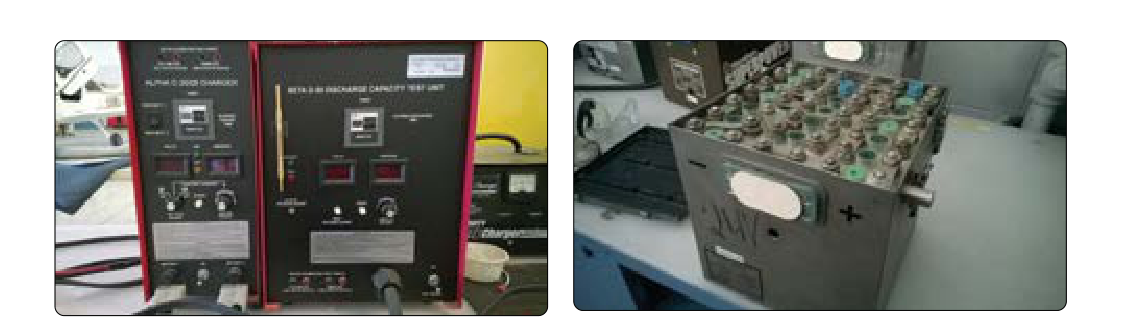
NiCd maintenance is more complex. Because specific gravity cannot indicate state of charge, technicians perform a deep-cycle capacity test at intervals specified by the manufacturer and applicable airworthiness directives. This test fully charges the battery, discharges it through a known load at a specified rate, and measures the time until terminal voltage drops to a cutoff threshold. The capacity (in ampere-hours) is then calculated and compared to the battery's rated capacity; many operators use approximately 80% of rated capacity as a common benchmark for requiring replacement or further service, though the applicable threshold is ultimately set by the manufacturer's maintenance manual and any applicable airworthiness directive rather than a single FAA-mandated figure.
The electrolyte (KOH) is caustic and requires careful handling — technicians must use appropriate personal protective equipment including gloves and eye protection. Electrolyte contamination between a NiCd battery and a lead-acid battery's electrolyte (or vice versa) will destroy both batteries and must be scrupulously prevented. Battery compartments, tools, and chargers must be dedicated to one chemistry or the other. Over time, NiCd cells can develop the so-called memory effect, where repeated shallow discharge-charge cycles cause a slight reduction in effective capacity; full deep cycling is the recommended remedy.
Charging Equipment Compatibility
Lead-acid and NiCd batteries require different chargers and different charging voltage profiles. A charger designed for lead-acid batteries will typically apply a constant voltage that is inappropriate for NiCd cells and can cause overcharging. Using the wrong charger is a maintenance error with potentially serious consequences, including thermal runaway in a NiCd battery or damage to a lead-acid battery. Always verify charger compatibility before connecting any aircraft battery to a charger, and follow the battery manufacturer's approved maintenance manual instructions.
Key Numbers and Rules
- Lead-acid cell voltage: approximately 2.0 V per cell; 12 V battery = 6 cells, 24 V battery = 12 cells.
- NiCd cell voltage: approximately 1.2 V per cell; 24 V battery typically = 19–20 cells.
- Lead-acid state of charge: measured by electrolyte specific gravity (hydrometer); fully charged ≈ 1.275–1.300.
- NiCd state of charge: cannot be measured by specific gravity — electrolyte gravity is essentially constant.
- NiCd capacity test: replace or service when capacity falls below approximately 80% of rated ampere-hour capacity (per manufacturer maintenance manual).
- Thermal runaway: hazard unique to NiCd batteries; requires temperature monitoring on aircraft so equipped (14 CFR 25.1353(c)).
- Electrolyte types: lead-acid uses sulfuric acid (acidic); NiCd uses potassium hydroxide (alkaline/caustic) — never mix tools, containers, or chargers.
- Top-off fluid: lead-acid uses distilled water only; NiCd electrolyte is replenished per manufacturer's instructions using KOH solution.
Common Test Traps
- Using a hydrometer on a NiCd battery: The FAA knowledge test frequently tests this. A hydrometer measures specific gravity and is valid for lead-acid batteries, but is useless for determining state of charge of a NiCd battery. The correct method for NiCd is a capacity (discharge) test.
- Confusing cell voltages: Students mix up the 2.0 V/cell (lead-acid) and 1.2 V/cell (NiCd) figures, then calculate the wrong number of cells for a given system voltage — a common calculation-type question.
- Thermal runaway attribution: Thermal runaway is specifically a NiCd hazard. Test questions may try to attribute it to lead-acid batteries or describe it as a normal overcharge condition rather than a potentially catastrophic event.
- Electrolyte top-off with wrong fluid: Adding acid to a low lead-acid battery (instead of distilled water) or using the wrong electrolyte in a NiCd battery are classic distractor answer choices. Always top off lead-acid with distilled water only.
- Charger interchangeability: A common misconception is that any constant-voltage charger works for either battery type. NiCd and lead-acid batteries require chemistry-specific chargers; using the wrong one can cause failure or fire.