Aircraft airframes endure millions of small, repetitive movements every flight. Fastener holes flex, mating surfaces rub microscopically against each other, and different metals share the same joint—all of which create conditions ripe for two of the most insidious forms of corrosion an aviation maintenance technician will encounter: fretting corrosion and galvanic (dissimilar metal) corrosion. Neither announces itself loudly. Both can progress hidden beneath paint, sealant, or fastener heads until significant structural damage has occurred. Understanding why these forms of corrosion happen, how to find them, and how to stop them is a core competency for any AMT working on sheet metal and bonded structures.
This article covers the mechanisms behind each type, the specific airframe locations where they lurk, the materials and techniques used to control them, and the testable facts the FAA expects you to know for the AMT Airframe knowledge test and practical exam.
Fretting Corrosion: The Mechanics of Motion
Fretting corrosion is caused by small-amplitude relative motion—often called micromotion or microslip—between two contacting surfaces that are nominally clamped together. In an airframe, this happens wherever two structural members are fastened but not welded: lap joints, butt joints, rib-to-skin attachments, and anywhere a fastener passes through stacked sheets.
During each flight, aerodynamic loads and vibration cause the mating surfaces to slide against each other by just a few micrometers. That tiny motion is enough to:
- Break through the thin oxide layer that normally protects aluminum, titanium, or steel.
- Generate fine metallic debris (wear particles) at the interface.
- Expose fresh metal to oxygen, which immediately re-oxidizes, producing more abrasive oxide particles.
- Create a self-accelerating cycle of wear and re-oxidation that is far more aggressive than either wear or oxidation alone.
The visible result is a reddish-brown or grayish powdery deposit at the joint interface—often called cocoa because of its color and fine texture when the joint is opened. On aluminum structures, the debris is typically described as a grayish-black or dark powder, though FAA references do not rigidly define fretting debris color for every alloy. On steel components, it looks like fine rust. Either way, the underlying metal surface shows characteristic shallow pitting and surface roughening.
Locations Most Vulnerable to Fretting
Any fastened joint that sees cyclic loading is a candidate, but the highest-risk locations include: lap splices in the fuselage skin, wing spar attach fittings, control surface hinge brackets, engine mount attach points, and landing gear trunnion interfaces. Inspection of these areas during scheduled maintenance should always include opening suspect joints when the surface condition, paint cracking, or sealant disbonding suggests micromotion has occurred.
Dissimilar Metal (Galvanic) Corrosion: The Electrochemical Story
Galvanic corrosion occurs when two metals with different electrochemical potentials are in electrical contact in the presence of an electrolyte—typically moisture with dissolved salts or other ions. The more active (anodic) metal gives up electrons to the less active (cathodic) metal, and the anodic metal corrodes preferentially.
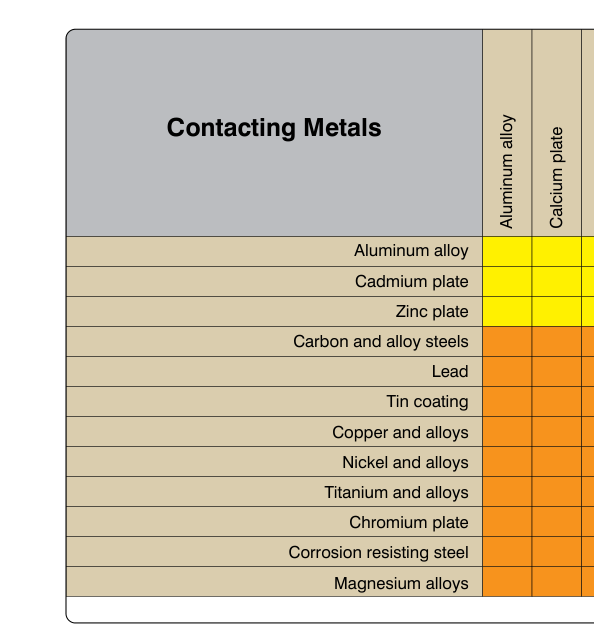
The FAA handbooks use the concept of the galvanic series to describe the relative activity of metals in a seawater or moist-air environment. Metals far apart on this series create a large potential difference and therefore a more aggressive galvanic cell. Key pairings that an AMT encounters regularly include:
- Aluminum alloy and steel (or stainless steel): Steel is significantly more noble than aluminum. If steel fasteners are used in aluminum sheet without proper insulation, the aluminum corrodes rapidly around the fastener hole.
- Aluminum and copper (or copper alloys like brass): Copper is very noble; aluminum is very active. This combination is highly corrosive to the aluminum.
- Magnesium and virtually anything else: Magnesium is the most active structural metal commonly used in aviation. It will corrode aggressively when in contact with aluminum, steel, or any more noble metal.
- Carbon fiber composite and aluminum: Carbon fiber acts as a very noble cathodic material in a galvanic couple. When aluminum structure is bonded or fastened directly to carbon composite without isolation, the aluminum corrodes. This is a growing concern as composite use in airframes expands.
The electrolyte is the critical third ingredient. A perfectly dry joint between dissimilar metals will not corrode galvanically. This is why eliminating moisture paths is just as important as choosing compatible materials.
Prevention and Control Techniques
The AMT's job is not just to recognize corrosion but to prevent its recurrence during repair and reassembly. FAA maintenance handbooks and manufacturer structural repair manuals (SRMs) specify a layered approach:
Material Compatibility Selection
Where possible, use the same alloy for fasteners and structure, or choose fasteners from a compatible alloy group. Anodized aluminum, cadmium-plated steel, or titanium fasteners are commonly used in aluminum structure because cadmium and titanium sit close enough to aluminum in the galvanic series to minimize the potential difference. Bare steel or stainless steel fasteners should never be installed in aluminum structure without adequate surface treatment and sealant.
Surface Treatments and Primers
Bare aluminum should be treated with a chemical conversion coating (such as alodine/chromate conversion coating) before priming. This coating improves adhesion and provides mild sacrificial corrosion protection. A zinc chromate or epoxy primer over the treated surface further isolates the metals. Always follow the specific SRM or manufacturer guidance, because the approved primer and sealant systems are part of the type design.
Wet Installation of Fasteners
One of the most effective techniques for controlling both fretting and galvanic corrosion is wet installation: applying a corrosion-inhibiting compound or sealant to the fastener shank and head before driving it into the hole. This fills the interface gap, excludes moisture and oxygen, and provides a lubricating film that reduces the micromotion that causes fretting. Polysulfide sealants and zinc chromate paste are traditional materials; many modern aircraft use aerospace-grade epoxy sealants.
Isolation of Dissimilar Metals
When dissimilar metals cannot be avoided, physical isolation breaks the electrical circuit. Approved isolation methods include:
- Zinc chromate tape or fiberglass cloth between faying surfaces
- Nylon or plastic bushings in fastener holes to prevent metal-to-metal contact
- Full encapsulation with approved sealant at all edges and fastener heads
- Anodized or otherwise coated fasteners that interrupt galvanic continuity
For carbon composite-to-aluminum joints, many manufacturers specify a layer of fiberglass fabric co-cured or bonded at the interface, combined with titanium or coated steel fasteners, to interrupt the galvanic cell while maintaining structural integrity.
Detection and Inspection
Early detection depends on thorough visual inspection combined with non-destructive testing (NDT) methods where joints cannot be opened. Signs that suggest fretting or galvanic activity include: paint bubbling or cracking at joint edges, white or reddish-brown staining bleeding from under fastener heads, sealant disbonding at faying surfaces, and corrosion products visible at drain holes or weep holes near joints.
When a joint is opened during maintenance, the technician should look for the telltale powdery fretting debris, pitting of the faying surfaces, and galvanic attack concentrated around fastener holes. Any pitting must be measured for depth and compared against allowable damage limits in the SRM. If pitting exceeds the allowable limit, a structural engineer must be consulted before the aircraft is returned to service.
Eddy-current inspection is particularly useful for detecting subsurface cracking that can initiate from fretting pits in fatigue-sensitive locations such as lap joints. Fluorescent penetrant inspection can reveal surface-connected cracks after fretting damage has been cleaned away.
Key Numbers and Rules
- FAA handbooks describe the galvanic series qualitatively; metals positioned farther apart on the series create a larger potential difference and are generally considered less compatible for direct contact in aviation structures without isolation, though no fixed voltage threshold is specified.
- Wet installation is a widely used and recommended practice, and many manufacturer SRMs call for it when steel, stainless, or titanium fasteners are used in aluminum or magnesium structure, but the specific requirement depends on the applicable SRM or type design rather than a blanket FAA rule.
- Fretting damage pits must be blended smooth to remove stress concentrations before measuring for depth allowables.
- Chemical conversion coating (alodine) is standard recommended corrosion protection practice for bare aluminum surfaces exposed during repair, applied before priming and reassembly per the applicable SRM or maintenance manual.
- Magnesium components require the most aggressive isolation—no direct contact with any other structural metal is acceptable without a full barrier system.
- Carbon fiber composite behaves as a noble, cathodic material for galvanic compatibility purposes, even though it is not itself a metal; aluminum in contact with it is the anode and will corrode.
Common Test Traps
- Fretting vs. wear: Test questions may describe a powdery deposit at a fastened joint and ask you to identify the type of corrosion. Remember that fretting requires micromotion—it is not simple wear, and it is not surface or pitting corrosion. The key identifiers are the location (at a clamped interface), the debris (fine powder), and the surface condition (pitting with a polished or smeared appearance).
- Galvanic corrosion requires an electrolyte: A common distractor says galvanic corrosion happens whenever two dissimilar metals touch. This is false—moisture must be present to complete the electrochemical cell. However, in practice, moisture is almost always assumed to be present in service, so the practical rule is still to isolate dissimilar metals.
- Carbon fiber is cathodic: Many students assume composite is inert. For galvanic purposes, carbon fiber composite behaves as a highly noble, cathodic material and will drive aggressive corrosion of adjacent aluminum if not properly isolated.
- Cadmium-plated fasteners in aluminum: Cadmium is close to aluminum in the galvanic series, making it a compatible choice. Do not confuse cadmium-plated with bare steel or stainless, which are far more noble and incompatible without isolation.
- Fretting is not fatigue—but it causes it: Fretting itself is a corrosion/wear mechanism, but the pits it creates are stress risers that initiate fatigue cracks. The FAA knowledge test may ask you to identify fretting as a fatigue crack initiator in lap joints—this is a correct and important relationship.