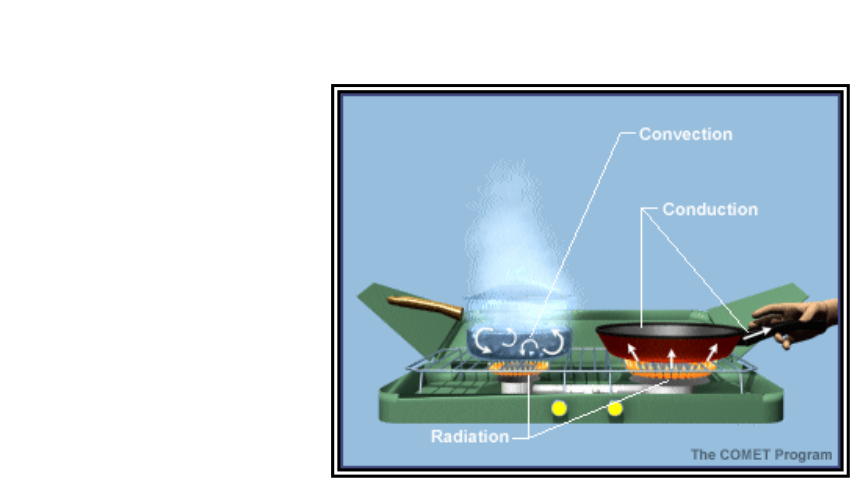
Every aircraft system that generates or absorbs energy eventually has to deal with heat. Engines, brakes, avionics, hydraulic systems, and even the airframe itself are constantly exchanging thermal energy with their surroundings. For an Aviation Maintenance Technician (AMT), understanding how heat moves is not an academic exercise — it directly shapes how you inspect cooling fins, route cooling air, select materials, and troubleshoot overheating components. The three fundamental mechanisms of heat transfer are conduction, convection, and radiation. Each works through a different physical process, and in most aircraft applications all three operate simultaneously.
This article explores each mechanism in depth, ties the concepts to real aircraft systems, and highlights the key numbers and principles that appear on FAA AMT knowledge tests.
What Heat Transfer Actually Means
Heat is thermal energy in transit — it always flows from a region of higher temperature to lower temperature, never the reverse. The rate at which it flows depends on the temperature difference (called the thermal gradient), the properties of the materials involved, and the geometry of the system. Technicians encounter this constantly: a cylinder head running too hot, an avionics bay with inadequate ventilation, or brake assemblies glowing after a rejected takeoff. Knowing which transfer mechanism dominates in each situation tells you where to look for the fix.
Conduction: Heat Through Direct Contact
Conduction is the transfer of heat through a solid material — or between two solids in direct physical contact — without any movement of the material itself. At the atomic level, energetic (hot) atoms vibrate more vigorously and pass that kinetic energy to adjacent, cooler atoms through molecular collisions. The process continues until the temperatures equalize.
The governing relationship is Fourier's Law: the rate of heat flow is proportional to the thermal conductivity of the material, the cross-sectional area available for heat flow, and the temperature gradient across the material. In practical terms: thicker material slows conduction; higher conductivity speeds it up.
Thermal Conductivity in Aircraft Materials
Different materials conduct heat at vastly different rates. Metals are generally excellent conductors because their free electrons carry energy efficiently. Copper has very high conductivity, which is why it dominates electrical wiring and heat-sink applications. Aluminum alloys — the backbone of most airframes — conduct heat well; pure aluminum's conductivity is roughly half that of copper, though common aircraft aluminum alloys (such as 2024 and 7075) run somewhat lower than pure aluminum depending on alloy and temper, and all are far better conductors than steel. This is one reason aluminum is used for cylinder cooling fins: fins increase surface area so that heat conducted outward from the hot cylinder barrel can be handed off quickly to cooling air. Steel conducts heat more slowly than aluminum, which is why steel exhaust stacks must be carefully designed for heat rejection. Titanium, increasingly common in high-temperature airframe structures, has relatively low thermal conductivity for a metal, which is an asset when you want to limit heat migration into adjacent structure.
Non-metallic materials — rubber, fiberglass, certain plastics, and thermal barrier coatings — are poor conductors (good insulators). Engine compartment firewalls exploit this: a stainless-steel or titanium sheet backed with an insulating blanket limits conduction of engine heat into the cockpit. When you inspect a firewall for condition, you are, among other things, verifying the integrity of a critical conduction barrier.
A key maintenance implication: any gap, air void, or contamination at a metal-to-metal interface dramatically increases thermal resistance. This is why proper torque on cylinder hold-down studs, correct installation of heat-sink compounds on avionics components, and undamaged mating surfaces on heat exchangers all matter. An air gap only a few thousandths of an inch thick can insulate like a significant thickness of metal.
Convection: Heat Carried by Fluid Motion
Convection transfers heat by the bulk movement of a fluid — either a gas (such as air) or a liquid (such as oil or coolant). The fluid physically carries thermal energy from one place to another. Convection comes in two forms that an AMT must distinguish:
- Natural (free) convection occurs when fluid motion is driven purely by buoyancy. Hot fluid expands, becomes less dense, and rises; cooler, denser fluid flows in to replace it. This is the mechanism at work inside an unpowered avionics bay or inside an engine nacelle after shutdown — the famous heat soak condition. Natural convection is relatively slow and gentle.
- Forced convection occurs when a pump, fan, blower, or the aircraft's own forward motion forces fluid over a heated surface. Forced convection transfers heat far more efficiently than natural convection and is the dominant mechanism in most aircraft cooling systems.
Engine Cooling Systems
Air-cooled reciprocating engines rely almost entirely on forced convection. Ram air enters the cowling inlet, is directed by baffles to flow tightly around the cylinder fins, absorbs heat conducted outward through the fins, and exits through cowl flaps at the bottom of the nacelle. The baffles are critical: if they are cracked, missing, or improperly sealed, air bypasses the cylinders and cooling effectiveness drops sharply. Cowl flap position directly controls the volume and velocity of cooling airflow — opening them increases convective heat removal during climbs when engine power and heat production are high and forward airspeed (and thus ram air pressure) is relatively low.
Liquid-cooled reciprocating engines, found on some light aircraft, circulate coolant (typically a water/glycol mixture) through passages around the cylinders, carrying heat by forced convection to a radiator where it is then transferred to outside air. Oil cooling systems in both reciprocating and turbine engines work identically in principle: the oil pump forces oil through an oil cooler (a small heat exchanger) where forced convection removes heat into airflow. Turbine engines, by contrast, do not use a water/glycol liquid coolant loop; internal cooling is accomplished with bleed air and oil systems.
Turbine engines use compressor bleed air — routed through internal passages in turbine blades and vanes — to cool components that would otherwise melt in the gas stream. This is forced convective cooling taken to an extreme engineering level.
Convection and Avionics
Modern avionics generate substantial heat in compact enclosures. Many units rely on forced convective cooling from internal fans or from avionics bay blower systems. When an avionics cooling fan fails, the unit may overheat and shut down or suffer accelerated component aging. During inspection, confirming that cooling fans are operative and that air pathways are unobstructed is a direct application of convective heat-transfer principles.
Radiation: Heat Through Electromagnetic Waves
Radiation transfers heat as electromagnetic energy — primarily in the infrared spectrum — without requiring any intervening medium. Unlike conduction and convection, radiation can travel through a vacuum. Every object above absolute zero emits thermal radiation; hotter objects emit far more than cooler ones (the relationship follows the Stefan-Boltzmann Law, where radiated power scales with the fourth power of absolute temperature).
In aircraft, radiation is most significant where temperatures are extremely high. The exhaust system of a reciprocating engine radiates substantial infrared energy outward; this is why the area around exhaust stacks must be free of flammable materials and why exhaust system inspections check for proximity to fuel lines, wiring, and control cables. Turbine engine tailpipes and thrust reversers glow visibly during high-power operation — a direct demonstration of thermal radiation.
The color and surface finish of a material strongly influence how much radiation it absorbs and emits. Dark, matte surfaces are near-perfect absorbers and emitters (called blackbodies). Bright, polished surfaces reflect radiation rather than absorb it. This is why exhaust heat shields and firewall blankets are often coated with reflective foil on the engine-facing side — the foil reflects radiant heat back rather than absorbing it, limiting temperature rise in adjacent structure. Conversely, an oil cooler or avionics heat sink painted flat black radiates heat away more efficiently than a bare metal surface.
Why All Three Mechanisms Work Together
In real aircraft systems, conduction, convection, and radiation operate simultaneously. Consider a cylinder on a running engine: combustion gases heat the cylinder walls by conduction and convection from the hot gas; heat then conducts outward through the metal to the fins; forced convection carries heat from the fins into cooling airflow; and the hot exhaust pipe simultaneously radiates heat to nearby structures. A technician diagnosing an engine overheat must think through all three pathways to find the bottleneck.
Key Numbers and Rules
- Heat always flows from hotter to cooler — the second law of thermodynamics. No exceptions.
- Aluminum conducts heat roughly three to four times as well as common steels (the exact ratio depends on alloy and steel grade) and is therefore preferred for cooling fins.
- Radiation intensity scales with the fourth power of absolute temperature — small temperature increases cause large increases in radiated heat at high temperatures (critical for turbine exhaust components).
- Forced convection is far more effective than natural convection; baffling integrity directly controls forced convective cooling in air-cooled engines.
- Air gaps and voids at contact interfaces act as thermal insulators, reducing conductive heat transfer — critical when reassembling heat-dissipating components.
- Surface finish matters for radiation: dark/matte surfaces absorb and emit more radiant heat; bright/polished surfaces reflect it.
Common Test Traps
- Confusing conduction with convection: Conduction requires no fluid movement — it is atom-to-atom energy transfer through a solid. Convection requires bulk fluid motion. Test questions sometimes describe a scenario and ask which mechanism applies; focus on whether material is moving.
- Assuming radiation requires a medium: It does not. Radiation is the only heat-transfer mechanism that works through a vacuum. Conduction and convection both require matter.
- Forgetting that surface finish affects radiation: A polished metal surface is a poor radiator and a poor absorber. Test questions may ask why a heat shield uses a reflective surface — the answer is to reflect radiant energy, not to conduct or convect it away.
- Underestimating baffle condition: Test scenarios about engine overheating commonly involve damaged or missing baffles. The correct diagnosis is reduced forced convective cooling, not a conduction or radiation problem.
- Mixing up natural and forced convection: Natural convection is buoyancy-driven and relatively weak; forced convection uses mechanical means and is far more efficient. Questions about post-shutdown heat soak (engine hot after shutdown) involve natural convection, not forced.