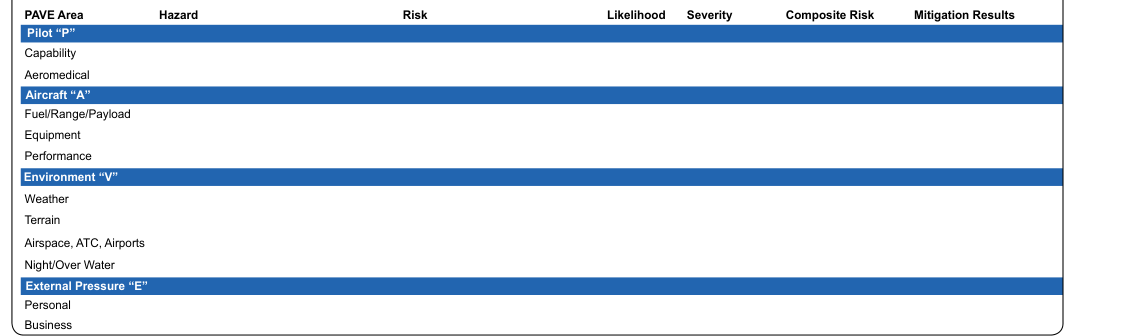
Every flight involves risk. The FAA's position, stated clearly in the Risk Management Handbook (FAA-H-8083-2), is not that risk can be eliminated, but that it can be systematically identified, evaluated, and controlled. The PAVE checklist is one of the primary structured tools the FAA gives pilots and flight instructors to do exactly that. PAVE is an acronym standing for Pilot in command, Aircraft, enVironment, and External pressures. Working through each category honestly — on the ground, before the engine starts — transforms an abstract sense of unease about a flight into a concrete, actionable picture of where the real hazards lie and what to do about them. For instructors operating under the Flight Instructor Airplane (FIA) or Certified Flight Instructor Instrument (CFII) Airplane and Instrument Rating Airman Certification Standards (ACS), teaching PAVE is both a tested knowledge item and a core instructional responsibility.
The PAVE Framework and the ADM Chain
PAVE sits inside the broader Aeronautical Decision-Making (ADM) framework described throughout FAA-H-8083-2 and reinforced in the Pilot's Handbook of Aeronautical Knowledge (FAA-H-8083-25). ADM research and general aviation accident data consistently show that most fatal accidents involve a chain of individually survivable errors rather than a single catastrophic failure. PAVE is designed to interrupt that chain at the preflight stage — when the pilot has the most time, the most options, and the least psychological pressure to continue.
The checklist also connects directly to the concept of personal minimums. The FAA strongly encourages every pilot to establish in advance, in writing, specific go/no-go thresholds for each PAVE category — not during the preflight when self-imposed pressure is already building, but days or weeks earlier when judgment is calm and unconflicted. Personal minimums should always be more conservative than the regulatory minimums found in 14 CFR, especially for low-time pilots or those returning from a long break from flying.
Breaking Down Each PAVE Category
P — Pilot in Command
The Pilot category asks the most personal and sometimes uncomfortable question: Am I actually fit to fly this flight today? Being legally certificated is only the starting point. The pilot must also be current — within the recent flight experience requirements of 14 CFR Part 61 — and personally fit. Physical health, fatigue, emotional state, stress load, and experience level relative to the planned flight are all relevant.
The FAA pairs PAVE's Pilot category with the IMSAFE personal checklist: Illness, Medication, Stress, Alcohol, Fatigue, Emotion and Eating. IMSAFE is a self-assessment drill that lives inside the P element — it is not a separate system but a deeper probe of that single category. For example, a pilot might pass a medical examination but still fail IMSAFE on a given day due to an over-the-counter antihistamine, a poor night's sleep, or news of a family crisis. Legal currency does not equal personal readiness.
Instructors should note that experience relative to the specific flight is part of this category, not just total hours. A 500-hour pilot with zero mountain flying experience evaluating a high-density-altitude canyon route must weigh that gap honestly under the P category.
A — Aircraft
The Aircraft category examines whether the airplane itself is legally airworthy, properly equipped, and performance-adequate for the planned operation. Airworthiness requires that all required inspections be current — the annual under 14 CFR 91.409, the 100-hour if operated for hire under 91.409(b), the ELT battery under 91.207, the transponder under 91.413, and the pitot-static system under 91.411 for IFR. The aircraft must also carry the documents summarized in the AROW acronym: Airworthiness certificate, Registration, Operating limitations (POH/AFM), and Weight-and-balance data.
Beyond paperwork, the pilot must ask whether the aircraft's performance — climb rate, service ceiling, range, payload — is adequate for the specific route, weather, and load planned for that day. An airplane may be airworthy in a legal sense yet poorly suited for a high-elevation airport on a hot afternoon. Weight-and-balance computations are mandatory, not optional, and an out-of-CG condition can make an otherwise serviceable aircraft dangerous regardless of every other PAVE category being green.
V — enVironment
The enVironment category is intentionally broad: it captures every external condition that is not the airplane and not the pilot. Weather is the most obvious element — ceiling, visibility, winds, turbulence, icing potential, and convective activity all belong here. But the FAA's framing of enVironment extends further to include terrain and obstacle clearance, airspace structure and any temporary flight restrictions, NOTAMs affecting departure, en route, or destination airports, runway conditions (contamination, length, surface type), and even lighting conditions such as night versus day or sun angle on approach.
A key instructional point: conditions that exist at departure may be far different from conditions en route or at the destination. The enVironment evaluation is not a snapshot of the ramp; it is a dynamic assessment across the entire planned flight including alternates. This is why a thorough weather briefing from an FAA-approved source — obtained far enough in advance to allow genuine go/no-go decision-making — is inseparable from a complete V-category evaluation.
E — External Pressures
External pressures is consistently cited in FAA-H-8083-2 as the most underestimated and most dangerous PAVE category. External pressures are the psychological and social forces acting on the pilot to fly even when the other three categories are signaling caution or a clear no-go. Common examples include passengers at the destination waiting for a ride, a business commitment that cannot be rescheduled, the perceived cost of a hotel delay, or simply the social awkwardness of announcing a cancellation in front of friends or family.
The FAA calls this cluster of pressures self-imposed stress and links it to the hazardous attitude known as invulnerability — the false belief that bad outcomes happen to other pilots. Instructors must explicitly name and discuss external pressures in training because students rarely volunteer concerns in that category. A student will often identify a weather concern unprompted; the same student rarely admits that they felt pressured to continue a questionable cross-country because a parent was waiting at the arrival airport. Building a classroom culture where naming external pressure is normalized — and where canceling due to external pressure is applauded rather than embarrassed — is one of the most lasting contributions an instructor can make.
Applying PAVE: A Preflight Workflow
Effective PAVE use is not a mental checklist completed in thirty seconds. A thorough preflight risk assessment might look like this: The pilot reviews weather the evening before and flags a developing low. In the morning, a fresh briefing reveals improving ceilings but gusty crosswinds at the destination that are near the aircraft's demonstrated crosswind component. The pilot notes this under V. Checking the A category, the pilot confirms maintenance is current but realizes the alternator squawk from the last flight was deferred — that becomes an airworthiness question to resolve before departure. Under P, the pilot ran IMSAFE and identified two nights of poor sleep (F). Under E, the pilot honestly acknowledges that a friend in the right seat has never seen the pilot cancel a flight. Any one of these items might be manageable; the combination is what PAVE reveals. The appropriate response — delay, divert, or cancel — is now a rational data-driven decision rather than a gut call made under social pressure.
Why Flight Instructors Must Teach PAVE Explicitly
The Flight Instructor ACS requires applicants to demonstrate understanding of risk management and the ability to teach ADM tools including PAVE. But the instructional obligation goes beyond the test. Research reviewed in FAA-H-8083-2 shows that risk management behaviors modeled by instructors during dual flight are far more durable than risk management behaviors taught only in ground school. When a CFI openly runs through PAVE during a preflight briefing — naming each category, quantifying the concern, and stating a rationale for the decision — the student internalizes that process as normal professional behavior. When a CFI skips it or treats it as a knowledge-test formality, the student learns the same lesson: that real pilots don't actually use these tools.
Key Rules and Numbers to Know
- PAVE categories: Pilot in command, Aircraft, enVironment, External pressures — in that order.
- IMSAFE (Illness, Medication, Stress, Alcohol, Fatigue, Emotion/Eating) expands the P category only.
- 14 CFR 91.409 governs annual and 100-hour inspection currency (A category).
- 14 CFR 91.413 and 91.411 govern transponder and pitot-static certification for IFR (A category).
- Personal minimums should exceed regulatory minimums and be established before scheduling the flight, not during preflight.
- External pressures belong under E, not V — a common knowledge-test trap.
Common Test Traps
- Confusing E and V: ATC delays, weather, and terrain are enVironment. Schedule pressure, passenger expectations, and fear of appearing indecisive are External pressures. These two categories are frequently swapped on knowledge tests.
- Treating IMSAFE as a separate checklist from PAVE: IMSAFE is a sub-tool that deepens the P category of PAVE. They are nested, not parallel.
- Assuming all four green means no risk: PAVE identifies and helps manage risk — it does not eliminate it. A flight can proceed with elevated risk if it is within the pilot's personal minimums and properly mitigated, but no flight is zero-risk.
- Applying PAVE only to instrument or commercial operations: The FAA introduces PAVE as a foundational ADM tool for student pilots. It applies at every certificate level and in every operating environment.
- Treating personal minimums as fixed for life: Personal minimums should be reviewed and updated as pilot experience and recency change — they are a living document, not a one-time calculation.
Memory Aid
Think of PAVE as literally paving a safe path before you fly. Each letter lays one layer: the pilot's fitness, the airplane's readiness, the environment's demands, and the pressures working against your judgment. A path with one bad layer is still a bad road.