Continued VFR flight into instrument meteorological conditions (IMC) remains one of the deadliest and most preventable accident chains in general aviation. The FAA's Risk Management Handbook (FAA-H-8083-2) treats it as a textbook case of failed aeronautical decision-making (ADM), where incremental misjudgments compound into a catastrophic outcome. For flight and ground instructors, no safety topic demands more deliberate, scenario-based teaching. Understanding the specific risk factors—cognitive, environmental, physiological, and operational—gives instructors the vocabulary and the framework to interrupt that accident chain before a student ever faces it alone.
The classic sequence unfolds with painful consistency: a VFR-only pilot departs or continues despite marginal forecasts, visibility and ceiling erode gradually, the pilot presses onward rather than turning back, and the flight ends in spatial disorientation, controlled flight into terrain, or impact with an obstruction obscured by cloud. What makes this scenario so insidious is not ignorance but incrementalism—each mile deeper into deteriorating weather feels only marginally worse than the mile before, until a safe return is no longer possible.
The Cognitive Trap: Hazardous Attitudes and Get-There-Itis
The FAA's Risk Management Handbook and the Airplane Flying Handbook (FAA-H-8083-3) both identify hazardous attitudes as the psychological engine driving continued VFR into IMC. The five hazardous attitudes—anti-authority, impulsivity, invulnerability, macho, and resignation—each have a specific antidote, and instructors should be able to teach both halves of each pair. In continued VFR into IMC scenarios, the attitudes most frequently at work are:
- Invulnerability: "It won't happen to me." A pilot who has flown through marginal conditions once or twice without incident builds false confidence that the outcome will always be survivable. The antidote is the honest recognition that accidents happen to experienced pilots too.
- Get-there-itis (pressing on): While not listed as a standalone hazardous attitude, the FAA explicitly identifies get-there-itis as a powerful motivational force that combines elements of macho behavior, invulnerability, and resignation into a single compelling urge to reach the destination regardless of conditions.
- Resignation: "What's the point of turning back now?" Once a pilot has descended below a cloud layer or entered reduced visibility, resignation can take over—the mistaken belief that the situation is now out of their hands and they must simply fly through it.
Teaching students to name the attitude they are experiencing—out loud, if necessary—is one of the most effective interventions the FAA endorses. The act of labeling "I am feeling invulnerable right now" creates cognitive distance between the feeling and the action, interrupting the automatic decision to press on.
Environmental Risk Factors
Terrain and Geography
Flat, open terrain is forgiving of poor weather judgment in ways that mountains, coastal ranges, and river valleys simply are not. Rising terrain combined with lowering ceilings creates a physical trap: the pilot's altitude above the ground decreases even while they maintain a constant indicated altitude, and escape routes close off faster than situational awareness keeps up. The Aviation Weather Handbook (FAA-H-8083-28) explains how orographic lift forces moist air upward, dropping ceilings and reducing visibility rapidly on the windward side of ridges—a hazard that can develop within minutes and long before an ASOS or AWOS sensor at a nearby airport reflects it.
Night Operations
Night flight removes the incremental visual cues that daylight provides. In daytime, a pilot can typically see cloud layers approaching from ahead, observe how the horizon is becoming indistinct, and note that ground features are becoming harder to identify. At night, the first indication of IMC may be a sudden loss of all visual reference—the transition from VMC to IMC happens without warning. The Instrument Flying Handbook (FAA-H-8083-15) notes that spatial disorientation onset is rapid and incapacitating for a pilot without instrument proficiency, and the Risk Management Handbook identifies night VFR over areas without cultural lighting as a scenario with particularly high risk for inadvertent IMC entry.
Fog, Haze, and Precipitation
Radiation fog, advection fog, and upslope fog all share a critical characteristic for the VFR pilot: they can form faster than a flight can be safely concluded. Visibility in fog can drop from 3 miles to near zero in less than 30 minutes. Haze presents a different trap—slant-range visibility in haze may appear adequate when looking horizontally, but the actual forward visibility at cruise altitude can be far below VFR minimums. Pilots frequently misjudge haze visibility because they compare it to looking upward (where visibility appears better) rather than forward along the flight path.
Pilot-Specific Risk Factors
Experience and Currency
Low-time pilots—particularly those with fewer than 100 hours total time—are statistically overrepresented in continued VFR into IMC accidents. However, experience alone is not protective; a 500-hour pilot who has never flown in marginal VFR has no experiential baseline for how quickly conditions can deteriorate. Currency in actual or simulated IMC gives instrument-rated pilots a physiological and procedural reference point that non-instrument-rated pilots completely lack. The Risk Management Handbook stresses that a pilot's honest self-assessment of their own limitations—part of the PAVE checklist's "Pilot" component—is the first line of defense.
Absence of Personal Minimums
Basic VFR weather minimums for controlled airspace (Class B, C, D, and E) at or below 10,000 feet MSL require 3 statute miles visibility and specific cloud clearances (500 feet below, 1,000 feet above, and 2,000 feet horizontal from clouds) under 14 CFR 91.155—there is no single flat "1,000-foot ceiling" rule, but these values represent a legal floor, not an operational safety standard. The FAA explicitly encourages pilots to establish personal minimums that are more conservative than the regulatory baseline, particularly for night flight, flight over mountainous terrain, and flight in unfamiliar areas. A pilot without a pre-established personal minimums plan is forced to make a go/no-go judgment at the worst possible moment—when they are already emotionally invested in the flight, when time pressure is highest, and when fatigue may be a factor. Advisory Circular 60-22 addresses aeronautical decision-making and reinforces the value of pre-trip risk assessment as a structured habit.
External Pressures and the PAVE Framework
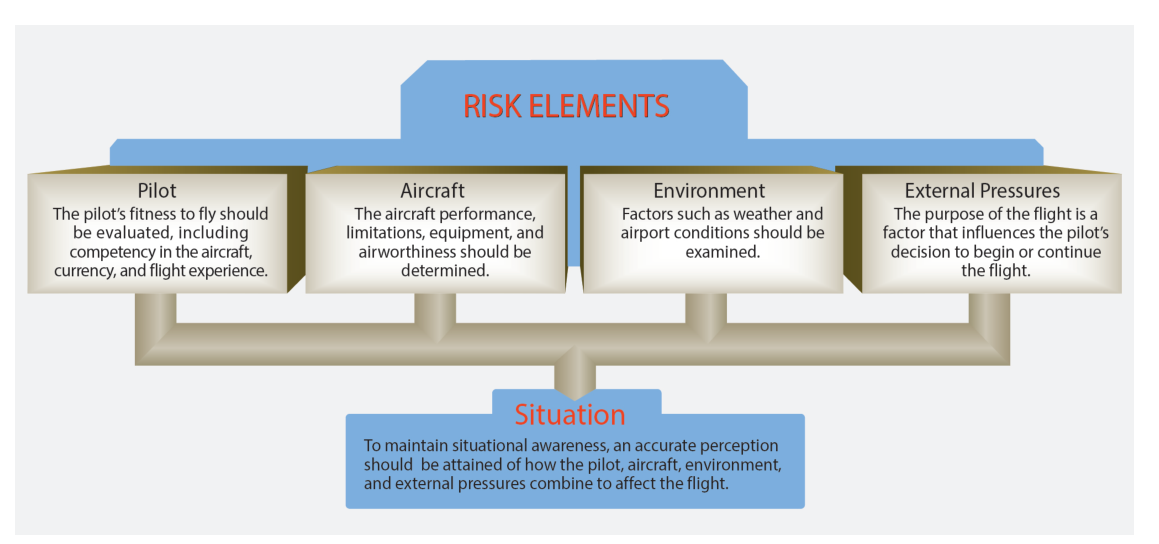
The PAVE checklist—Pilot, Aircraft, enVironment, External pressures—provides a structured preflight risk filter that surfaces hazards the unaided mind tends to minimize. The "External pressures" leg of PAVE is particularly relevant here. Passenger expectations, business deadlines, airline-connection timing, and the social embarrassment of canceling a flight all exert real psychological force on the go/no-go decision. The Risk Management Handbook describes these as "real or perceived" pressures, and the distinction matters: even imagined pressure—a pilot's belief that passengers will be disappointed—can be just as motivationally powerful as an actual hard deadline.
Instructors should ask students to walk through PAVE aloud during preflight briefings and during scenario-based training exercises. The 5 Ps check—Plan, Plane, Pilot, Passengers, Programming—serves a complementary in-flight function, providing a structured mental scan that can be repeated at regular intervals during cross-country flight to catch deteriorating conditions before they reach a critical threshold.
Key Numbers and Rules
- Basic VFR minimums in Class G airspace below 1,200 feet AGL during daytime: 1 statute mile visibility and clear of clouds—illustrating how narrow the legal margin can be before conditions become IMC.
- Special VFR: Requires at least 1 statute mile visibility and clear of clouds within Class B, C, D, or E surface areas; cannot be conducted at night unless the pilot is instrument-rated and the aircraft is equipped for IFR (14 CFR 91.157).
- Spatial disorientation onset: Without visual reference to the horizon, a pilot can lose accurate attitude awareness within as little as 10 to 20 seconds—well before most pilots realize the problem has begun.
- Personal minimums recommendation: Many FAA safety publications suggest VFR pilots set personal minimums at least 500 feet higher and 1 mile greater than the applicable regulatory minimums as a buffer against misjudgment and rapid deterioration.
Common Test Traps
- IMC vs. IFR: IMC describes actual meteorological conditions below VFR minima. IFR describes the operating rules under which a properly equipped and rated pilot flies. A VFR pilot entering IMC is not flying IFR—they are flying illegally and unsafely in dangerous conditions without the training or clearance to handle them.
- Gradual deterioration questions: Knowledge test scenarios often describe slowly worsening conditions. The correct answer almost always favors the earliest, most conservative diversion decision. The temptation to choose "continue and monitor" is the trap.
- All five hazardous attitudes: Know each attitude and its specific FAA antidote. Test items on continued VFR into IMC frequently key on invulnerability ("It won't happen to me") and resignation ("What's the use?"). Confusing the antidotes, or applying the wrong one to a given attitude, is a common error.
- Regulatory minimums are not safety standards: Questions may probe whether a student understands that meeting the legal VFR minimum does not mean the flight is operationally safe. The FAA's own guidance advocates personal minimums above the regulatory floor.
- Night VFR risk elevation: Some students underestimate how dramatically night operations increase continued-VFR-into-IMC risk. The FAA treats night VFR over unlighted terrain as a significantly elevated risk category, not merely a procedural variation on daytime VFR.