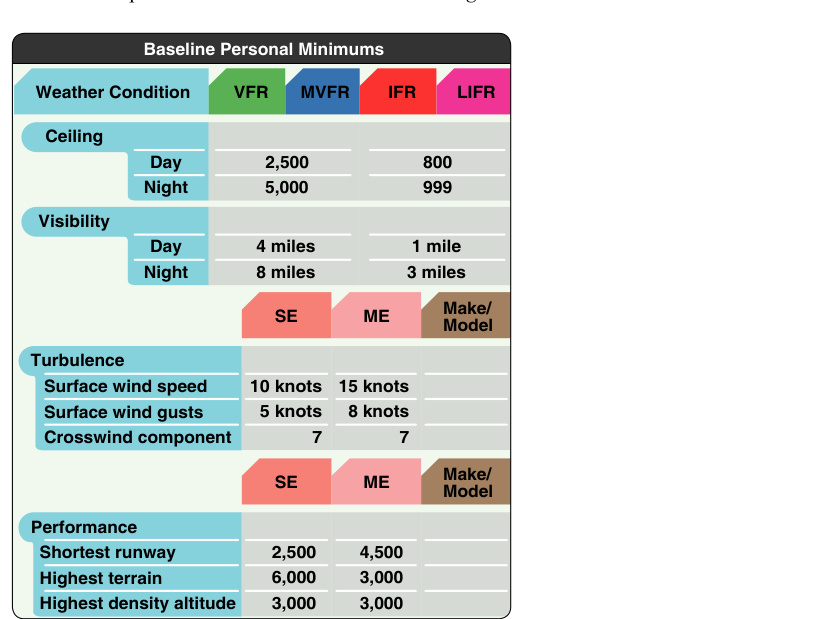
Every certificated pilot learns the FAA's legal weather minimums, but the Risk Management Handbook (FAA-H-8083-2) and the Pilot's Handbook of Aeronautical Knowledge (FAA-H-8083-25) are unambiguous: legal minimums are a regulatory floor, not an operational target. Sound aeronautical decision-making (ADM) demands that pilots layer their own personal minimums on top of those floors—self-imposed, written operating limits calibrated to their currency, experience, aircraft familiarity, and physiological state. For flight and ground instructors, teaching students to build and genuinely use personal minimums is among the highest-leverage safety interventions possible. The Aviation Instructor's Handbook (FAA-H-8083-9) frames risk management instruction not as optional enrichment but as a core instructor responsibility: you are not done teaching aeronautical decision-making when a student can recite the regulations.
What Personal Minimums Are—and Are Not
Personal minimums are not vague intentions. They are specific, numerical, written self-limits established before a flight and held firm against in-flight or pre-flight pressure. They differ from legal minimums in three important ways: they are more conservative, they are individualized, and they are dynamic—expected to change as experience and currency evolve.
The scope of personal minimums extends well beyond ceiling and visibility. The PAVE checklist, introduced in FAA-H-8083-2, provides the organizing framework. Each letter represents a risk category that warrants its own personal limit:
- Pilot — Currency, recency, total hours in type, physiological readiness, and stress state.
- Aircraft — Familiarity with the specific airframe and avionics suite, known squawks, performance margins for the planned mission.
- enVironment — Ceiling, visibility, wind, terrain, time of day, airspace complexity, and destination airport characteristics.
- External pressures — Passenger expectations, schedule demands, economic considerations, and the cultural pressure to complete a flight.
A complete personal minimums document addresses all four categories. Instructors who teach only the weather column produce pilots who set a ceiling limit but ignore the equally dangerous erosion that comes from flying an unfamiliar avionics suite or absorbing a passenger's anxiety about making a meeting.
The IMSAFE Self-Assessment as a Personal Minimum
Before any personal minimum related to weather or aircraft is applied, the pilot must first pass a personal fitness gate. The IMSAFE checklist, documented in FAA-H-8083-25, provides that gate: Illness, Medication, Stress, Alcohol, Fatigue, Eating/Emotion. Instructors should teach students to operationalize IMSAFE as an explicit personal minimum rule, not just a mental scan. A useful concrete rule: if any IMSAFE item generates a meaningful concern, the flight does not depart. Committing that rule to writing in advance removes the temptation to rationalize a marginal personal state on the morning of an important flight.
Fatigue deserves special emphasis. FAA-H-8083-2 notes that fatigue is one of the most insidious pilot impairments because the fatigued pilot is typically unaware of the degree of degradation. A personal minimum should include a specific, written rest requirement tailored to the individual pilot—for example, a minimum number of hours of sleep in the preceding 24 hours, with a higher threshold for IFR flight or flight over mountainous terrain. Writing that number down transforms a good intention into an enforceable limit.
Building the Weather Personal Minimums Card
The practical centerpiece of personal minimums instruction is guiding each student through creating a written personal minimums card. FAA-H-8083-2 recommends this explicitly. Work through the following sequence with the student:
- Identify the applicable legal minimum for the planned operation, based on the specific airspace class to be flown through (for example, under 14 CFR 91.155, Class C, D, and E airspace below 10,000 feet MSL require 3 statute miles visibility with 500 feet below, 1,000 feet above, and 2,000 feet horizontal cloud clearance, while Class B airspace requires only clear of clouds and 3 statute miles visibility).
- Add a personal buffer above that legal floor that reflects current skill and currency. For a student pilot or newly certificated private pilot, a reasonable starting point is a ceiling no lower than 3,000 feet above ground level and visibility no less than 5 statute miles for day VFR cross-country flight.
- Apply a deterioration gate: if the forecast shows any chance of the ceiling or visibility falling to within 500 feet or 1 mile of the personal minimum during the planned flight window, do not depart. This guards against optimistic interpretation of marginal forecasts.
- Raise limits for degraded conditions: night flight, unfamiliar terrain, high-density-altitude airports, and complex airspace all warrant adding additional margin above the daytime personal minimum.
Crosswind limits follow the same logic. The aircraft's demonstrated crosswind component, published in the Pilot's Operating Handbook, represents a test-pilot performance standard under controlled conditions—not a routine operational target for a private pilot with 75 total hours. Instructors should help students identify their own crosswind comfort ceiling through deliberate practice and honest self-assessment, setting an initial personal crosswind limit below the aircraft's demonstrated value and raising it gradually and conservatively only after logging intentional crosswind practice sessions at or above the current personal limit.
Dynamic Management: Raising, Lowering, and Resetting
A critical teaching point is that personal minimums are not carved in stone—but they can only be relaxed when currency and experience genuinely justify it, never simply because a trip is desirable. Equally important, they must be tightened in specific circumstances:
- After any meaningful gap in flying, add margin to all weather and aircraft-handling limits until currency is restored through dual or solo practice flights.
- After a checkride, practical test failure, or any flight incident, treat the minimums as if returning from a break and rebuild from conservative baselines.
- After a major life stressor—job change, illness, family crisis—apply heightened IMSAFE scrutiny and consider adding a co-pilot or mentor for the first few flights back.
- When transitioning to a new aircraft type or avionics suite, reset aircraft-category minimums to their most conservative state regardless of total flight experience.
The Instructor's Role: Making It a Habit, Not a Lecture
FAA-H-8083-9 describes the goal of flight instruction as developing not just proficiency but judgment—the ability to make sound decisions without direct supervision. Personal minimums are judgment made concrete. Instructors who want this habit to outlast training should embed it throughout the curriculum, not address it once during a ground lesson near the end of training.
Practical embedding strategies include: requiring students to produce a written personal minimums card before their first solo cross-country; debriefing every flight with a PAVE self-assessment; and role-playing external pressure scenarios in which a student must decline a flight that is legal but outside their personal minimums. When a student begins to rationalize a marginal situation, the instructor should name the hazardous attitude at work—invulnerability, anti-authority, get-there-itis—using the framework provided in both FAA-H-8083-2 and FAA-H-8083-9, then guide the student to the conservative decision.
Memory Aid
Use the paired mnemonic PAVE + IMSAFE as a two-gate system: IMSAFE clears the pilot first, then PAVE evaluates the full flight environment. If either gate fails, the personal minimums have been breached and the flight does not proceed.
Common Test Traps on the Knowledge Examination
- Legal does not equal safe. Examination scenarios frequently describe a pilot who meets all regulatory requirements but is operating at or beyond personal capability limits. The correct answer recognizes the distinction and supports the conservative choice.
- Personal minimums must be more restrictive than legal minimums for low-experience pilots. A newly certificated pilot flying to the edge of basic VFR minimums is a test distractor, not a role model.
- Personal minimums are pre-flight commitments. Test items may describe a pilot who revises personal minimums in flight due to schedule pressure. The Aviation Instructor's Handbook and Risk Management Handbook both identify this as a hazardous pattern—the correct answer is that minimums are set before departure and not renegotiated in the cockpit.
- Instructors bear an active responsibility for ADM instruction. Questions may ask what an instructor should do when a student demonstrates poor risk judgment. The correct answer always involves structured intervention—naming the hazardous attitude, explaining the risk framework, and reinforcing the habit of conservative decision-making—not simply completing the flight without comment.
- The PAVE checklist covers all four risk domains. A question asking what personal minimums should address is answered by all four PAVE categories, not just the weather column.