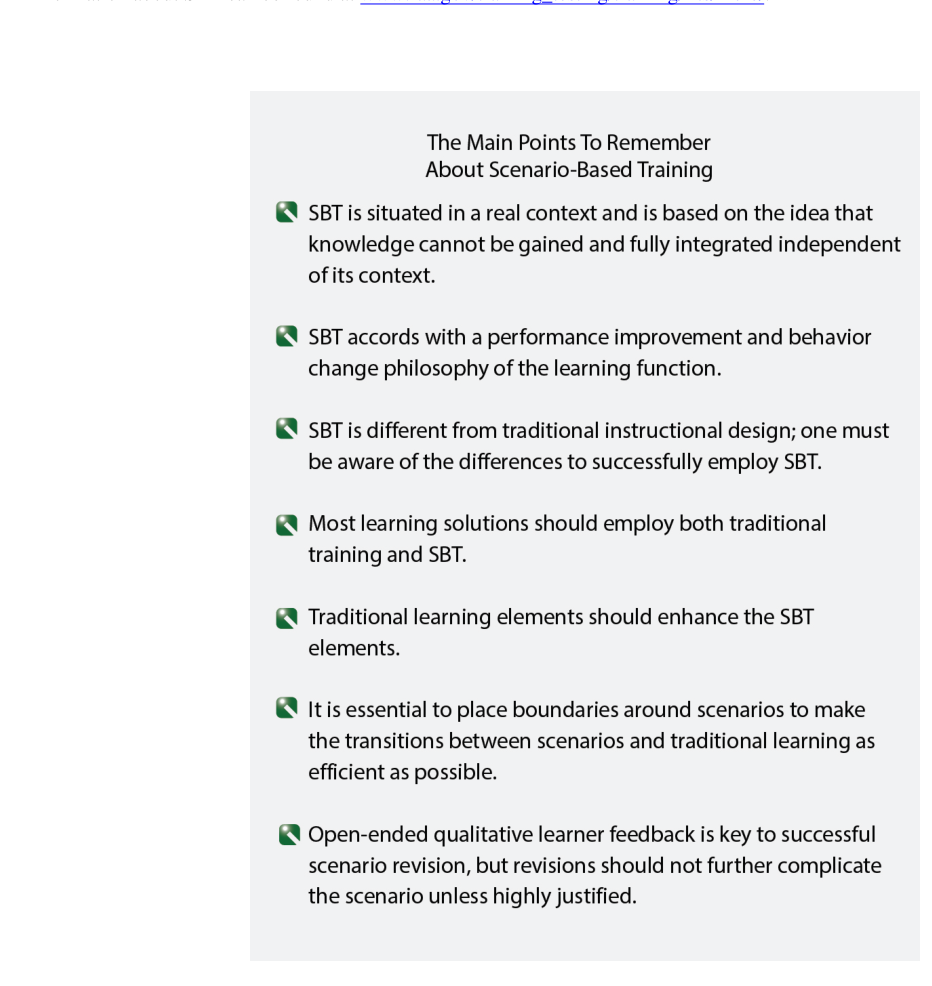
Traditional flight training has long emphasized discrete, observable maneuvers: slow flight, power-off stalls, short-field landings. Each skill is introduced, practiced, and signed off in relative isolation. Yet the accident record reveals a persistent truth: the overwhelming majority of general aviation accidents stem from flawed decisions, not from inadequate stick-and-rudder technique. The FAA's Risk Management Handbook (FAA-H-8083-2) makes clear that aeronautical decision-making (ADM) — the systematic mental process of determining the best course of action in response to changing circumstances — must be taught, not assumed to develop on its own. Scenario-based training (SBT) is the FAA-endorsed method for doing exactly that, weaving risk management instruction into realistic, story-driven flight situations so that students develop genuine judgment, not just isolated procedural compliance.
What Scenario-Based Training Actually Is
The Aviation Instructor's Handbook (FAA-H-8083-9) defines SBT as a structured instructional approach in which the student completes a goal-oriented flight scenario that mirrors a real-world operation. The critical distinction from conventional training is that the student must simultaneously apply technical skills, navigate operational decisions, and manage risk — all within the context of a single, cohesive mission. The instructor does not present isolated tasks; instead, the instructor constructs a situation in which multiple demands compete for the student's attention, just as they do on any actual flight.
A well-designed SBT scenario might read like this: a student pilot is planning a cross-country from a familiar home airport to an unfamiliar destination 150 nautical miles away. Weather at the destination is forecast to be marginal VFR, a close friend is in the right seat with an important appointment, the aircraft's carburetor heat system has a known squawk noted in the maintenance log, and fuel at the planned alternate is temporarily unavailable. No single element is catastrophic in isolation — but together they replicate the layered, compound nature of real aeronautical risk. The student must recognize each hazard, weigh the combined threat, and decide whether and how to proceed.
The Instructor's Role: Facilitator, Not Solver
Perhaps the most important — and most difficult — shift SBT demands of instructors is relinquishing the instinct to simply provide answers. FAA-H-8083-9 is explicit: in SBT, the instructor acts as a facilitator of learning, not a dispenser of correct solutions. The student must feel genuine ownership of the flight and its decisions. When a student misidentifies a risk or selects a suboptimal course of action, the instructor's job is to ask probing questions — "What does the fuel state look like now?" "How has the weather trend changed since your last check?" — rather than to announce the correct answer.
This does not mean the instructor is passive. Safety of flight is never delegated. If a student is about to fly into instrument meteorological conditions without an instrument rating, the instructor intervenes immediately. But within the boundaries of safety, the instructor tolerates imperfect decisions long enough for the student to recognize the consequences and self-correct. That experience of encountering a consequence — even a minor one, such as arriving at a fuel stop with lower reserves than planned — builds the mental models that persist long after training ends.
The instructor must also design the scenario with deliberate decision gates: structured moments where the student must consciously choose to continue, divert, or land. The FAA emphasizes that verbalizing the reasoning is as important as making the choice. An instructor who asks "What's your decision and why?" is not just checking awareness — they are practicing the habit of conscious, explicit risk processing that characterizes safe pilots.
The ADM Frameworks That Anchor SBT
SBT is most effective when it is explicitly linked to the ADM tools that the FAA has standardized across its handbooks. These frameworks give students a repeatable mental structure for managing risk in any situation.
The PAVE Checklist
FAA-H-8083-2 introduces the PAVE checklist as a pre-flight and in-flight risk identification tool. Each letter represents a category of hazard a pilot must examine:
- P — Pilot: Currency, recency, health, fatigue, proficiency for the planned flight.
- A — Aircraft: Airworthiness, equipment status, performance margins for conditions.
- V — enVironment: Weather, terrain, airspace, airport conditions, NOTAMs.
- E — External pressures: Schedule demands, passenger expectations, get-there-itis, economic pressure.
In a well-run SBT session, the student applies PAVE organically during the scenario — not as a recitation exercise before engine start, but as a living assessment that updates throughout the flight. If the weather deteriorates en route, the "V" leg of PAVE changes, and so does the overall risk picture.
IMSAFE Self-Assessment
Closely related is the IMSAFE checklist, which focuses specifically on the Pilot element of PAVE. It prompts honest evaluation of Illness, Medication, Stress, Alcohol (within the 8-hour and 0.04% BAC limits of 14 CFR 91.17), Fatigue, and Emotion. Scenarios that introduce a student with a mild cold, a recent family conflict, or a night flight after a long workday make IMSAFE personal and relevant rather than abstract.
The 3P Model
The FAA's 3P Model — Perceive, Process, Perform — provides a continuous loop for in-flight risk management. The pilot perceives hazards in the current situation, processes the cumulative risk those hazards represent, and performs a risk-management action to reduce that risk to an acceptable level. This cycle does not run once at preflight; it repeats constantly throughout every flight. SBT is the ideal training environment to make this loop a genuine habit, because the scenario continuously introduces new information that demands re-entry into the perceive-process-perform cycle.
Single-Pilot Resource Management (SRM) and CRM
For single-pilot operations, the FAA groups all information-management and decision-making skills under single-pilot resource management (SRM). This includes ADM, task management, automation management, controlled flight into terrain (CFIT) awareness, and situational awareness. SBT inherently exercises all of these simultaneously. Scenarios for multi-crew environments similarly develop crew resource management (CRM) — the effective use of all available human resources to achieve safe flight.
The Debrief: Where Learning Is Consolidated
FAA-H-8083-9 treats the post-scenario debrief as an essential, not optional, phase of SBT. A structured debrief asks the student to reconstruct the scenario, identify which hazards were correctly perceived and which were missed, evaluate the quality of decisions made at each gate, and articulate what they would do differently. The instructor guides this reflection without rendering a verdict prematurely — the goal is the student's self-assessment, which research in educational psychology consistently shows produces more durable learning than externally delivered critique alone.
Key Numbers and Rules
- 14 CFR 91.17 governs alcohol and drug limitations — a scenario involving a pilot who "had a drink last night" directly tests this regulation.
- The FAA's Risk Management Handbook identifies five hazardous attitudes — Anti-authority, Impulsivity, Invulnerability, Macho, Resignation — each with a specific antidote. SBT scenarios are designed to elicit these attitudes so they can be identified and corrected in a safe environment.
- Scenario complexity should increase progressively: early SBT sessions introduce one or two risk elements; advanced sessions introduce four or more simultaneously to approach real-world complexity.
- The FAA acknowledges both ground-based (simulator, FTD, ATD) and airborne SBT as valid delivery methods; the key criterion is that the student must actively manage the situation and experience realistic consequences.
Common Test Traps
- SBT is not simply narrating a scenario verbally. FAA test items distinguish between a ground discussion of "what would you do if…" and genuine SBT, which requires the student to actively manage a situation in real time.
- The instructor's role changes, but does not disappear. A frequent misconception is that SBT means hands-off flying. The instructor must design the scenario, monitor safety vigilantly, and debrief thoroughly — the role shifts from demonstrator to facilitator, not from present to absent.
- PAVE and IMSAFE require genuine reflection, not rote recitation. Knowledge-test questions probe whether a student understands what each element covers and can apply it to a novel situation, not merely list the letters.
- The five hazardous attitudes are testable individually. Know which attitude each antidote corrects: "Follow the rules — they are usually right" addresses Anti-authority; "Not so fast — think first" addresses Impulsivity; "It could happen to me" addresses Invulnerability; "Taking chances is foolish" addresses Macho; "I'm not helpless — I can make a difference" addresses Resignation.
- SBT, ADM, SRM, CRM, the 3P Model, and PAVE are interlinked. Expect knowledge-test questions that require you to connect two or more of these concepts rather than treating each in isolation.