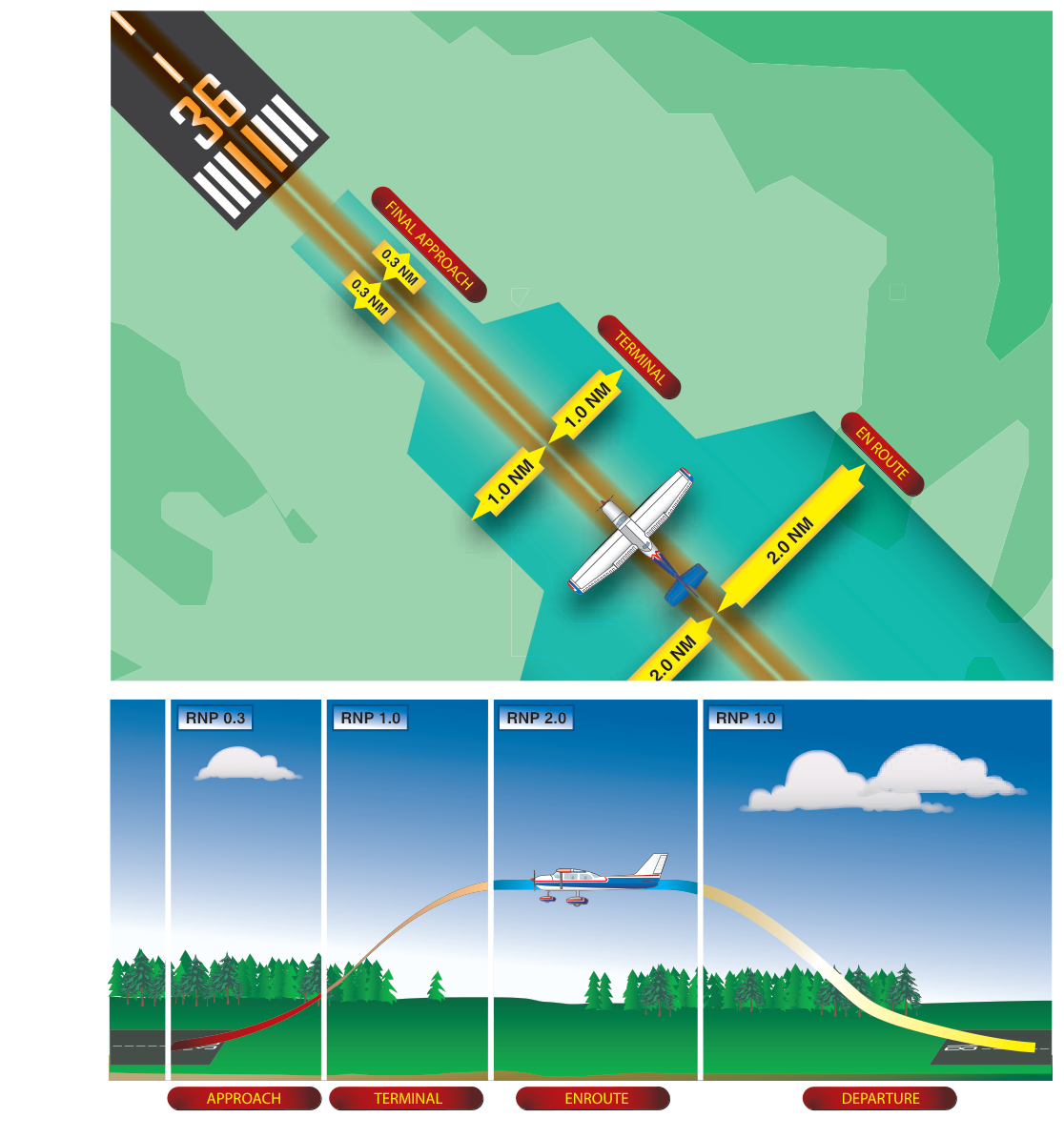
Required Navigation Performance Authorization Required (RNP AR) approaches represent the most demanding category of performance-based navigation (PBN) instrument approaches in commercial aviation. Unlike conventional or basic RNP approaches, RNP AR procedures can incorporate radius-to-fix (RF) legs—curved flight path segments—and may specify extremely tight lateral accuracy requirements, sometimes as low as 0.1 nautical mile (NM) or even 0.1 NM total system error (TSE). Because of these demands, RNP AR operations are not available to every aircraft or operator by default; they require a specific, FAA-issued authorization before an operator may fly them. For the aircraft dispatcher, understanding the planning requirements for RNP AR approaches is essential both for the Dispatcher Practical Test and for day-to-day operational safety.
The FAA's Instrument Procedures Handbook (FAA-H-8083-16) and the Aeronautical Information Manual (AIM) together form the primary regulatory and procedural foundation for RNP AR planning. Dispatchers do not merely release an aircraft to an RNP AR approach—they must verify that every element of the operation, from aircraft capability to crew qualification to alternate planning, is in place before departure.
How RNP AR Works
RNP AR is a subset of Performance-Based Navigation (PBN). PBN encompasses navigation specifications that define required performance in terms of accuracy, integrity, continuity, and availability. The "AR" designation—Authorization Required—distinguishes these procedures from standard RNP approaches because they demand a higher and more tightly monitored level of navigation performance. The core technical concept is the Total System Error (TSE), which must remain within the specified accuracy value 95% of the time. Equally important is the onboard monitoring and alerting function: the avionics must be capable of detecting and alerting the crew whenever performance degrades below the required threshold. This alerting capability is what gives RNP its safety advantage over conventional RNAV operations.
RNP AR procedures use a Required Navigation Performance value expressed in nautical miles. A procedure might specify RNP 0.3 on the final approach segment, meaning the aircraft's navigation system must keep lateral error within 0.3 NM of the centerline 95% of the time, with a 99.999% containment boundary of twice that value (0.6 NM). Some RNP AR approaches go as tight as RNP 0.1. The procedure designer selects the RNP value based on terrain, obstacle environment, and airport layout.
The defining geometric feature of many RNP AR approaches is the Radius-to-Fix (RF) leg. An RF leg is a constant-radius arc flown at a defined bank angle, allowing aircraft to navigate around terrain or obstacles that would otherwise make an approach impossible. RF legs are common at airports in mountainous terrain or constrained urban environments. Not all aircraft or flight management systems (FMS) are certified to fly RF legs; this is one of the reasons the authorization is required.
Authorization and Aircraft Eligibility
Before any RNP AR operation can be planned, the dispatcher must confirm that both the aircraft and the operator hold the required authorization. On the aircraft side, eligibility requires an FMS that meets specific performance standards, a dual-sensor navigation system (typically GPS/GNSS-based), and avionics that provide automatic alerting when the Estimated Position Uncertainty (EPU) exceeds the RNP value. The aircraft's Airplane Flight Manual (AFM) supplement or a related operations specification (OpSpec) must explicitly approve RNP AR operations, often specifying which RNP values the aircraft is approved for and whether RF legs are included.
On the operator side, Part 121 and Part 135 carriers must hold an FAA-issued Operations Specification (OpSpec) paragraph authorizing RNP AR approaches. This OpSpec is not granted automatically; it requires a demonstration of aircraft capability, maintenance program provisions, crew training, and a formal approval process with the Certificate Management Office (CMO). Dispatchers must be trained on their company's specific OpSpec limitations—for example, an OpSpec may authorize RNP AR down to RNP 0.3 but not RNP 0.1, or it may prohibit single-engine RNP AR operations.
Crew Qualification and Training Requirements
Crew qualification is a dispatcher planning input, not just a flight operations matter. Before releasing a flight to an RNP AR destination or alternate, the dispatcher must know whether the assigned crew is qualified for the specific procedure type. Qualification typically requires simulator training on RF leg intercepts, missed approach with curved segments, degraded navigation mode procedures, and recognition and response to RNP alerts. Operators who hold RNP AR OpSpecs maintain crew qualification records; a dispatcher who inadvertently releases a crew to an RNP AR approach they are not trained for creates a significant safety and regulatory exposure.
Why RNP AR Matters for Dispatch Planning
From the dispatcher's perspective, RNP AR introduces a layered set of go/no-go conditions that must be evaluated before departure and continuously monitored during flight. These layers include weather minima, NOTAM status of required navigation infrastructure, aircraft system status, and alternate airport planning.
Weather minima for RNP AR approaches can be significantly lower than conventional ILS or RNAV approaches at the same airport, sometimes allowing operations in visibility as low as 1/2 mile or with Decision Altitudes (DA) below 200 feet above touchdown zone elevation. This is precisely why RNP AR approaches exist—they unlock airports and runways that would otherwise be operationally unavailable in low-visibility conditions. However, the minima published on the approach chart are valid only when the aircraft and crew meet all authorization requirements.
NOTAM review is critical. RNP AR approaches depend on GNSS signal integrity. Ground-based augmentation system (GBAS) or satellite-based augmentation system (SBAS) availability, GPS RAIM (Receiver Autonomous Integrity Monitoring) predictions, and any satellite outages must be checked for the estimated time of arrival (ETA) plus a buffer. A NOTAM indicating GPS unreliable in the destination terminal area during the ETA window may render the RNP AR approach unavailable and force the dispatcher to select an alternate that does not rely on the same infrastructure.
MEL (Minimum Equipment List) considerations are another dispatcher responsibility. If the aircraft departs with an inoperative component listed in the MEL that affects navigation system performance—such as one GPS receiver failed—the dispatcher must determine whether the remaining system configuration still meets the authorization requirements for the planned RNP AR approach. In many cases, loss of a redundant navigation sensor will prohibit RNP AR operations, and the dispatcher must select an approach within the aircraft's degraded capability.
Alternate Airport Planning for RNP AR Destinations
When the destination is served primarily or exclusively by RNP AR approaches, alternate planning takes on special importance. If the destination's only approach capable of achieving usable minima is an RNP AR procedure, and the aircraft loses RNP AR capability en route, the alternate becomes the operational destination. The dispatcher must ensure the alternate airport has an approach that is achievable with the aircraft in its potentially degraded state. Standard Part 121 alternate minimums apply to the alternate; those minimums must be achievable without relying on RNP AR unless the aircraft's full capability is assured.
Fuel planning must account for the possibility of flying a longer, less efficient missed approach or divert profile. RNP AR missed approaches sometimes include curved climb segments that add distance; the fuel burn for these segments must be included in contingency fuel calculations.
Key Numbers and Rules
- RNP accuracy values: RNP AR approaches may specify values from RNP 0.3 down to RNP 0.1 NM (lateral accuracy, 95% of the time).
- Containment boundary: Twice the RNP value defines the 99.999% containment limit (e.g., 0.6 NM for RNP 0.3).
- Dual sensor requirement: Most RNP AR approvals require at least two independent navigation sensors (typically dual GPS/FMS); single-sensor operation usually voids the authorization.
- OpSpec requirement: Part 121/135 operators must hold a specific OpSpec paragraph from their CMO; no OpSpec = no RNP AR operation, regardless of aircraft hardware capability.
- RF leg approval: Must be explicitly authorized; not all RNP-capable aircraft are approved for RF legs.
- RAIM/GNSS availability: Must be confirmed for the ETA window; GPS outages or NOTAM-ed unreliability invalidate the approach.
- Visibility minima: Can be as low as 1/2 statute mile (or lower on some special procedures); always use the published chart minima for the specific aircraft category and authorization level.
Common Test Traps
- Confusing RNP AR with standard RNAV (RNP): Not every RNP approach is Authorization Required. The phrase "AR" on the approach chart title is the key distinguisher. Standard RNAV (RNP) approaches do not require an FAA-issued special authorization beyond normal OpSpecs.
- Assuming GPS availability equals RNP AR availability: GPS signal present does not mean RAIM meets the integrity requirement for the specific RNP value. A RAIM prediction for the exact ETA and procedure type is necessary.
- Overlooking MEL impacts on dual-sensor requirements: A single deferred GPS receiver may appear minor on the MEL but can eliminate the entire RNP AR capability for that flight.
- Treating RNP AR minima as unconditional: The published DA and visibility minima assume full aircraft authorization and crew qualification. An unqualified crew or non-authorized aircraft must use conventional approach minima or divert.
- Neglecting alternate approach capability: Selecting an alternate airport that can only be approached via RNP AR when the aircraft's RNP AR capability is in question defeats the purpose of naming an alternate.