Required Navigation Performance (RNP) approaches represent the highest standard of precision available to crews flying conventional RNAV procedures. Unlike basic RNAV (GPS) approaches that rely exclusively on straight-line course segments, RNAV (RNP) approaches may incorporate Radius-to-Fix (RF) legs — geometrically defined arcs that allow aircraft to negotiate curved flight paths with a level of accuracy measured in fractions of a nautical mile. For Airline Transport Pilot (ATP) candidates and instrument-rated pilots operating under Part 121 or 135, understanding how these approaches are charted, authorized, and flown — including the design logic behind their missed approach segments — is both an FAA knowledge test requirement and a critical operational competency.
This article grounds its analysis in the Instrument Procedures Handbook (FAA-H-8083-16B), Chapter 2, which provides the authoritative treatment of approach chart interpretation, leg types, and missed approach construction for RNAV procedures.
What Is an RNAV (RNP) Approach?
An RNAV (RNP) approach is an instrument approach procedure (IAP) that requires the aircraft navigation system to meet a published total system error (TSE) tolerance — typically expressed as a lateral accuracy value in nautical miles — and to continuously monitor its own performance against that tolerance. The key distinction from a standard RNAV (GPS) approach is the on-board performance monitoring and alerting (OPMA) requirement. The flight management system (FMS) must not only achieve the required accuracy but must also alert the crew when it cannot guarantee that performance.
Approach authorization is typically conveyed through the aircraft's avionics certification (often referenced via FAA Special Airworthiness Information Bulletins or Operations Specifications) rather than a simple database flag. Crews must verify that the aircraft is authorized for RNP AR (Authorization Required) operations before flying an RNAV (RNP) procedure containing RF legs. Not every RNAV (RNP) approach includes RF legs, but those that do will note this on the chart and require specific operator and aircraft authorization.
Radius-to-Fix (RF) Legs: How They Work
An RF leg is a constant-radius arc defined by three parameters: a center fix, a radius distance, and a terminating fix. The aircraft flies the arc from an entry point, maintaining a constant distance from the center fix, until it reaches the terminating fix. This geometry allows procedure designers to route the final approach course around terrain or obstacles in ways that straight-line segments cannot achieve, enabling approaches into airports previously inaccessible under IMC.
On approach charts, an RF leg appears as a curved line between two named fixes, often accompanied by a small arc symbol or notation. The radius of the arc is published in the approach procedure notes or can be derived from the distance between the center fix and the path fixes. Importantly, the FMS must be capable of executing the curved path autonomously — the pilot does not hand-fly an RF leg using raw data; the autopilot or flight director coupled to a certified FMS tracks the arc geometry continuously.
Entry Into an RF Leg
Proper entry into an RF leg requires the FMS to begin rolling the aircraft into the arc before reaching the entry fix — a process called lead-in. The amount of lead distance varies with groundspeed and bank angle limits. At higher speeds, the lead distance increases substantially, which is why many RNAV (RNP) procedures publish maximum speed restrictions at or before RF leg entry fixes. Exceeding these speeds can cause the aircraft to overshoot the arc geometry, which the FMS may flag as an RNP exceedance. Pilots must brief and comply with all published speed restrictions as a critical element of RF leg execution.
Bank Angle and Performance Monitoring
RF leg execution relies on a pre-computed bank angle derived from the arc radius and groundspeed. The FMS continuously cross-checks the aircraft's lateral position against the arc and adjusts bank angle within certified limits to maintain TSE. If the actual position error plus the navigation system error (NSE) exceeds the RNP value for that segment — commonly 0.1 NM on the final approach segment of an RNP AR approach — the system annunciates an alert and the crew must execute a missed approach. This real-time self-monitoring is the defining capability that separates RNP from basic RNAV.
RNAV (RNP) Approach Chart Layout
RNAV (RNP) approach charts follow the standard NOS/FAA chart format but include several unique elements that pilots must recognize:
- "AUTHORIZATION REQUIRED" note: appears prominently in the chart title block or notes section when RNP AR authorization is needed. This is a regulatory, not advisory, limitation.
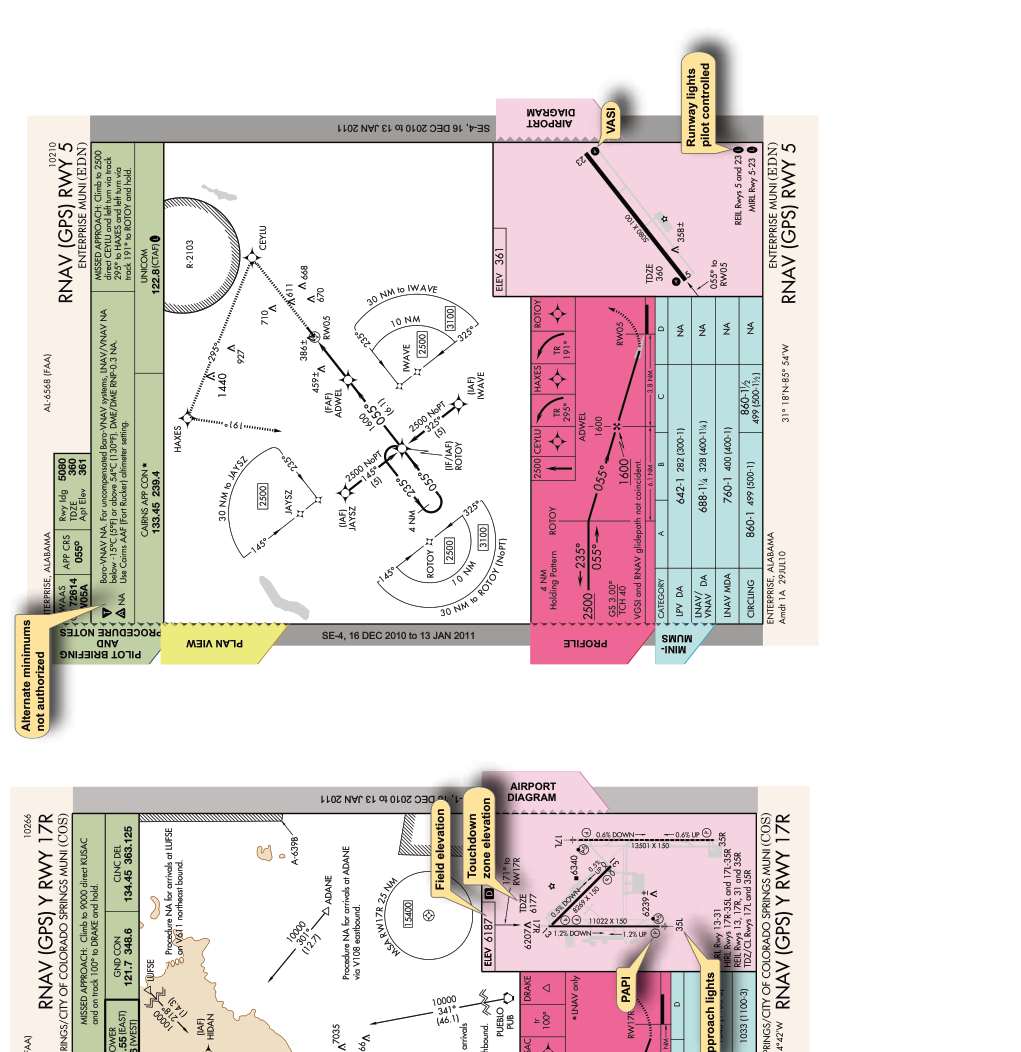
- RF leg arc depiction: curved final approach segments are drawn to scale on the plan view. The center point of the arc and the radius may be annotated.
- RNP values by segment: some charts annotate the required RNP value for each segment (e.g., 0.30 NM en route, 0.10 NM final). Pilots must confirm the aircraft's FMS is meeting or beating these values.
- Speed restrictions: mandatory speed limits at named fixes are shown as underlined values (e.g., 180 KIAS) and must be treated as maximums unless otherwise stated.
- DA/MDA in feet MSL: decision altitude is published for approaches with vertical guidance; some RNP AR approaches achieve the equivalent of ILS Category I, II, or even III minima based on RNP value and operator authorization.
Missed Approach Design for RNAV (RNP) Procedures
The missed approach segment of an RNAV (RNP) procedure is as carefully engineered as the approach itself, and in some cases is more complex. Because the aircraft may be at a very low altitude — sometimes below surrounding terrain in mountainous environments — with significant bank already established on a curved final, the missed approach must be designed to provide immediate obstacle clearance while accounting for realistic aircraft performance at the missed approach point (MAP).
Straight vs. Curved Missed Approach Segments
Many RNAV (RNP) missed approaches use straight climbing segments that the FMS flies as standard track-to-fix (TF) legs. However, some procedures — particularly those in mountainous terrain — incorporate RF legs in the missed approach itself. This is a critical charting distinction: if the missed approach contains an RF leg, the aircraft must maintain RNP authorization and FMS coupling through the entire go-around. Disconnecting the autopilot and hand-flying may invalidate the obstacle clearance basis of the procedure.
Missed approach RF legs are charted and annotated in the same manner as approach RF legs. The plan view will show the curved climb-out path, and the profile view will depict the required climb gradient. Many RNAV (RNP) missed approaches require climb gradients steeper than the standard 200 ft/NM (the standard TERPS value). A published climb gradient of, say, 400 ft/NM must be achievable at the aircraft's weight and with the expected engine configuration (e.g., one engine inoperative on Part 121 operations).
Missed Approach Holding
The published missed approach holding fix for an RNAV (RNP) procedure is a defined waypoint in the FMS database. The hold may be entered automatically by the FMS when the crew selects the missed approach, or it may require manual activation depending on system design. Crews must brief the hold entry type (parallel, teardrop, or direct) and be prepared for the FMS to sequence into the hold without prompting. As with all instrument holds, the published leg length or time (1 minute below 14,000 ft MSL, 1.5 minutes at or above 14,000 ft MSL) applies unless otherwise specified.
Why RF Legs and RNP AR Matter Operationally
RNP AR procedures with RF legs exist because geography and terrain make conventional straight-in approaches impossible or impractical at certain airports. Airports like Queenstown, New Zealand, or Innsbruck, Austria pioneered this technology; in the United States, airports in Alaska and the western mountain states have the highest density of RNP AR procedures. These procedures can reduce approach minima to decision altitudes as low as 150–200 ft AGL in some international operations, dramatically improving access in low-visibility, mountainous conditions.
From an ATP operational standpoint, failure to understand RF leg entry, speed management, and missed approach construction is a leading source of RNP exceedances. An exceedance on final that forces a missed approach in IMC, at low altitude, over terrain, is among the highest-risk scenarios in commercial aviation. The design of the missed approach with its own RF legs and climb gradients is the safety net — but only if the crew executes it correctly and the aircraft maintains its RNP authorization throughout.
Key Numbers and Rules
- RNP AR final segment accuracy: commonly 0.10 NM TSE; some procedures go as low as 0.05 NM.
- Standard missed approach climb gradient: 200 ft/NM; RNP AR missed approaches frequently require 300–500 ft/NM or more.
- Holding altitude breakpoint: 1-minute legs below 14,000 ft MSL; 1.5-minute legs at or above 14,000 ft MSL (AIM reference).
- Speed compliance: published speed restrictions at RF leg entry fixes are mandatory maximums; non-compliance risks TSE exceedance.
- Authorization: "AUTHORIZATION REQUIRED" on the chart title means operator OpSpecs/MSpecs AND aircraft avionics certification are both required — no self-dispatch exceptions.
- Autopilot requirement: many RNP AR procedures require the autopilot engaged through the missed approach point; verify in the operator's approved procedures.
Common Test Traps
- Confusing RNAV (GPS) with RNAV (RNP): A standard RNAV (GPS) approach does not require OPMA and cannot include RF legs. Only RNAV (RNP) procedures with proper authorization can use RF leg geometry.
- Assuming authorization is avionics-only: Aircraft avionics certification is necessary but not sufficient. The operator must also hold appropriate OpSpecs (Part 121/135) or MSpecs (Part 91K). Both must be current.
- Treating the DA like an MDA: RNAV (RNP) approaches with vertical guidance use a Decision Altitude (DA), not an MDA. At the DA, the pilot must immediately initiate the missed approach if the runway environment is not in sight — there is no "dive and drive" option.
- Ignoring climb gradient on missed approach: Examinees often focus only on approach minima and overlook the published missed approach climb gradient. On a single-engine missed approach scenario, the aircraft may not meet a steep gradient, making the approach operationally unavailable.
- Believing any GPS can fly RF legs: RF leg execution requires an FMS with certified arc-tracking capability. A basic IFR GPS navigator without this certification will not support RF legs, and attempting to fly them without it violates the procedure authorization basis.