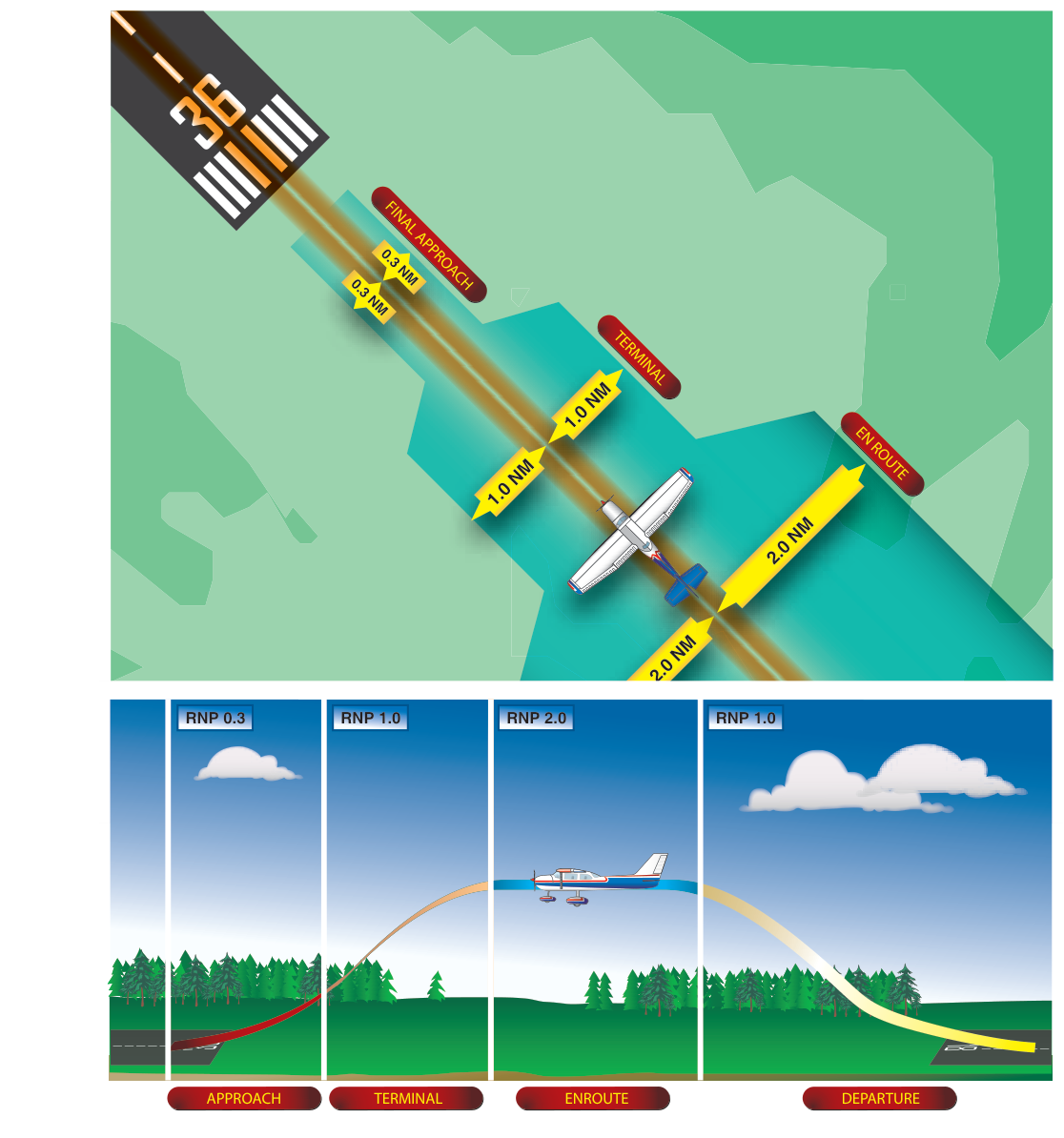
Required Navigation Performance, universally abbreviated as RNP, is one of the most consequential concepts in modern airline and instrument flying. Unlike earlier navigation standards that simply specified which equipment to carry, RNP defines a complete performance contract: the aircraft must achieve a stated lateral accuracy, and it must continuously monitor that accuracy, and it must alert the crew when performance degrades below the required threshold. That three-part obligation — accuracy, monitoring, and alerting — is what separates RNP from conventional area navigation (RNAV) and is the foundation of every question you will encounter on the ATP knowledge test about this subject.
RNP has enabled a new generation of instrument procedures that were simply impossible with older navigation technology. Curved paths through mountain passes, precise approaches to runways surrounded by rising terrain, and tight oceanic tracks with reduced separation all depend on the confidence that RNP monitoring provides. Understanding RNP at the systems level — not just memorizing the numbers — will make you a safer line pilot and a better automation manager.
Accuracy Standard: What the Numbers Mean
Every RNP specification is expressed as a single distance value, stated in nautical miles, that defines the Total System Error (TSE) that must not be exceeded for more than 0.001 percent of flight time (i.e., 95 percent containment requires the aircraft to be within the value at least 95 percent of the time, and the containment limit is typically twice the RNP value for the 99.999 percent boundary). Practically speaking, if a procedure is published as RNP 0.1, the aircraft must keep TSE within ±0.1 nautical miles of the defined path 95 percent of the time, and the monitoring system must alert before the error reaches twice that value — the alert limit of 0.2 nm.
TSE is not just GPS error. It is the vector sum of three components: Navigation System Error (NSE) — the difference between the aircraft's computed position and its true position; Flight Technical Error (FTE) — the deviation of the aircraft's actual path from the computed path (essentially how well the autopilot or pilot tracks the FMCS output); and Path Definition Error (PDE) — the difference between the stored path and the desired path, which in modern certified FMS databases is treated as negligible. The crew must understand that FTE is partly within their control: disengaging the autopilot and hand-flying an RNP AR approach increases FTE dramatically and may push TSE beyond limits.
Monitoring and Alerting: The Defining Characteristic
The FAA's foundational framework for RNP is contained in the Instrument Flying Handbook (FAA-H-8083-15) and Instrument Procedures Handbook (FAA-H-8083-16), and the regulatory basis for specific performance-based navigation (PBN) operations flows from 14 CFR Part 91, Part 121, and the relevant operations specifications (OpSpecs). Advisory Circular AC 90-105A provides detailed guidance on approval for RNP operations.
The critical distinction is that an RNP-capable system must provide a Horizontal Protection Level (HPL) computation at all times. HPL is the radius of a circle, centered on the estimated position, that the true position must lie within at a very high probability (typically 10-7 per hour). The FMS or navigation computer compares HPL to the Horizontal Alert Limit (HAL) — which equals twice the RNP value for most approach operations. If HPL exceeds HAL, the system must alert the crew within a specified time-to-alert (usually six seconds).
In the cockpit, this monitoring manifests as the UNABLE RNP advisory. When the navigation computer determines it can no longer guarantee the required performance, it annunciates this message, and the crew must treat it as a mandatory missed approach trigger on final approach or a deviation from an oceanic track. This is not a discretionary warning — it is a performance boundary being crossed.
RNP Specification Types You Must Know
The ICAO PBN framework groups RNP specifications into several types, each suited to a different phase of flight. For the ATP, focus on these:
- RNP 4: Used in oceanic and remote continental airspace. Requires ±4 nm accuracy. Enables reduced separation standards (e.g., 30 nm lateral or 50 nm longitudinal in some oceanic tracks) when paired with ADS-C position reporting.
- RNP 2: Applied to en route continental and oceanic operations; requires ±2 nm accuracy.
- RNP 1: Used for standard terminal arrivals (STARs) and departures in terminal areas; ±1 nm accuracy required.
- RNP APCH (0.3): The standard for GPS-based RNAV (GPS) approaches with LPV or LNAV/VNAV minima; ±0.3 nm in the initial and intermediate segments, tightening to ±0.1 nm in the final approach segment.
- RNP AR APCH: Authorization Required approaches, which can demand RNP values as tight as 0.1 nm or even lower in the final segment. These procedures may include radius-to-fix (RF) leg segments — curved approach paths — that are impossible without RNP AR capability. Special aircraft and crew authorization (OpSpecs B036 or equivalent) is required.
RNP AR: Radius-to-Fix Legs and Curved Approaches
RNP Authorization Required (RNP AR) procedures represent the highest-performance application of RNP and are increasingly common at terrain-challenged airports. The enabling technology is the RF leg — a constant-radius arc to a fix. Unlike a standard procedure turn or DME arc flown via successive waypoints, an RF leg is a mathematically defined curved path that the FMS tracks continuously. The autopilot must be engaged and the FMS must be in approach mode for the aircraft to achieve the FTE necessary to stay within the tight accuracy limits.
Because RNP AR procedures can be designed with vertical guidance and curved paths simultaneously, they can thread through terrain that would otherwise preclude any instrument approach. Crews operating these procedures must be specifically trained and qualified, the aircraft must have a certified RNP AR avionics suite, and the airline must hold the appropriate OpSpec. A go-around from an RNP AR approach is itself a performance-based procedure — missed approach RF legs exist on some procedures, requiring the crew to maintain RNP monitoring even after beginning a climb.
Why It Matters: Safety and Operational Implications
The accident record that motivated RNP development is sobering. Multiple controlled-flight-into-terrain (CFIT) accidents occurred at airports where terrain precluded conventional ILS approaches, and operators flew visual or non-precision approaches in marginal conditions. RNP approaches with vertical guidance dramatically reduce CFIT risk by providing a stabilized, monitored path to lower minima without requiring ground-based navaids.
From an automation management perspective, RNP creates specific crew responsibilities. The crew must verify the estimated position uncertainty (EPU) — sometimes displayed as Actual Navigation Performance (ANP) — is less than or equal to the RNP value before commencing an RNP approach. If EPU/ANP exceeds RNP at any point in the approach, the crew must execute a missed approach. Waiting for the UNABLE RNP annunciation is not best practice; proactive monitoring of EPU versus RNP is part of threat management.
Key Numbers and Rules
- Alert limit = 2 × RNP value for most operations (e.g., RNP 0.3 → alert at 0.6 nm).
- 95% containment within the RNP value; 99.999% containment within twice the value.
- Time to alert: typically ≤ 6 seconds once HPL exceeds HAL on approach.
- RNP AR minimum: as low as RNP 0.1 nm in the final segment; some procedures use 0.1 to 0.3 nm depending on terrain and design.
- Autopilot required for RNP AR approaches — hand-flying exceeds FTE limits.
- UNABLE RNP = mandatory missed approach if received on final approach course.
- GPS RAIM is the underlying integrity mechanism for most RNP operations; RAIM prediction must confirm availability for the planned operation.
Common Test Traps
- RNP is not the same as RNAV. RNAV specifies accuracy only; RNP requires onboard monitoring and alerting in addition. An RNAV 1 route and an RNP 1 route may look identical on a chart, but only the RNP route comes with a mandatory alert function. The ATP test loves to exploit this distinction.
- EPU/ANP must be less than or equal to RNP — not just less than the alert limit. Waiting until the alert fires means you have already exceeded the performance standard.
- RF legs require specific avionics certification. Not all FMS-equipped aircraft can fly RF legs; the aircraft's approved RNP AR authorization (via OpSpec) is the controlling document, not the presence of GPS alone.
- RNP AR missed approaches may also contain RF legs. Students often assume the missed approach is conventional; on some procedures it is not, and losing RNP monitoring on the missed approach has the same implications as losing it on final.
- Oceanic RNP 4 requires ADS-C in most implementations. The reduced separation benefit depends on automatic position reporting — a crew that disables ADS-C has effectively lost the justification for the reduced separation standard, which is a regulatory compliance issue, not just a technical one.