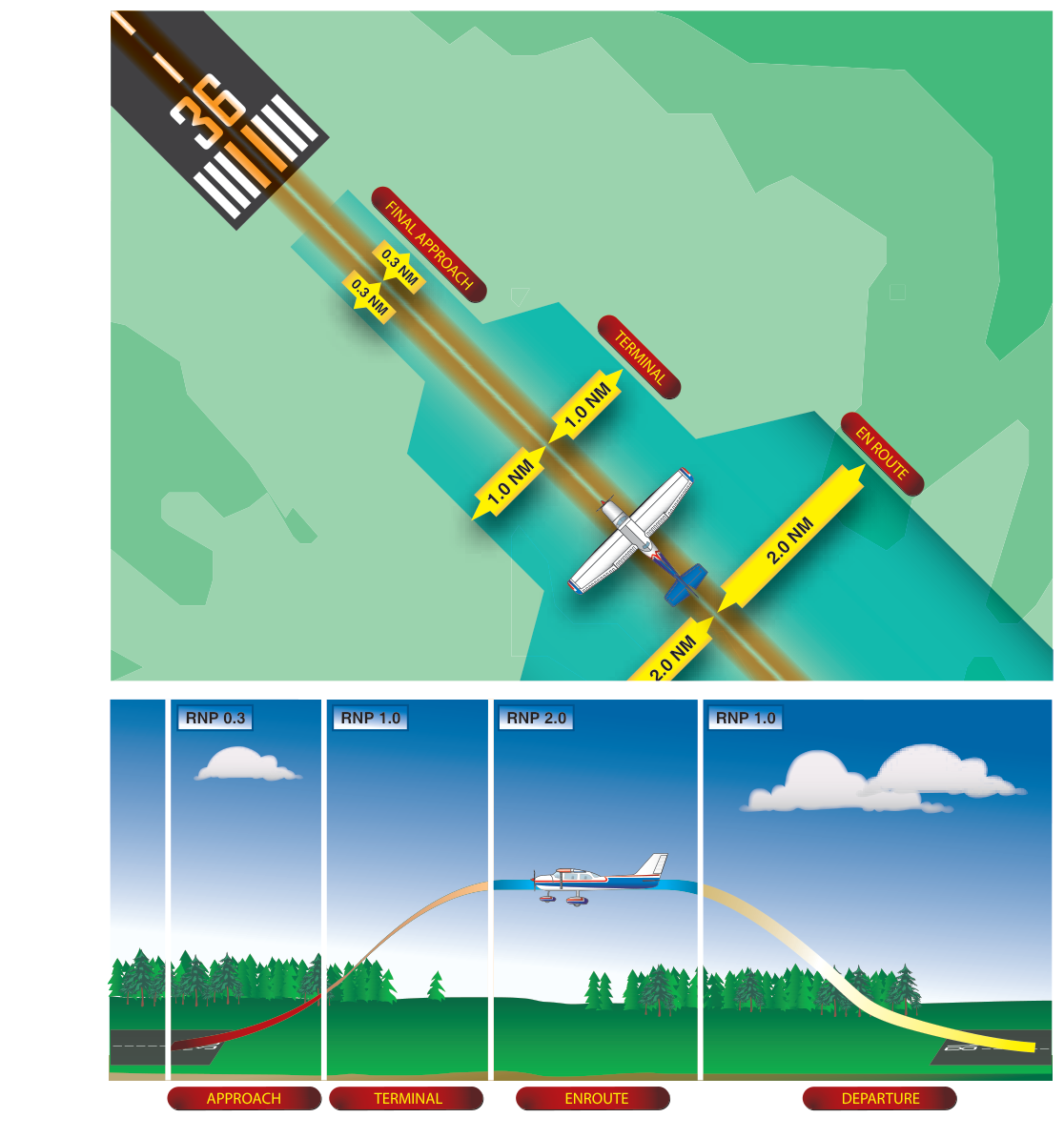
Modern instrument flying has moved well beyond tuning a single VOR and tracking a needle. Today's IFR pilots operate in a performance-based navigation (PBN) environment where the question is no longer simply which sensor you use, but how accurately and reliably your navigation system performs. Two interlocking concepts sit at the heart of PBN: Required Navigation Performance (RNP) and Actual Navigation Performance (ANP). Understanding them is essential for any instrument-rated pilot flying RNAV routes, GPS approaches, or RNP AR procedures — and for passing the instrument knowledge test.
At the simplest level, RNP is the accuracy standard the airspace or procedure demands, and ANP is the accuracy your avionics are actually delivering at any given moment. When ANP stays within RNP, you are within the protected airspace. When ANP grows larger than RNP, your system is telling you it can no longer guarantee you are where you think you are — and action is required.
The Concept of Performance-Based Navigation
The FAA's PBN framework, grounded in ICAO standards and described in the Instrument Flying Handbook (FAA-H-8083-15) and the Instrument Procedures Handbook (FAA-H-8083-16), replaced the older sensor-specific idea ("you need a VOR receiver for this route") with a capability-based one ("your navigation system must meet this accuracy, integrity, and continuity standard"). RNP is the specification that defines those standards for a given phase of flight or procedure.
There are two broad families within PBN: Area Navigation (RNAV) specifications and RNP specifications. The key difference is that RNP specifications include a mandatory on-board performance monitoring and alerting (OPMA) requirement. An RNAV system might tell you where you are; an RNP system also continuously checks whether its estimate is reliable and alerts you if it is not. That self-monitoring capability is what makes RNP approaches possible in conditions and environments where extra terrain or obstacle clearance confidence is needed.
Required Navigation Performance (RNP): What It Is
RNP is expressed as a distance in nautical miles. It represents a total system error (TSE) limit within which the aircraft must remain for at least 95% of flight time. For example, RNP 1 means the aircraft must be within 1 NM of the centerline or defined path at least 95% of the time. The value defines a protected corridor: the procedure or route designer has built obstacle clearance areas around that corridor, so staying inside it means you have the required separation from terrain, obstacles, and other traffic.
Common RNP/RNAV values you will encounter include:
- RNAV 2: Used on many high-altitude RNAV routes (Q-routes and T-routes). Total system error must not exceed 2 NM for 95% of flight time.
- RNAV 1: Used on RNAV SIDs and STARs. System error must stay within 1 NM for 95% of flight time.
- RNP 1: Similar accuracy to RNAV 1 but adds the mandatory on-board alerting requirement.
- RNP APCH: The initial and intermediate segments of an RNP approach typically use RNP 1, stepping down to RNP 0.3 NM (about 1,824 feet either side of course) for the final approach segment, for 95% of flight time. Some LPV and LNAV procedures use even tighter values approaching the threshold, so the applicable RNP value can vary by segment and by procedure — always check the specific approach chart.
- RNP AR (Authorization Required): Can have values as tight as 0.1 NM and allows curved (radius-to-fix) paths. These require special aircraft certification and FAA operational approval.
The 95% figure is not the whole story. RNP specifications also carry an implicit integrity standard: the probability of the system error exceeding twice the RNP value (the "2×RNP" bound) without alerting the crew must be extremely small — typically less than 10⁻⁵ per hour. This is why the on-board monitoring function exists.
Actual Navigation Performance (ANP): What It Is
ANP — also called Estimated Position Uncertainty (EPU) in some avionics systems — is a real-time figure your FMS or GPS navigator computes to describe its own uncertainty about your current position. Think of it as a radius of a circle of confidence: the navigation computer is telling you, "I am confident your true position is within this many nautical miles of the position I am displaying, 95% of the time."
ANP is dynamic. It changes continuously based on factors like GPS satellite geometry (dilution of precision, or DOP), the number and signal quality of visible satellites, whether WAAS or other augmentation is available, how long the system has been running, and whether any sensor inputs have been excluded due to a fault. In excellent conditions — clear skies, strong WAAS signal, optimal satellite geometry — ANP might be 0.02 NM or less. In degraded conditions — poor geometry, RAIM issues, WAAS outage — ANP can grow significantly.
The Critical Relationship: ANP vs. RNP
The rule is straightforward and must be internalized: ANP must be less than or equal to RNP for the operation to remain valid. Many modern avionics display this relationship directly. Some units show an "unable RNP" or "RNP not met" annunciation when ANP exceeds the applicable RNP value. Others display both figures side by side so the crew can monitor the margin.
Consider a practical example. You are flying an RNP approach with an RNP value of 0.3 NM. Your avionics show ANP = 0.08 NM. You have a comfortable margin — the system's position estimate uncertainty is well within the procedure's required accuracy. Now imagine WAAS signal degrades during a solar event and ANP climbs to 0.35 NM. ANP now exceeds RNP. The system can no longer guarantee containment within the protected corridor. The correct response is to discontinue the approach and execute the missed approach, then divert or hold until the situation improves.
This real-time, self-reporting nature of RNP systems is a significant safety improvement over older systems. Rather than relying entirely on pre-flight RAIM prediction or ground monitoring, the aircraft itself is continuously auditing its own performance and notifying the crew the moment it can no longer meet the required standard.
RAIM and Its Role
For non-WAAS GPS operations, Receiver Autonomous Integrity Monitoring (RAIM) serves a related but slightly different function. RAIM algorithms detect whether the GPS constellation geometry is sufficient to detect a satellite fault — but classic RAIM does not compute ANP in the same continuous, FMS-integrated fashion. The Instrument Flying Handbook distinguishes between basic RNAV GPS operations (which rely on RAIM checks) and full RNP operations (which require on-board performance monitoring and alerting that goes beyond traditional RAIM). WAAS-equipped receivers automatically satisfy the integrity requirement for RNP APCH procedures by continuously checking WAAS corrections and computing protection levels that function similarly to ANP/EPU.
Why It Matters in the Cockpit
Understanding ANP versus RNP is not an academic exercise. Instrument procedures designed as RNP approaches may serve airports surrounded by terrain or in challenging meteorological environments where traditional ILS infrastructure is not feasible. The RNP system's self-monitoring means that if the equipment cannot deliver the required accuracy, it says so — but only if the pilot is watching for the alert and knows to act on it.
Before commencing any RNP procedure, pilots should confirm the avionics are in the appropriate mode (LNAV, LNAV/VNAV, LPV, or RNP AR as applicable), check that ANP is displayed and is within limits, verify that WAAS or the required augmentation is active, and review NOTAMs for GPS outages or satellite anomalies that could degrade performance en route. During the approach, periodic cross-checks of the ANP readout (where displayed) add an important layer of situational awareness.
Key Numbers and Rules
- RNP expressed in NM: The smaller the value, the tighter the accuracy requirement (RNP 0.1 is more demanding than RNP 1).
- 95% containment: The aircraft must remain within ±RNP of the defined path at least 95% of the time.
- Integrity bound: Probability of exceeding 2×RNP without an alert is typically less than 10⁻⁵ per hour.
- RNP APCH (GPS approach) typical values: RNP 1 for initial/intermediate segments, stepping down to RNP 0.3 NM in the final approach segment (some procedures use tighter values near the threshold).
- RNP AR minimum values: Can reach 0.1 NM; requires special certification and FAA authorization.
- ANP must be ≤ RNP: If ANP exceeds RNP, the operation cannot safely continue — missed approach or diversion is required.
- WAAS LPV approaches provide precision approach-like vertical guidance and meet RNP APCH accuracy requirements at thousands of airports without an ILS.
Common Test Traps
- Confusing RNAV and RNP: All RNP operations are RNAV operations, but not all RNAV operations are RNP. RNP adds the mandatory on-board performance monitoring and alerting requirement — that distinction is frequently tested.
- Misreading the ANP/RNP relationship: Students sometimes think a larger ANP number means better performance. It is the opposite — a large ANP means high uncertainty. You want ANP to be small and well below RNP.
- Assuming RAIM equals RNP monitoring: Classic RAIM provides fault detection for basic GPS operations; it does not fully satisfy the on-board monitoring and alerting requirement of formal RNP specifications. WAAS-based protection levels are needed for RNP APCH.
- Forgetting the missed approach requirement: If ANP exceeds RNP during an approach, the correct action is not to continue and hope it improves — it is to immediately execute the missed approach. The test may present scenario questions where continuing is a tempting but wrong answer.
- Overlooking pre-flight NOTAM checks: GPS service outages, solar activity, or WAAS outages can all degrade ANP. Pilots must check NOTAMs and, for non-WAAS operations, run a RAIM prediction before departing. Failing to do so is a common oversight that the test addresses in ADM and flight planning questions.