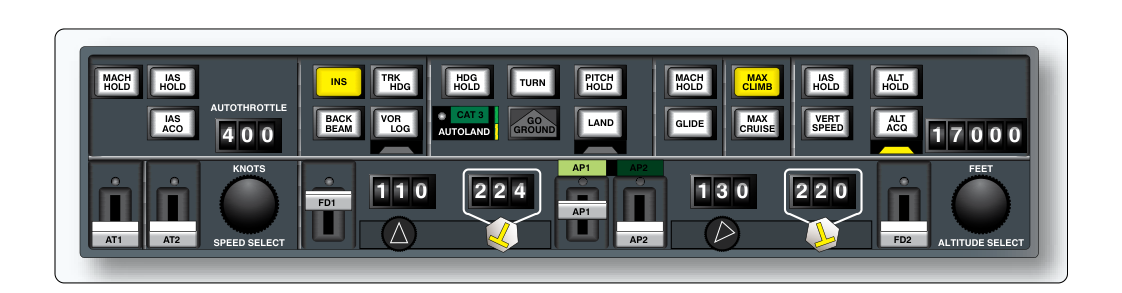
Modern transport-category aircraft depend on sophisticated autopilot systems to reduce crew workload, improve precision, and enable operations in low-visibility environments. At the heart of that automation is the Mode Control Panel (MCP) — the cockpit interface through which pilots command the autopilot, flight director, and autothrottle. Understanding exactly what each mode does, how modes interact, and where the boundaries of automation lie is a foundational competency for Airline Transport Pilot (ATP) candidates and a recurring source of questions on the ATP knowledge test.
This article explains MCP architecture, each major autopilot mode category, how mode transitions work, and the real-world consequences of mismanaging automation — all grounded in FAA guidance from the Instrument Flying Handbook, the Instrument Procedures Handbook, and the Pilot's Handbook of Aeronautical Knowledge.
What the MCP Is and How It Fits the Automation Architecture
The MCP (sometimes called the Flight Control Unit or FCU on Airbus-family aircraft) sits on the glareshield and serves as a direct communication channel between the pilots and the autopilot computers. It is distinct from the Flight Management System (FMS): the FMS is a navigation and performance computer that calculates routes, fuel burn, and optimal profiles, while the MCP translates crew intent into immediate autopilot commands. The two systems work together — the crew can choose to let the autopilot follow FMS-generated guidance (managed mode) or override with manually-set MCP values (selected mode).
The autopilot itself monitors control surface positions, compares aircraft state to the commanded reference, and drives the flight control actuators to eliminate any error. The flight director (FD) presents command bars on the primary flight display (PFD) that show the pilot where to fly; when the autopilot is engaged it follows those same command bars automatically. The autothrottle (A/T) manages thrust to maintain a target speed or thrust mode. All three systems — autopilot, flight director, and autothrottle — are commanded and monitored through the MCP.
Major Autopilot Mode Categories
Lateral Modes
Lateral modes control the aircraft's heading and track. The most common are:
- Heading (HDG) Select: The autopilot flies the heading dialed into the MCP heading window. It takes the shortest turn to that heading. This mode does not account for wind — the aircraft flies a magnetic heading, not a ground track. Pilots must apply mental wind correction to achieve the desired track.
- Track (TRK) Select: Available on some aircraft types, this mode commands the autopilot to maintain a specific ground track over the surface, automatically compensating for crosswind. It is a GPS/GNSS-referenced mode.
- VOR/LOC: Arms the autopilot to capture and track a VOR radial or localizer. When armed, the system waits for the course deviation indicator (CDI) to approach center before activating (capturing). Once captured, the autopilot tracks the beam, adjusting for crosswind drift. The exact localizer capture point varies significantly by aircraft type and manufacturer — many systems capture based on deviation trend and closure rate rather than a fixed deviation value, so pilots should consult the aircraft-specific AFM/FCOM for capture behavior.
- LNAV (Lateral Navigation): Follows the active FMS route. The autopilot tracks waypoints, course changes, and procedure turns programmed into the FMC. LNAV is the standard lateral mode for oceanic and enroute flight and for RNAV approaches.
- Approach (APP): Couples the autopilot to both the localizer and glideslope for a full ILS approach. This is a prerequisite for autoland capability on suitably equipped aircraft.
Vertical Modes
Vertical modes control pitch and, by extension, altitude, climb rate, and airspeed. The key modes include:
- Altitude Hold (ALT HLD): Maintains the altitude at which the mode was engaged. Any deviation caused by turbulence or configuration change will be corrected automatically. Pilots must be cautious about inadvertent engagement during a climb or descent — the aircraft will level at the current altitude, not the assigned one.
- Altitude Select (ALT SEL or VNAV ALT): The autopilot arms the selected altitude in the MCP altitude window and will automatically level off when that altitude is reached. This is one of the most tested concepts: the aircraft will not climb or descend to the selected altitude on its own — it needs a separate vertical mode (V/S, FLC, or VNAV) to actually move vertically.
- Vertical Speed (V/S): Maintains a pilot-selected rate of climb or descent in feet per minute. The autothrottle adjusts thrust to maintain speed while the autopilot holds the commanded vertical rate. A risk of V/S mode is overspeed or underspeed if the pilot selects a climb rate the aircraft cannot sustain at the current thrust setting — the aircraft will pitch up and slow down, potentially approaching a stall.
- Flight Level Change (FLC) / IAS Hold: Maintains a selected airspeed while climbing or descending, using pitch to control speed and thrust (via autothrottle) to manage the energy. This is generally the preferred mode for large altitude changes because the aircraft will not slow below the commanded speed; rather, the climb rate will reduce if thrust is insufficient.
- VNAV (Vertical Navigation): Follows the vertical profile computed by the FMS, including step climbs, descent profiles, crossing restrictions, and arrival procedures. VNAV PATH mode tracks a computed descent profile; VNAV SPD mode manages speed during constraint captures. Understanding the VNAV sub-modes and their transitions is a common ATP test topic.
- Glideslope (G/S): Captures and tracks the ILS glideslope signal. Like the localizer, it arms first (GS ARM) and then captures when the aircraft is close enough to the beam. Below glideslope capture the autopilot uses pitch to maintain the 3° (nominal) descent path.
Autothrottle Modes
The autothrottle operates in several modes as well, coordinated with the vertical mode. Speed (SPD) mode maintains a selected airspeed by adjusting thrust. Thrust (THR) or N1 mode holds a commanded thrust level (for example, climb thrust) and allows the pitch axis to control speed. Retard mode commands throttles to idle near touchdown during autoland or autothrottle-coupled approaches. The crew must monitor autothrottle mode annunciations closely — a failure to command proper thrust during a go-around, for example, can create a dangerous energy state.
Mode Annunciations and the Flight Mode Annunciator (FMA)
Every active and armed mode is displayed on the Flight Mode Annunciator (FMA), located at the top of the PFD. The FMA is divided into columns for thrust, pitch (vertical), and roll (lateral), and typically shows both the active mode (usually in green or white) and armed modes (usually in white or cyan). Standard airline procedures and FAA guidance on automation management recommend a crew verbal callout any time a mode changes — either because the crew commanded it or because the automation transitioned automatically — though the specific callout procedure is set by operator SOP rather than a single codified FAA regulation. This practice of mode awareness is central to preventing automation surprises.
Why This Matters: Automation Surprises and Mode Confusion
The FAA's Risk Management Handbook and multiple NTSB accident studies identify mode confusion — not knowing what the autopilot is doing or why — as a significant causal factor in transport accidents. Common scenarios include an aircraft leveling at the wrong altitude because the crew dialed in a new altitude before the autopilot reached the previous one, or a jet descending on VNAV PATH without the crew realizing that a crossing restriction was no longer being met. The FAA emphasizes that automation does not remove pilot responsibility: the pilot flying must always know the active mode, the armed mode, and the next expected transition.
Additionally, disconnecting the autopilot at low altitude during a high-workload phase (such as a circling approach) requires immediate hand-flying competency. Automation dependency — the erosion of manual flying skills through over-reliance on the autopilot — is a recognized safety concern addressed in FAA guidance such as AC 120-123 (Devices and Automation) and related SAFO guidance, and is tested at the ATP level.
Key Numbers and Rules
- The ATP practical test standards (ACS) require candidates to demonstrate understanding of automation modes and the ability to monitor and verify FMA annunciations.
- 14 CFR Part 121.579 specifies altitude alerting system requirements for air carrier aircraft, which work in conjunction with MCP altitude selections.
- Autoland (Category II/III operations) requires both the autopilot and autothrottle to be engaged in APP mode with specific aircraft and airport certification — not all autopilot-coupled approaches qualify as autoland.
- When selecting a new altitude on the MCP, the aircraft will not move to that altitude until a vertical mode (V/S, FLC, or VNAV) is active — Altitude Select only arms the capture.
- Localizer and glideslope modes ARM first and CAPTURE second — selecting APP mode does not mean the aircraft is immediately on the ILS.
- Autopilot behavior during a go-around, including any altitude at which the autopilot may disengage, is entirely aircraft- and system-specific and is defined in the aircraft's AFM/FCOM rather than by a single FAA-published value — the crew must always be ready to hand-fly immediately if disengagement occurs.
Memory Aid — STAR for Mode Awareness
When any autopilot mode change occurs, use the STAR check to verify system state:
- S — Selected: What mode did I select (or what did the automation select automatically)?
- T — Transition: Did the mode transition as expected (arm to capture, or one mode to another)?
- A — Annunciation: Does the FMA confirm the expected active and armed modes?
- R — Result: Is the aircraft actually flying the expected path and speed?
This four-step scan keeps the crew ahead of the automation rather than reacting to it after the fact.
Common Test Traps
- Altitude Select does not climb or descend the aircraft. Many candidates incorrectly believe that dialing a new altitude into the MCP immediately commands a climb or descent. It only arms the level-off; a vertical mode must be active to actually move altitude.
- V/S mode can cause an inadvertent stall. Selecting an aggressive climb rate in V/S mode with insufficient thrust will cause the aircraft to slow while maintaining the commanded pitch, potentially leading to an overspeed warning on descent or a stall warning on climb — the autopilot holds the rate, not the speed.
- Heading mode does not equal track. In a crosswind, flying HDG 090 does not produce a ground track of 090. The FMS/LNAV tracks ground track; HDG mode does not.
- APP mode arms, it does not instantly capture. Selecting APP mode too close to the localizer or glideslope can cause an aggressive intercept or a missed capture. Proper intercept geometry (typically 30° or less, at a reasonable distance) is required for a stable capture.
- Autopilot engagement does not transfer responsibility. The crew remains legally and operationally responsible for the aircraft's flight path at all times. An autopilot-coupled exceedance of an altitude clearance is still a violation under 14 CFR.