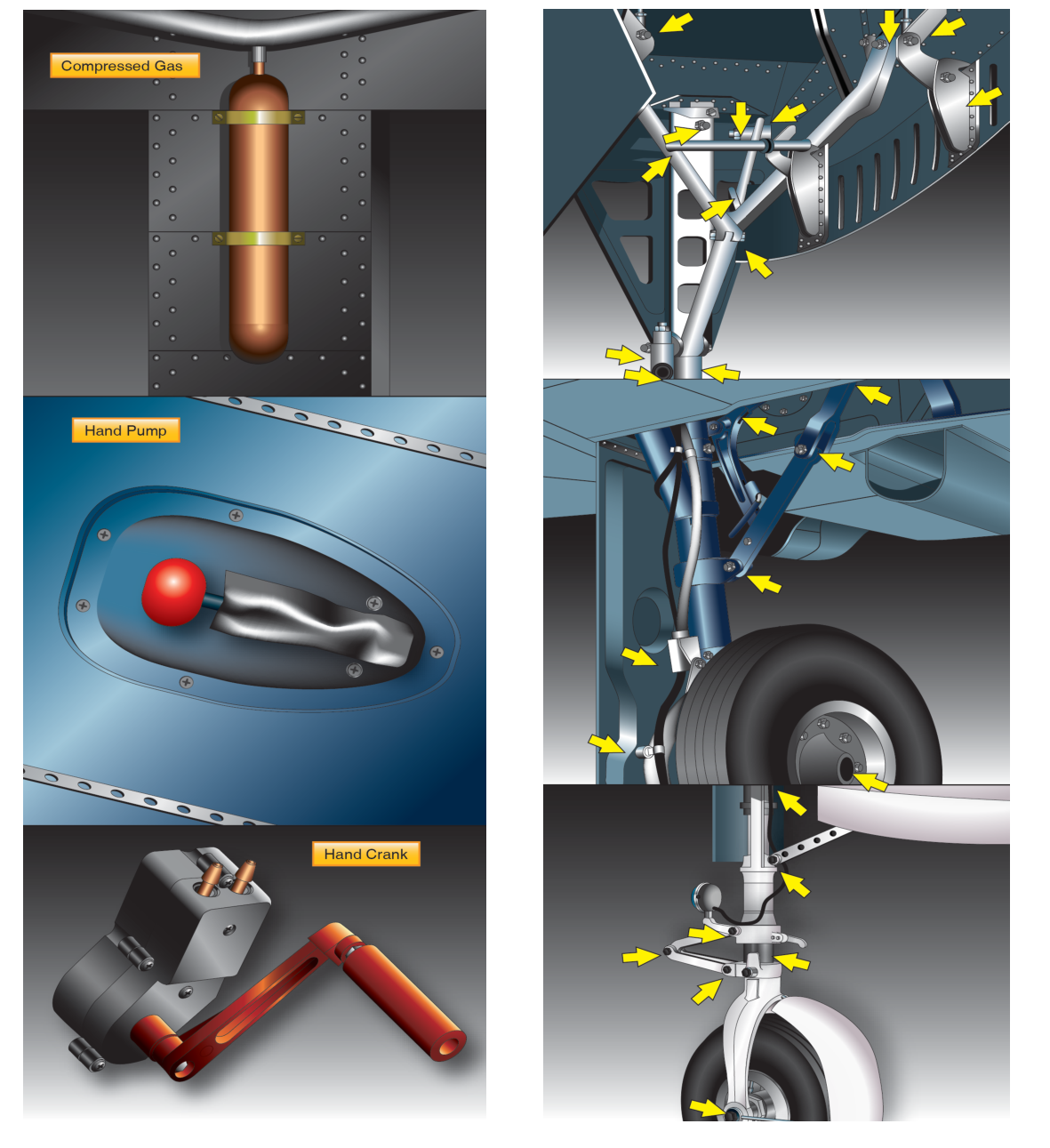
Retractable landing gear is one of the defining systems separating higher-performance aircraft from their fixed-gear counterparts, and it commands serious attention on the Commercial Pilot Airplane knowledge test. The performance dividend is real: eliminating the drag of exposed wheels, struts, and wheel fairings reduces parasite drag and can meaningfully improve cruise speed and fuel economy, though the exact gain varies considerably by airframe design. But that advantage comes packaged with additional mechanical complexity, a set of limiting speeds, and a sobering accident category — the gear-up landing — that remains entirely preventable through knowledge, discipline, and consistent procedure.
How Retractable Gear Systems Are Actuated
The two primary actuation architectures are hydraulic and electric, and many production aircraft blend both. In a purely hydraulic system, an engine-driven or electrically driven pump generates fluid pressure that moves actuating cylinders to raise or lower the gear. In an electric system, a DC motor drives mechanical actuators or screwjacks directly. The most common light-aircraft arrangement is electro-hydraulic: an electric motor powers a reversible hydraulic pump, and fluid pressure does the mechanical work. This setup is found in many Piper and Cessna retractable designs.
Regardless of architecture, virtually every certificated retractable-gear aircraft must provide an emergency or alternate extension capability. Depending on the design, this may be a hand-operated hydraulic pump, a free-fall or gravity-drop system that unlocks the uplocks and allows aerodynamic and gravitational forces to extend the gear, a pneumatic backup charged with compressed air or CO₂, or a combination of these methods. The Pilot's Operating Handbook (POH) / Airplane Flight Manual (AFM) specifies the exact sequence for the particular aircraft, and the commercial pilot candidate is expected to know that sequence for the aircraft used in practical testing.
Critical Speed Limits: VLO and VLE
Two airspeed limitations govern retractable-gear operations, and confusing them is among the most frequently exploited test traps:
- VLO — Maximum Landing Gear Operating Speed: The highest airspeed at which the gear may be extended or retracted. Exceeding VLO during gear movement risks structural damage to doors, actuators, and gear legs due to aerodynamic loads. VLO may be different for extension versus retraction in some aircraft, so always consult the AFM limitations section.
- VLE — Maximum Landing Gear Extended Speed: The highest airspeed at which the aircraft may be flown with the gear already down and locked. Because the extended gear creates significant drag and aerodynamic loading, VLE is a structural limitation protecting the gear doors, struts, and attachment points.
The critical rule: VLO is typically lower than VLE, and it is the more restrictive limit during the act of operating the gear. Think of it this way — the gear in motion is more vulnerable than the gear locked down. If you need to extend the gear in an emergency descent, slow to VLO before moving the handle, then verify positive extension before allowing speed to rise toward VLE if needed for drag.
Safety Mechanisms: How the System Protects Itself
Squat Switch (Weight-on-Wheels Switch)
The squat switch is a micro-switch or proximity sensor mounted in the main gear strut that detects whether the aircraft's weight is compressing the strut — meaning the aircraft is on the ground. When weight is on wheels, the squat switch opens the retraction circuit, making it electrically impossible to retract the gear even if the pilot inadvertently moves the handle to UP. Critically, the squat switch does not inhibit extension — the gear can be lowered at any time. The squat switch prevents a ground retraction; it cannot prevent a pilot from forgetting to extend the gear for landing.
Gear Warning Horn
The gear warning system provides an aural alert — typically a continuous horn or intermittent beeper — when the throttle is reduced below a design threshold (usually approach or near-idle power settings) and the gear is not down and locked. The trigger is throttle position, not airspeed. This means a pilot who pulls power back during cruise descent may hear the horn activate even with no intention of landing; this is normal operation and not a malfunction. On final approach, a silent horn when the throttle is retarded to idle is cause for immediate concern — either the gear is down and locked (good) or the horn system has failed (requiring immediate troubleshooting). Never silence a gear horn and continue the approach without positively confirming gear position.
Gear Door Sequencing
Most retractable systems integrate gear doors that must open before the gear extends and close after the gear retracts. The sequencing is automatic and managed through mechanical cams, hydraulic sequencing valves, or electrical limit switches. When the system operates normally, the pilot notices only the time delay for the full cycle. When a sequencing failure occurs, a gear leg may attempt to extend against a closed door — an expensive mechanical interference. Understanding sequencing explains why the gear-extension cycle takes several seconds and why unusual sounds during the cycle warrant immediate checklist consultation.
Mechanical Downlocks and Uplocks
Once the gear is fully extended, it must be locked positively in position to prevent collapse under the substantial vertical loads of landing. Downlocks use over-center link mechanisms or separate locking pins that snap into place when the gear reaches full extension, holding the gear rigid against compression loads without requiring continuous hydraulic pressure. Conversely, uplocks hold the gear securely in the retracted position during flight so it cannot fall open due to vibration or aerodynamic forces. Both locks must be mechanically released before the gear can move in either direction. A green gear-position light illuminates only when the downlock is positively engaged — not simply when the gear has dropped to the extended position.
Cockpit Indications and Verification
The primary cockpit indicator is the gear position light system. Three green lights — one per gear leg in a tricycle configuration — confirm that all three gear are down and locked. A red or amber light, or a light that fails to illuminate, indicates the gear is in transit, unsafe, or that the indicator circuit has failed. The absence of all three greens at landing is a go-around trigger until the situation is resolved. Many aircraft use a gear handle shaped like a small wheel, a tactile design feature that reduces the risk of grabbing the flap handle by mistake — a real hazard that has caused accidents. Some aircraft also include a mirror, a window port, or a camera system allowing the pilot to visually confirm nose gear extension independent of the indicator.
Emergency Gear Extension Procedure
If the primary system fails to extend the gear normally, the general commercial-pilot sequence is: identify and confirm the failure, slow to at or below VLO, complete the emergency gear extension checklist from the POH/AFM, cycle the alternate extension method, verify gear position via lights and any available visual means, and land as soon as practicable. If the gear cannot be confirmed down and locked, the pilot should declare an emergency, advise ATC, and follow airport emergency services guidance. Attempting to force a partially extended gear down or landing with unconfirmed gear position is generally more destructive and dangerous than executing a controlled, gear-up landing if extension proves impossible — but this decision is always governed by the specific AFM guidance and pilot-in-command judgment, in coordination with ATC and airport emergency services.
Why the Commercial Pilot Standard Emphasizes Procedures
The FAA's Airplane Flying Handbook (FAA-H-8083-3) stresses that the single most effective defense against gear-up landings is a consistent, disciplined pre-landing checklist executed at multiple points in the pattern — typically abeam the numbers on downwind, on base, and on final. Automated safety devices are backup layers, not substitutes for procedure. Distraction, an abbreviated pattern, a straight-in approach, or an abnormal situation are the conditions most frequently associated with gear-up accidents. Recognizing when warning systems fail silently — a horn that does not sound, a green light that does not illuminate — is equally critical and requires the pilot to cross-check multiple information sources.
Memory Aid
GUMPS is the standard mnemonic for pre-landing flow checks: Gas (fuel quantity checked, proper tank selected, and fuel pump on as required), Undercarriage (gear down and three green confirmed), Mixture (enriched for landing altitude), Propeller (control set full forward/increase RPM in case a go-around is needed), Seat belts, shoulder harnesses, and switches (secured and configured, including landing lights and fuel pump as applicable). Running GUMPS on downwind, base, and final creates a three-layer redundancy specifically targeted at the items most likely to be missed during a distracted approach.
Common Test Traps
- VLO vs. VLE: VLO limits gear movement; VLE limits flight with gear extended and locked. VLO is typically the lower — and more restrictive — speed during gear operation.
- Squat switch direction: The squat switch blocks retraction on the ground. It does not block extension. The gear can always be lowered; it cannot be raised when weight is on the wheels.
- Horn trigger vs. airspeed: The gear warning horn is throttle-actuated, not airspeed-actuated. A power reduction at cruise altitude can trigger the horn without any approach intent — this is normal system behavior.
- Three green means locked — not just extended: The green light circuit is wired through the downlock switch. A gear that has dropped but not achieved a positive mechanical lock will not illuminate the green light, correctly indicating an unsafe condition.
- Emergency extension and VLO: Even during an emergency, the pilot must slow to at or below VLO before using the alternate extension system. Deploying the gear at excessive speed can cause structural failure of the gear or doors.