Piston aircraft engines convert chemical energy into mechanical power only when the fuel-air mixture reaching each cylinder is precisely controlled. Two fundamentally different technologies accomplish this metering task in general aviation: the float-type carburetor and the fuel injection system. Both are addressed in the FAA Pilot's Handbook of Aeronautical Knowledge (PHAK, FAA-H-8083-25) and in the Airplane Flying Handbook (FAA-H-8083-3). Commercial pilot applicants are expected to understand not only the mechanical principles behind each design, but also the operational strengths, failure modes, icing characteristics, starting techniques, and in-flight management implications that distinguish them.
How the Float-Type Carburetor Works
A float-type carburetor relies on the venturi principle to draw fuel into the airstream. As intake air accelerates through the narrowed venturi throat, its velocity increases and its static pressure drops below atmospheric. This low-pressure region sits directly above a discharge nozzle connected to the float bowl, so atmospheric pressure acting on the bowl surface pushes fuel up through the nozzle, where it atomizes into the moving airstream. The resulting mixture travels through the intake manifold to the cylinders.
The float itself is a sealed, buoyant chamber resting on the surface of the fuel in the bowl. As fuel is consumed, the float drops, opening a needle valve and admitting more fuel from the supply line. When fuel replenishes the bowl, the float rises and closes the needle valve. This feedback loop maintains a near-constant fuel level—and therefore a consistent fuel-to-air ratio at any given throttle position. Because the float bowl vents to outside air, changes in air density with altitude affect how much air the engine ingests relative to the fixed fuel metering, which is why pilots must lean the mixture as they climb.
Mixture Control in Carbureted Engines
The mixture control on a carbureted engine typically adjusts a needle or valve that limits fuel flow through the main metering jet. At sea level on a standard day the full-rich position provides an appropriate mixture, but as density altitude rises, the same volume of air contains fewer air molecules. Without leaning, the mixture becomes excessively rich, wasting fuel and reducing power. The PHAK recommends leaning for cruise above 3,000 feet density altitude or whenever power settings allow, following the aircraft's Pilot Operating Handbook (POH).
Carburetor Ice: The Float System's Critical Vulnerability
The most significant hazard unique to carbureted engines is carburetor icing. Two simultaneous physical processes chill the air inside the carburetor throat. First, fuel vaporization absorbs latent heat from the surrounding air. Second, the venturi pressure drop itself causes a temperature decrease. Together, these effects can reduce local air temperature by as much as 60°-70°F (approximately 15°-21°C) below the ambient temperature—a value cited in FAA training materials. Ice then accumulates on the throttle plate and venturi walls, progressively restricting airflow and reducing power with no external warning to the pilot.
The insidious nature of carburetor ice is that it forms most readily at outside air temperatures between approximately 20°F and 90°F (roughly −6°C to 32°C) combined with high relative humidity—conditions that feel mild and unthreatening. The FAA emphasizes that icing is especially likely at reduced power settings, such as during descent, when fuel flow and airflow are both low. Applying carburetor heat introduces warm air from around the exhaust manifold, raising the temperature inside the throat above the freezing point. Pilots should treat carburetor heat as a preventive tool during icing-conducive conditions rather than waiting for a rough engine as confirmation that ice has already formed.
Technique When Ice Is Suspected
When carburetor heat is applied and ice is present, the engine will typically run rougher initially—a sign that ice is melting and passing as water through the intake. This temporary roughness is normal and expected. The pilot should maintain full carburetor heat until the engine smooths out completely before returning to cold air. Removing heat too early, while ice is only partially melted, can allow refreezing. Additionally, applying carburetor heat always introduces less-dense warm air, which enriches the mixture. In extended cruise flight with carb heat on, slight leaning may be appropriate per the POH.
How Fuel Injection Systems Work
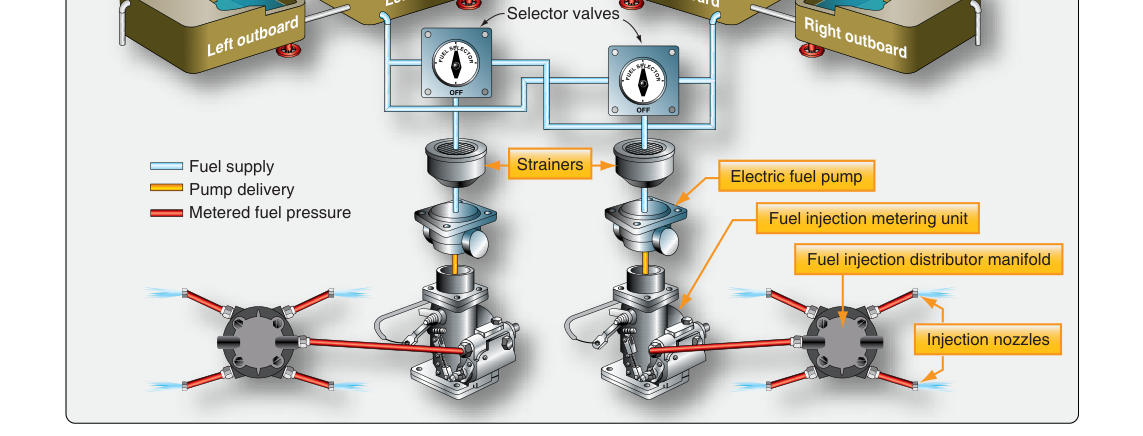
A continuous-flow fuel injection system—the type most commonly found on certificated light aircraft such as those equipped with Lycoming or Continental injected engines—eliminates the venturi-and-bowl arrangement entirely. An engine-driven fuel pump pressurizes fuel to a calibrated pressure and delivers it to a fuel-air control unit, which simultaneously meters both fuel flow and incoming air based on throttle position and mixture setting. Metered fuel then travels to a flow divider (sometimes called a distribution valve), which divides the flow equally among the individual injector nozzles positioned at each cylinder's intake port. Fuel is injected just upstream of the intake valve, where it vaporizes in the warm port environment and mixes with air before entering the cylinder.
Advantages of Fuel Injection
- More uniform cylinder-to-cylinder fuel distribution, improving power output and reducing the likelihood of individual cylinders running excessively lean or rich.
- Better throttle response, because fuel delivery tracks airflow changes more directly without relying on the venturi's pressure differential.
- Elimination of venturi and float-bowl icing, removing the carburetor ice hazard described above.
- Improved fuel efficiency at cruise, since precise metering allows leaner operation near best-economy settings with greater confidence in mixture distribution.
- Reduced susceptibility to fuel contamination affecting a float valve, since there is no float bowl in the induction path.
The Hot-Start Challenge and Vapor Lock
Fuel injection's principal operational drawback is its behavior after a hot shutdown. Residual heat from a recently operated engine can vaporize fuel remaining in the injection lines—a condition known as vapor lock. When the pilot attempts to restart, the fuel-air control unit and injector lines may contain vapor rather than liquid fuel, making normal starting procedures ineffective. Most manufacturers address this with a specific hot-start procedure in the POH, which typically involves setting the mixture to idle-cutoff, using the boost pump at a prescribed low or high setting to purge vapor from the lines, and then introducing mixture at the correct moment during cranking. Flooding the engine by pumping the throttle—an instinct carried over from carbureted engines—is incorrect for most injected engines and can worsen the situation. Always follow the aircraft-specific POH procedure.
Impact Ice: The Injected Engine's Induction Hazard
While fuel injection eliminates carburetor venturi icing, it does not make an aircraft completely immune to induction icing. Injected engines remain susceptible to impact ice—the accumulation of ice at the air intake filter or alternate air inlet when supercooled water droplets or wet snow are ingested. Most fuel-injected aircraft are equipped with an alternate air source (sometimes called an alternate air door) that draws air from inside the engine cowling if the primary filtered intake becomes blocked. The PHAK notes that this alternate air is warmer than outside air because it has been heated by the engine compartment, providing some protection. Pilots operating injected aircraft in visible moisture or near-freezing conditions should verify alternate air status and procedures in the POH.
Key Numbers and Rules to Know
- Carburetor temperature drop: up to approximately 60°-70°F (15°-21°C) below ambient from combined vaporization and venturi cooling.
- Highest carburetor icing risk: outside air temperature between roughly 20°F and 90°F with visible moisture or high relative humidity.
- Applying carb heat always enriches the mixture because warm air is less dense—leaning may be needed for extended carb-heat operation.
- Fuel injection eliminates venturi/float-bowl icing but does not eliminate impact icing at the intake.
- Hot-start vapor lock requires a manufacturer-specific procedure; never use carbureted-engine instincts on an injected engine without consulting the POH.
- Continuous-flow injection delivers fuel near the intake port, not directly into the cylinder (that is direct injection, found in different engine designs).
Common Test Traps
- Carburetor ice forms in temperatures well above freezing. Students frequently assume freezing outside air is required; the FAA states icing is actually most common in mild, humid conditions during low-power flight.
- Roughness after applying carb heat is a positive indication. It means ice is melting—maintain heat until the engine runs smoothly. Removing heat at the first sign of roughness is a dangerous error.
- Fuel injection does not guarantee freedom from all induction icing. Impact ice at the filtered air intake remains a real hazard; alternate air sources exist for this reason.
- The hot-start procedure for injected engines is model-specific. A technique that works on one aircraft may flood or damage another; POH compliance is mandatory.
- Mixture enrichment from carburetor heat is normal and expected. It is not a malfunction; it occurs because warmer, less-dense air reduces the air portion of the mixture ratio.
- Float carburetors do not inherently run richer at altitude without pilot action. Left alone, rising altitude progressively enriches the mixture because air density decreases while the fuel metering orifice stays the same size.