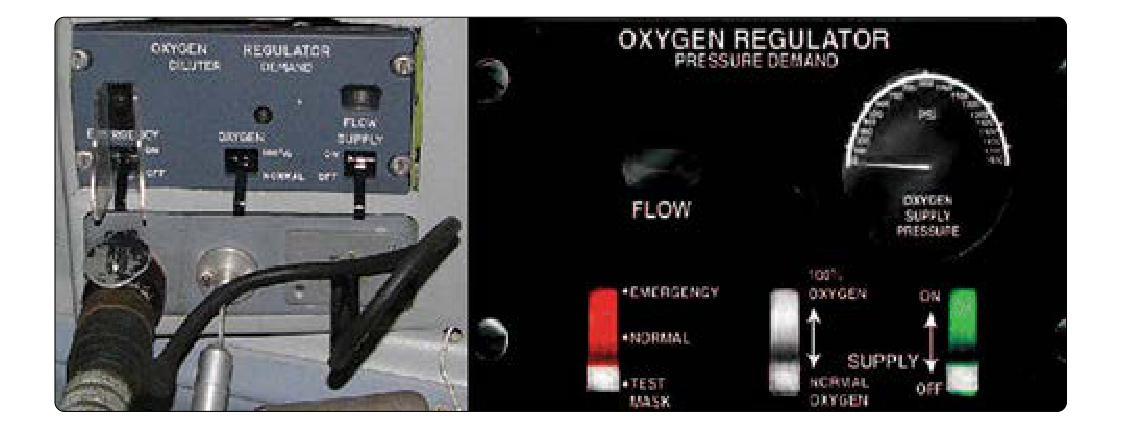
High-altitude flight exposes every occupant to the progressive threat of hypoxia—a condition in which insufficient oxygen reaches the body's tissues, degrading judgment and motor function long before the pilot feels any distress. The FAA's Pilot's Handbook of Aeronautical Knowledge (PHAK, FAA-H-8083-25) and the Instrument Flying Handbook (FAA-H-8083-15) both emphasize that hypoxia is insidious precisely because its early symptoms—mild euphoria, slow reaction time, impaired decision-making—mimic fatigue rather than an emergency. For commercial pilots operating pressurized aircraft at altitude, the oxygen system is a critical safety barrier, and understanding the exact differences between diluter-demand and pressure-demand regulators is an ACS-tested knowledge requirement with direct safety implications.
The Demand-Flow Principle: What Both Systems Share
Both diluter-demand and pressure-demand regulators belong to the demand-type category of oxygen systems. Unlike continuous-flow systems—which bleed a constant stream of oxygen into a rebreather bag regardless of the breathing cycle—demand-type regulators open a valve only when the user begins to inhale, creating a momentary negative pressure at the mask inlet. This on-demand delivery conserves the oxygen supply significantly compared with continuous-flow designs, making demand systems the standard choice for flight crew positions on high-altitude aircraft.
The PHAK identifies three main categories of aircraft oxygen systems: continuous-flow, diluter-demand, and pressure-demand. Continuous-flow is common for passenger supplemental oxygen at lower altitudes; the two demand types are intended for flight crew use at higher altitudes where more precise oxygen control is necessary.
Diluter-Demand Regulators: How They Work
A diluter-demand regulator automatically blends 100% oxygen from the aircraft supply with ambient cabin air in a ratio that changes with altitude. At lower cabin pressure altitudes, where ambient air still provides meaningful partial pressure of oxygen, the regulator introduces a relatively large proportion of cabin air into the breathing mixture, conserving the oxygen supply. As cabin altitude increases, the regulator progressively enriches the mixture with a higher percentage of pure oxygen. By the time cabin altitude reaches approximately 34,000 feet, the diluter-demand regulator is delivering 100% undiluted oxygen on every breath—there is no more cabin air being mixed in.
The mechanism that triggers flow is the slight negative pressure generated by the user's inhalation effort. The lungs must create enough of a pressure differential to open the regulator's demand valve. At cabin pressure altitudes up to roughly 40,000 feet, a healthy person can generate that differential and draw in an adequate volume of 100% oxygen. This is the effective ceiling of a diluter-demand system. Beyond approximately 40,000 feet, the ambient pressure is so low that even breathing in pure oxygen at ambient pressure cannot deliver a sufficient partial pressure of oxygen to the alveoli for adequate saturation of hemoglobin. At that point, the diluter-demand system—however full its oxygen supply—cannot protect the user.
The Diluter Selector Switch
Most diluter-demand regulators include a manual selector that allows the crew member to override the automatic blending and select 100% oxygen at any altitude. This is used when contamination of cabin air is suspected (smoke, fumes) or during emergency depressurization drills. The PHAK recommends selecting 100% if any doubt exists about cabin air quality, even at altitudes where the automatic blending mode would normally be appropriate.
Pressure-Demand Regulators: Going Beyond the Ceiling
A pressure-demand regulator incorporates everything a diluter-demand unit does and adds one transformative capability: it delivers oxygen under positive pressure. Rather than simply responding to the negative pressure of inhalation, a pressure-demand regulator actively pushes oxygen into the mask—and crucially, it maintains a slight positive pressure even during the exhalation phase of the breathing cycle.
This positive-pressure delivery solves the problem that defeats diluter-demand systems above 40,000 feet. Because the regulator is forcing oxygen into the lungs under pressure rather than waiting for the pilot to pull it in, adequate oxygen partial pressure is maintained at the alveolar level even when ambient atmospheric pressure is extremely low. Pressure-demand systems extend effective crew oxygen protection to above 40,000 feet and are standard equipment on aircraft designed to operate in that environment.
Mask Seal Requirements
Positive pressure is only effective if it stays where it belongs—inside the mask. Because the regulator actively pressurizes the breathing space, the mask must form a reliable, airtight seal against the pilot's face. Pressure-demand oxygen masks are therefore tight-fitting and are individually fitted to each crew member. A loose or improperly sized mask renders a pressure-demand system nearly useless at extreme altitude, since pressurized oxygen will simply leak out around the edges rather than enter the lungs. This is a frequently tested point: the requirement for a proper mask fit is a functional requirement tied directly to how the regulator delivers oxygen, not merely a comfort issue.
Regulatory Framework: 14 CFR Requirements
Title 14 CFR Part 91 establishes minimum oxygen use requirements for general aviation operations, and Part 121 imposes additional requirements for air carriers. Key regulatory thresholds that appear on FAA knowledge tests include:
- Above 12,500 feet MSL up to and including 14,000 feet MSL: Flight crew must use supplemental oxygen for any portion of the flight that exceeds 30 minutes at those altitudes.
- Above 14,000 feet MSL: Flight crew must use supplemental oxygen for the entire time at or above that altitude.
- Above 15,000 feet MSL: Each occupant of the aircraft must be provided with supplemental oxygen under 14 CFR 91.211(a)(3).
For pressurized aircraft, 14 CFR Part 91 also specifies requirements related to the availability of oxygen masks and the ability to don them rapidly in the event of depressurization. Commercial operators under Parts 121 and 135 face additional equipment requirements tied specifically to the type of regulator installed and the certificated operating altitude of the aircraft.
Why the Distinction Matters in the Cockpit
Understanding regulator type is not merely a written-test concern. A crew operating a pressurized turboprop with a diluter-demand system at FL390 is adequately protected—the system is delivering 100% oxygen and the cabin is maintained at a safe pressure altitude. But if that aircraft experienced a rapid decompression to flight altitude, the diluter-demand system would be unable to protect the crew above 40,000 feet. Flight planning, emergency procedures, and aircraft certification are all influenced by which regulator type is installed.
Additionally, time of useful consciousness (TUC)—the interval after oxygen loss during which a crew member can take meaningful corrective action—drops dramatically with altitude. At 40,000 feet, TUC may be as short as 15 to 20 seconds. This is why mask donning time is standardized and drilled, and why mask fit and regulator type directly affect survival in a depressurization event.
Key Numbers and Rules
- Diluter-demand regulators deliver 100% oxygen automatically at approximately 34,000 feet cabin altitude.
- Diluter-demand systems are effective up to approximately 40,000 feet; above that, pressure-demand is required.
- Pressure-demand regulators maintain positive pressure during both inhalation and exhalation, unlike diluter-demand units.
- Pressure-demand masks must be tight-fitting and individually fitted to each crew member to contain the positive pressure effectively.
- Both system types are demand-flow—they flow only on inhalation (plus the exhalation positive pressure for pressure-demand), making them more efficient than continuous-flow systems.
- A manual 100% oxygen override is typically available on diluter-demand regulators for use in smoke or fume emergencies.
Common Test Traps
- Diluter-demand is not continuous-flow. Both are demand-type systems. Many distractors on FAA knowledge tests list these as the same or opposite categories—they are both demand-type but differ in pressure delivery.
- The 34,000-foot threshold is about mixture, not effectiveness. The regulator reaches 100% oxygen at 34,000 feet but remains capable of protecting the user up to approximately 40,000 feet. These are two different numbers with two different meanings.
- Pressure-demand does not require more physical breathing effort. It is easier to breathe from, not harder—the regulator is assisting inhalation, not resisting it.
- Mask fit is a functional safety issue for pressure-demand, not a comfort preference. Test questions often ask why pressure-demand masks must fit tightly; the correct answer is to maintain the effectiveness of positive-pressure delivery.
- A full oxygen cylinder does not make a diluter-demand system effective above 40,000 feet. The limiting factor is atmospheric pressure, not oxygen supply quantity.
Memory Aid
"Diluter dilutes with air; Pressure pushes past the limit." Diluter-demand blends cabin air into the mix and relies on your lungs to pull—effective to about 40,000 feet. Pressure-demand actively pushes oxygen under positive pressure, extending protection above that ceiling. When the altitude goes beyond where your lungs can pull enough in, you need the system that pushes it in for you.