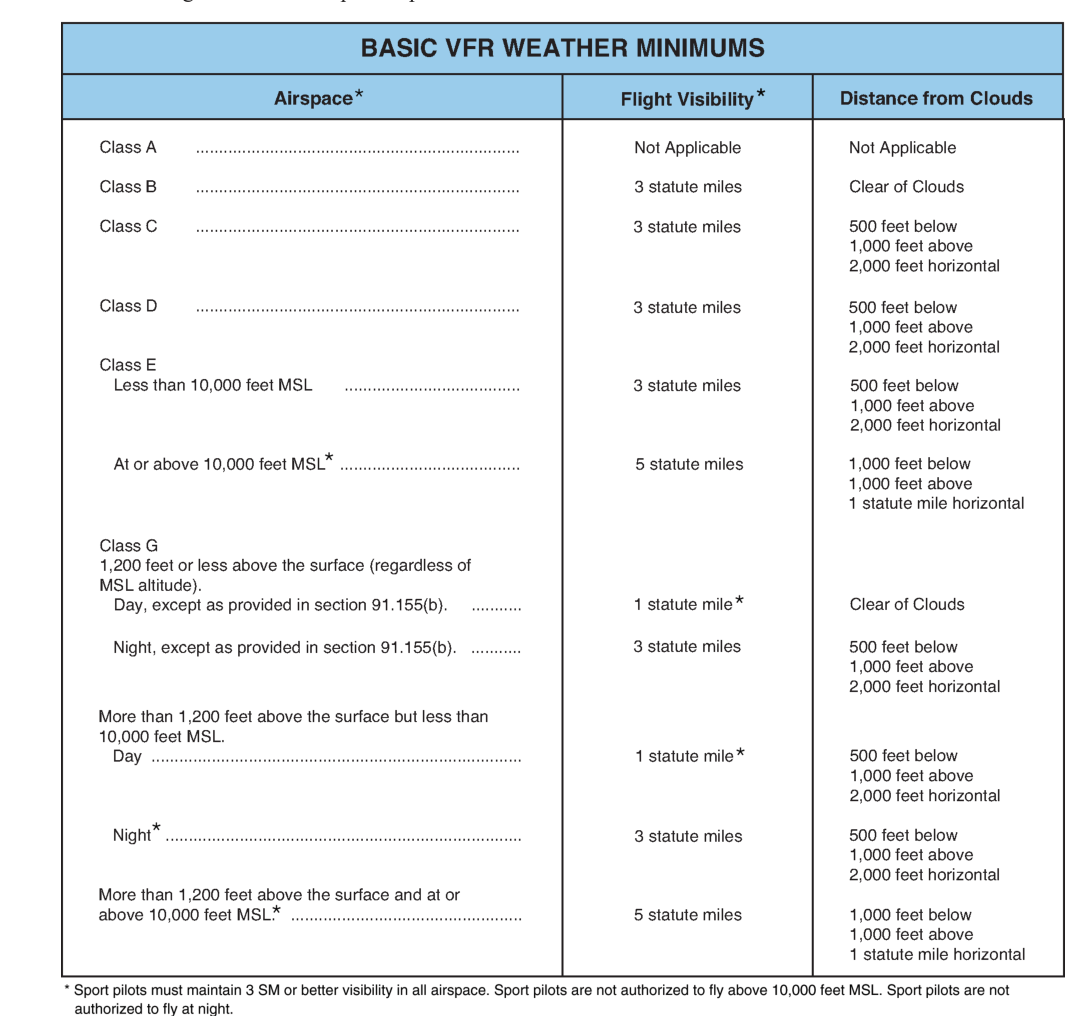
One of the most important limitations a sport pilot must understand is where and when they are legally allowed to fly. Sport pilots operate under Visual Flight Rules (VFR) only, and the Federal Aviation Regulations set specific weather minimums they must meet before and during flight. These minimums exist to ensure that sport pilots—who fly light-sport aircraft and have a more limited training background than private pilots—maintain adequate visual separation from clouds and terrain at all times.
Under 14 CFR Part 61.315, sport pilots may not operate in Class A airspace or at night, and they may not fly in Class B, C, or D airspace, or at an airport located in that airspace, unless they have received specific training and a logbook endorsement for that airspace. Because of this, the weather minimums most relevant to sport pilots are those that apply to Class G and Class E airspace at altitudes below 10,000 feet MSL.
The Minimums in Plain English
In Class E airspace at and below 10,000 feet MSL, sport pilots must maintain at least 3 statute miles of flight visibility and remain 500 feet below, 1,000 feet above, and 2,000 feet horizontally from any cloud. This is the standard VFR cloud clearance requirement most student pilots memorize as "152"—1,000 above, 500 below, 2,000 horizontal—alongside 3 miles visibility.
In Class G airspace the rules vary slightly by altitude and time of day. During the day, at altitudes of 1,200 feet AGL or less, sport pilots need only 1 statute mile visibility and must remain clear of clouds (no specific numeric distance required). At night in Class G airspace, sport pilots cannot fly at all—sport pilot privileges are limited to daytime flight only under 14 CFR 61.315(c)(13).
In Class G airspace above 1,200 feet AGL but below 10,000 feet MSL, the daytime requirement rises to 1 statute mile visibility with 500 feet below, 1,000 feet above, and 2,000 feet horizontal cloud clearance, while nighttime (which sport pilots cannot fly anyway) would require more. Again, since sport pilots are day-VFR only, the nighttime figures are academic but worth recognizing on the test.
Why It Matters
Weather minimums are not arbitrary numbers—they represent the bare minimum conditions under which a VFR pilot can reasonably see and avoid other aircraft, terrain, and obstacles. Flying into deteriorating weather is one of the leading causes of general aviation accidents. Sport pilots are especially vulnerable because light-sport aircraft are often slower and less equipped than certificated aircraft, and sport pilots may have fewer total flight hours. Staying well above the legal minimums is always the safest practice, but you must know the legal floor to recognize when a flight must be cancelled or delayed.
Also remember: if a sport pilot wants to fly in Class B, C, or D airspace, they need a logbook endorsement from a flight instructor who has verified the pilot's proficiency for that airspace. Without that endorsement, sport pilots must stay out regardless of weather conditions.
Memory Aid
For Class E (and controlled airspace) VFR minimums below 10,000 feet MSL, use the classic "152" mnemonic: 1,000 feet above clouds / 500 feet below clouds / 2,000 feet horizontal, plus 3 statute miles visibility. For Class G airspace during the day below 1,200 feet AGL, think "1 and clear"—1 mile visibility and clear of clouds.
Common Test Traps
- Day-only limitation: Sport pilots cannot fly at night. If a question describes a sport pilot flying after sunset, the answer almost always involves a regulatory violation.
- Class G daytime vs. Class E: Students often apply the Class E "152" rule everywhere. Remember that Class G daytime below 1,200 AGL requires only 1 mile visibility and clear of clouds—but this more relaxed rule does not apply in Class E airspace.
- Airspace endorsement trap: Even if the weather is perfectly VFR, a sport pilot without a Class B/C/D endorsement cannot enter that airspace. Weather minimums and airspace authorization are separate requirements.
- "Clear of clouds" does not mean close: Some test-takers think "clear of clouds" gives them a free pass to skim right under a cloud deck. In practice, this standard simply has no numeric value—but ATC and examiners expect pilots to use good judgment and maintain a safe, practical separation.