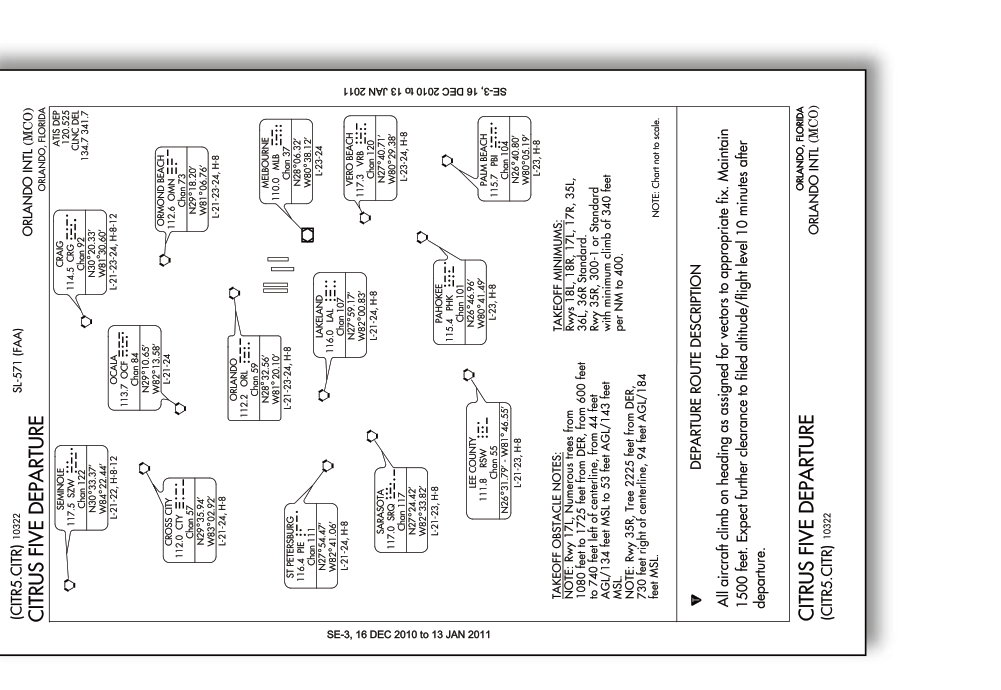
When an IFR-equipped aircraft departs a busy terminal area, the transition from the runway environment to the en route airway structure must be managed carefully. Terrain, obstacles, noise-sensitive areas, traffic flow, and radio frequencies all demand attention simultaneously. The Standard Instrument Departure (SID) — also called a Departure Procedure (DP) of the obstacle departure procedure/SID type — is the FAA's solution: a single, pre-published graphic and textual procedure that pilots and controllers can reference by name, replacing a lengthy voice clearance with just a few words. Understanding SIDs in depth is essential both for passing the Instrument Rating knowledge test and for operating safely in the real IFR environment.
SIDs are one of two broad categories of Departure Procedures (DPs) defined in the FAA's Instrument Procedures Handbook (FAA-H-8083-16). The other category is the Obstacle Departure Procedure (ODP), which is purely about obstacle clearance and is typically textual. A SID, by contrast, is specifically designed by ATC to serve both obstacle clearance and traffic management goals, and is always depicted graphically on a chart. When ATC issues a clearance that includes a SID, pilots accept a significant workload reduction in exchange for flying a precisely defined route.
How SIDs Are Structured
Every SID consists of several identifiable components that appear on its chart and in the associated text. Knowing these components helps you decode any SID you encounter in training or on the checkride.
The Procedure Name and Identifier
Each SID has a unique name and an alphanumeric identifier. The name typically references a prominent navigation fix or geographic feature near the departure airport (for example, "COMPTON TWO DEPARTURE"). The trailing number distinguishes the current amendment version. A letter suffix (e.g., "COMPTON2A") may indicate a runway-specific transition or an amendment variant. On a clearance, ATC might say "Cleared to XYZ via the COMPTON TWO departure, then as filed" — that SID name is the key the pilot needs to pull the correct chart.
Common Route and Transitions
SIDs are organized around a common route — the shared segment that all aircraft flying the procedure will follow — and one or more transitions that branch off the common route toward specific en route fixes or airways. Think of it like a highway on-ramp (the common route) that feeds onto several different interstate corridors (the transitions). During preflight, pilots identify which transition connects the end of the SID's common route to their filed en route structure, and ATC will specify it in the clearance (e.g., "...COMPTON TWO departure, ALPHA transition").
Runway-Specific Instructions
Many airports have multiple runways, and the obstacle environment differs by runway heading. A SID may include runway-specific instructions that apply only when departing from a particular runway. These may specify an initial heading, a climbing turn direction, or altitude restrictions unique to that runway. Pilots must read the fine print carefully — the instruction buried in the notes section for Runway 28L may be completely different from Runway 10R, even on the same SID chart.
Altitude Restrictions
SID charts contain altitude constraints shown with standard symbology. An altitude printed with a line above it means "at or above." An altitude with a line below it means "at or below." Both lines around an altitude means "at" (cross at exactly that altitude). These restrictions are mandatory and must be met unless ATC issues a specific amended clearance. When ATC assigns "climb via the SID," the pilot is expected to comply with all published altitude and speed restrictions. If ATC says "climb via the SID except maintain [altitude]," that specified altitude supersedes the published top altitude of the SID, but all intermediate crossing restrictions remain in effect.
Speed Restrictions
Some SIDs publish speed restrictions at certain fixes, usually to maintain traffic sequencing or noise abatement. Like altitude restrictions, these are mandatory when a "climb via" clearance is in use. Pilots must anticipate these constraints during preflight and brief them alongside the altitude requirements.
Textual and Graphic Portions
Every SID chart has both a graphic portion — the plan-view depiction of routes, fixes, navaids, and terrain — and a textual description in the header or notes area. The textual portion contains critical information such as required equipment, lost communications procedures, takeoff minimums, and departure frequency. Pilots must read both the graphic and the text; relying solely on the picture is a common and dangerous shortcut.
Obstacle Clearance Guarantee
The core safety promise of a SID is obstacle clearance. When a pilot flies a SID exactly as published, the FAA guarantees obstacle clearance above all obstacles within the departure corridor — provided the aircraft achieves a standard climb gradient of at least 200 feet per nautical mile (ft/NM) from the departure end of the runway. This equates to roughly a 3.3% climb gradient.
If a SID requires a higher-than-standard climb gradient, that gradient will be published on the chart in feet per nautical mile and sometimes converted to feet per minute at a reference groundspeed. If your aircraft cannot achieve the required gradient — due to weight, density altitude, engine performance, or any other factor — you must not accept that SID. You would instead request an alternative clearance, fly an ODP if applicable, or request radar vectors. Attempting a SID with insufficient climb performance is genuinely dangerous and has contributed to controlled flight into terrain (CFIT) accidents.
Why SIDs Matter: Workload and Safety
The practical benefit of SIDs extends well beyond obstacle avoidance. In a high-traffic terminal environment, a lengthy voice clearance naming every waypoint, altitude restriction, and heading change would consume precious cockpit time during the most demanding phase of IFR flight. By referencing a single procedure name, ATC and the pilot share a complete, unambiguous route description that took seconds instead of minutes to communicate. This is the same philosophy behind STARs on the arrival end.
From a safety management standpoint, a SID pre-briefed on the ground becomes a mental model the crew can execute with reduced surprise. When deviations occur — a missed waypoint, an unexpected altitude restriction — the crew already knows what should be happening, making the deviation instantly obvious. This is why thorough SID briefing is a non-negotiable step in any professional or instrument-rated departure flow.
Pilot Acceptance and the Right to Refuse
Pilots are not required to accept a SID. If a pilot does not have the chart, if the aircraft cannot meet the climb gradient, or if the pilot prefers not to use it, they may inform ATC with the phrase "unable SID" and request an alternative. ATC will then provide radar vectors or a detailed voice clearance. Importantly, filing "NO SID" in the remarks section of an IFR flight plan communicates this preference before departure, reducing the likelihood of being assigned one. However, at some busy airports, refusing a SID may result in significant delays.
Key Numbers and Rules
- Standard climb gradient: 200 ft/NM from the departure end of the runway (the baseline guarantee for obstacle clearance).
- Non-standard gradients: Published on the chart in ft/NM and/or ft/min at a stated groundspeed; must be achievable before accepting the SID.
- "Climb via" clearance: Requires compliance with ALL published altitude and speed restrictions along the SID.
- "Climb via SID except maintain [altitude]": The stated altitude supersedes the SID's top altitude, but all crossing restrictions below that altitude remain mandatory.
- Lost communications: Follow the procedure published in the SID notes; if none, follow 14 CFR 91.185 (squawk 7600, fly last assigned or expected altitude, proceed to the clearance limit).
- Equipment requirements: SIDs may require specific navigation equipment (DME, RNAV/GPS, ADF). Verify your aircraft is equipped before accepting.
- Takeoff minimums: Non-standard takeoff minimums associated with the airport or SID are published in the same procedure chart package; these are regulatory for Part 121/135 and advisory for Part 91 (though ignoring them is operationally reckless).
Memory Aid
When briefing a SID before departure, use the mnemonic CRAFT extended with SID awareness — confirm the Clearance matches your filed SID, verify Route transitions align with your filed route, check Altitude restrictions fix by fix, confirm Frequency (departure control), and verify Transponder code. While CRAFT itself addresses the full IFR clearance readback, applying it methodically ensures the SID is correctly integrated into every element of the clearance.
Common Test Traps
- "Climb via" vs. "maintain": Many students assume any altitude ATC assigns overrides ALL SID restrictions. In reality, "climb via" preserves ALL published crossing restrictions; only an explicit amended altitude cancels the top altitude portion.
- Ignoring the textual notes: The test may present a scenario where critical information (such as a non-standard climb gradient or a specific heading after takeoff) appears only in the text block, not on the graphic. Always read both sections.
- Assuming a SID is mandatory: Students sometimes believe they must accept every SID ATC issues. Part 91 pilots may decline with "unable SID" and request an alternative — though this should be done on the ground or before departure whenever possible.
- Misreading altitude constraint symbols: Confusing "at or above," "at or below," and "at" constraints is a frequent knowledge-test trap. Remember: line above = at or above; line below = at or below; both lines = exactly at.
- Forgetting equipment requirements: A SID requiring RNAV capability cannot be legally or safely flown in an aircraft without an approved RNAV system, even if the route looks simple on the chart. The equipment note in the text block is binding.