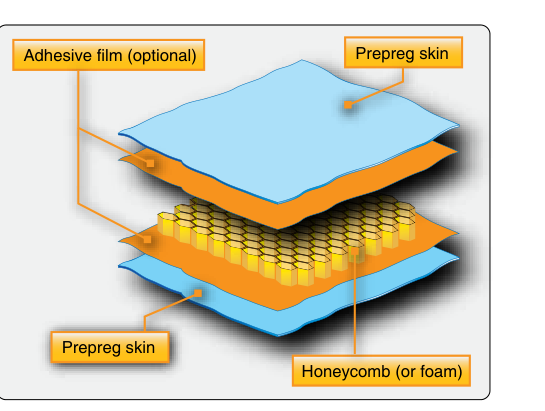
Sandwich construction is one of the most elegant solutions in aerospace engineering: two thin, stiff face sheets — called skins — are bonded to a thick but lightweight core material, creating a panel that behaves structurally like a deep I-beam. The skins carry bending loads in tension and compression, while the core separates them and resists shear, preventing the skins from sliding relative to each other. The result is a structure that is dramatically stiffer and stronger per unit weight than a solid sheet of the same material. Modern aircraft use sandwich panels everywhere — from control surfaces and floor panels to nacelles, fairings, and fuselage sections — making a thorough understanding of sandwich construction indispensable for any AMT candidate preparing for the airframe knowledge test.
This article walks through the major core types, the principles of core-to-skin bonding, how sandwich structures carry and distribute loads, and the failure modes that technicians must recognize and repair correctly. All information is grounded in the FAA Aviation Maintenance Handbook — Airframe (FAA-H-8083-31).
Anatomy of a Sandwich Panel
Every sandwich structure consists of three essential layers. The face skins are thin plies of high-strength material — most commonly fiberglass, carbon fiber, or aramid (Kevlar) fabric pre-impregnated with resin, or occasionally thin aluminum sheet. The core sits between them and is the defining feature of sandwich construction. The adhesive bondline joins core to skin and is responsible for transferring shear forces between the two layers; without an effective bond, the panel immediately loses most of its load-carrying ability.
The geometry explains the structural efficiency. Because the skins are placed far apart by the core, the panel's bending stiffness increases approximately with the cube of the total thickness, as a general engineering approximation — so doubling the core thickness, without adding significant weight, can substantially increase panel stiffness. This is why engineers accept the complexity of sandwich fabrication: the weight savings over solid laminate or metal construction are substantial, directly improving aircraft performance and fuel economy.
Core Materials and Their Characteristics
Honeycomb Core
The most widely used aerospace core is the honeycomb, a structure of thin cell walls arranged in a repeating hexagonal pattern. Honeycomb cores are manufactured from aluminum foil, fiberglass fabric, aramid paper (sold under brand names like Nomex), or thermoplastics. Nomex aramid honeycomb has become the dominant choice for bonded composite panels because it is lightweight, flame-resistant, and compatible with epoxy adhesive systems used in composite skins.
Honeycomb properties depend critically on cell size and foil or paper density. Smaller cell sizes and thicker cell walls increase both compressive and shear strength but add weight. The core is anisotropic: its shear strength differs between the ribbon direction (the strongest axis, running through bonded foil strips) and the transverse direction. Technicians must orient replacement core sections to match the original ribbon direction, which is usually marked on the core block or specified in the structural repair manual (SRM).
Foam Core
Rigid foam cores — polyurethane, polyvinyl chloride (PVC), polymethacrylimide (PMI), and others — provide a continuous, closed-cell structure that is easier to machine and shape into complex contours than honeycomb. Foam cores are commonly found in general aviation aircraft, gliders, and secondary structure panels. Because foam is isotropic (equal properties in all directions), orientation during replacement is less critical than with honeycomb. However, foam is generally less efficient in compression than high-density honeycomb and can be more susceptible to moisture absorption and solvent attack if the surface is damaged.
Balsa Wood Core
End-grain balsa is one of the oldest sandwich core materials and is still used in some aircraft floor panels and light aircraft structures. Balsa's end-grain orientation, where the wood fibers run perpendicular to the panel face, provides excellent compressive strength for its weight. It is heavier and more moisture-sensitive than synthetic cores, and technicians working with balsa-core panels must ensure that any moisture intrusion is fully identified and remediated before repair.
Core-to-Skin Bonding Mechanics
The structural integrity of a sandwich panel depends almost entirely on the quality of the bondline between skin and core. Under bending loads, the panel behaves like a beam: the top skin is compressed, the bottom skin is placed in tension, and the core carries the shear loads that transfer stress between the skins. If the bond fails — a condition called disbond — the skins can no longer act together, and the panel loses the vast majority of its bending stiffness, often catastrophically.
In a properly manufactured panel, the adhesive must do two things: wet out the core cell walls or foam surface completely, and form a continuous fillet — called a fillet bond — around each honeycomb cell. This fillet dramatically increases the effective bonding area and resists peel forces that try to strip the skin away from the cell wall edges. Film adhesives, which are supplied as pre-weighed sheets of supported or unsupported resin, are the standard choice for production honeycomb bonding because they provide precise, controlled bondline thickness and consistent fillet formation during cure. Paste adhesives and wet layup resins may be used for repairs but require careful technique to achieve adequate fillets.
Cure pressure and temperature are critical variables. Honeycomb panels bonded with film adhesive are typically cured in an autoclave or hot-press at elevated temperature and pressure, allowing the adhesive to flow slightly, form fillets, and cross-link fully. Repair situations often require technicians to use vacuum bag pressure combined with either oven heat or heat blankets. Achieving the correct temperature at the bondline — not just at the surface — is essential and must be verified with embedded thermocouples when required by the SRM.
Why It Matters: Structural and Safety Implications
Sandwich panels are not tolerant of hidden damage. Impact from ground equipment, hail, or tool drops can crush the core beneath an apparently undamaged skin, a condition called core crush. Moisture can enter through small skin cracks or damaged edge seals, migrate through the core over months or years, and cause internal corrosion of aluminum honeycomb or degrade the adhesive bondline. Because the outer skin may look intact, these defects are invisible to simple visual inspection.
Technicians must use approved non-destructive inspection (NDI) methods to find hidden damage. The most common field method is coin tap testing (also called acoustic tap testing): tapping the surface with a coin or specialized tap hammer and listening for a change from a sharp ring (sound bond) to a dull thud (disbond or crushed core). While simple and fast, coin tap is limited in sensitivity; ultrasonic inspection, thermography, and radiography provide more reliable detection of subtle disbonds and moisture ingress and are required for critical structure.
Key Numbers and Rules
- Core ribbon direction: Always orient replacement honeycomb so the ribbon (strongest shear) direction matches the original, as specified in the SRM.
- Damage limits: The SRM defines allowable damage limits (ADL) — damage within these limits may be left unrepaired or receives a simple cosmetic repair; damage exceeding ADL requires a structural repair.
- Potted inserts: Any fastener penetrating a sandwich panel requires a potted insert — a region filled with high-density adhesive or filler — to distribute the point load and prevent core crushing beneath the fastener head.
- Moisture contamination: Core that has absorbed moisture must be dried before bonded repair; undried cores trap steam during cure, creating voids and blisters that weaken the new bondline.
- Stepped and scarfed repairs: Skin repairs to sandwich panels use either a stepped-lap or scarf geometry to restore load transfer; minimum step width and scarf ratios are prescribed in the SRM and must not be reduced.
- Adhesive storage: Film adhesives are typically stored frozen to prevent premature cure, with the exact temperature (commonly around 0 °F, but varying by product) and permissible room-temperature out-time specified by the adhesive manufacturer; out-time must be tracked and must not exceed the manufacturer's limit, or the adhesive must be discarded.
Common Test Traps
- Confusing disbond with delamination: A disbond is a failure between the skin and the core; a delamination is a failure within the laminate itself (between plies). The FAA knowledge test distinguishes these terms, and confusing them leads to incorrect repair procedures.
- Assuming coin tap detects all damage: Coin tap is a screening tool and has real sensitivity limits. The test may present scenarios where coin tap is insufficient and ultrasonic or other NDI methods are required; always apply the method appropriate to the structure and damage type.
- Ignoring core orientation: Replacing honeycomb core without matching the ribbon direction is a common error that reduces repair shear strength. The test expects technicians to know that orientation matters and must be verified from the SRM.
- Using the wrong adhesive system: Not all adhesives are compatible with all core or skin materials. The SRM specifies approved materials; substituting a different adhesive — even one that appears similar — is not acceptable for structural repairs.
- Skipping moisture removal: Repairing a wet core without drying it first is a recurring source of repair failures. Test questions may describe symptoms (blistering during cure, low peel strength after repair) that trace back to retained moisture in the core.
Mastering sandwich structure construction means understanding the complete system: core and skin materials working together, the critical bondline that joins them, and the NDI and repair practices that keep that system performing safely throughout the aircraft's service life. Every choice — core type, adhesive selection, cure parameters, and repair geometry — is governed by the SRM and the foundational principles described in the FAA Aviation Maintenance Handbook, and technicians who understand the why behind each requirement will be far better equipped to make sound decisions on the hangar floor.