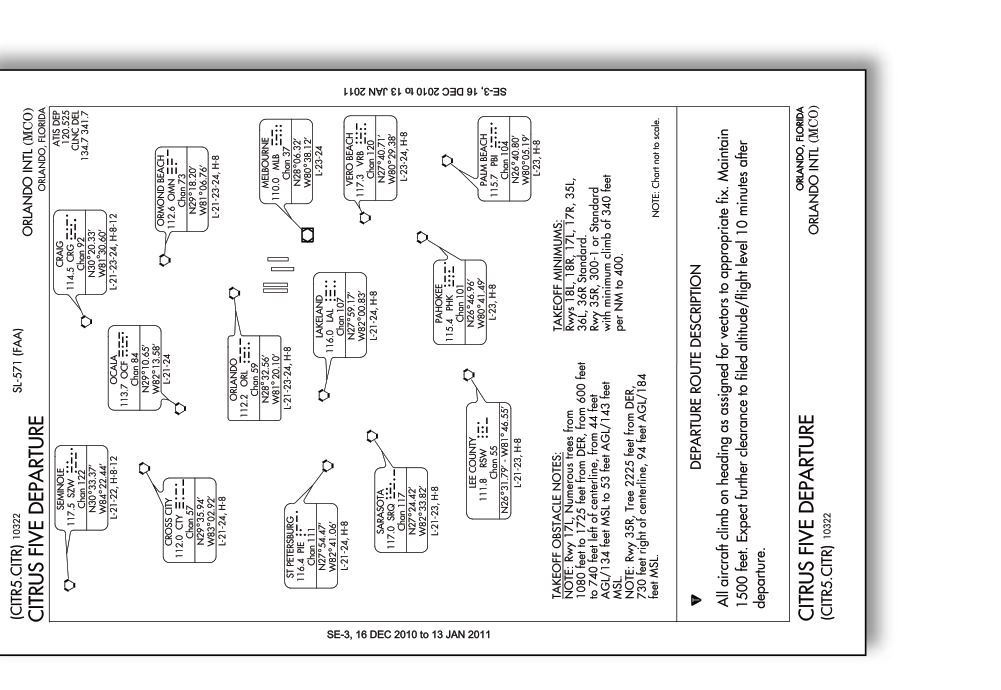
The moment your wheels leave the runway in instrument meteorological conditions (IMC), you enter one of the most unforgiving phases of flight. The ground is close, visibility may be near zero, and terrain or obstacles could be anywhere around the airport. To manage this risk, the FAA has established a structured family of departure procedures (DPs) that provide a clear, charted path from the runway into the en-route environment. As an instrument pilot, you must understand three distinct types: the Obstacle Departure Procedure (ODP), the Standard Instrument Departure (SID), and the Diverse Vector Area (DVA). Each serves a different purpose, has different regulatory weight, and demands a different level of pilot action.
This article breaks down how each procedure is developed, when to use it, and exactly what the FAA knowledge test expects you to know. Understanding these differences is not just an academic exercise — it is a fundamental skill for operating safely in the instrument environment.
The Foundation: Obstacle Clearance Requirements
Before diving into each procedure type, it helps to understand the underlying engineering standard they all share. The FAA designs departure procedures to guarantee a minimum of 35 feet of obstacle clearance per nautical mile of climb, based on an obstacle clearance surface (OCS) that rises at approximately 152 feet per nautical mile. Pilots, however, must achieve the standard climb gradient of 200 feet per nautical mile (ft/NM), which provides the required margin above the OCS. This standard gradient assumes a normal climb from a relatively flat departure environment. If obstacles or terrain penetrate the obstacle identification surface (OIS) at a given airport, a steeper gradient or a specific routing is required, and that information is published in the departure procedure.
When no published departure procedure exists for a runway, the FAA's general rule in the AIM is that pilots operating under IFR should climb in visual conditions to the published minimum IFR altitude before proceeding on course — but this is a last resort, not preferred practice. Published procedures always provide a safer, more structured solution.
Obstacle Departure Procedures (ODPs)
An ODP is the most basic published departure procedure. Its sole purpose is terrain and obstacle avoidance — it has nothing to do with traffic flow or ATC routing. ODPs are developed whenever a standard 200 ft/NM climb gradient is insufficient to clear obstacles on or near the departure path.
ODPs may be presented in two formats. A textual ODP is printed in plain language in the front matter of the instrument approach procedure booklets (often called the DP text section) — for example, "Climb runway heading to 2,400 feet before turning left." A graphical ODP is a charted procedure that looks similar to a SID but is identified by the term "OBSTACLE" in the procedure name (e.g., "KEENE OBSTACLE TWO DEPARTURE").
A critical regulatory point: ODPs are not assigned by ATC. They are available for pilot use and are especially important when flying under Part 91 in IMC without an ATC clearance that includes a SID or specific routing. Technically, Part 91 pilots are not required by regulation to fly an ODP — but deliberately ignoring one when terrain is a factor is poor airmanship and potentially unsafe. Under Part 121 and Part 135, operators generally must comply with applicable ODPs unless their operations specifications allow an alternative.
When a non-standard climb gradient is required, you will see it published on the ODP chart — for example, "Climb at 340 ft/NM or higher to 5,000 feet." You must verify your aircraft can meet this gradient with the actual weight, density altitude, and engine-out (if applicable) performance on that day. If your aircraft cannot achieve the required climb gradient, you are not authorized to depart under IFR in those conditions without visual conditions to remain clear of obstacles.
Standard Instrument Departures (SIDs)
A SID — officially called a departure procedure (DP) in FAA terminology but universally referred to as a SID — is a published ATC procedure designed primarily for the orderly flow of IFR traffic out of a busy terminal area. SIDs simplify clearance delivery by replacing a long list of headings, altitudes, and fixes with a single procedure name. Rather than reading back a paragraph of routing, the controller says "Fly the KAYLN TWO departure" and both parties understand the full routing.
SIDs are always assigned by ATC — you will not fly a SID unless it appears in your IFR clearance. Because SIDs also incorporate obstacle clearance criteria, they simultaneously serve the safety function of an ODP. However, if a SID is assigned, it supersedes any applicable ODP; you follow the SID, not both.
SIDs are graphically charted and include all waypoints, altitude crossing restrictions, speed restrictions, and the transition routes that connect the SID to the en-route structure. Each SID will specify a climb gradient (usually 200 ft/NM unless otherwise noted) and may list specific gradient requirements for particular runways. Some SIDs include engine-out obstacle avoidance procedures (EODPs) for Part 121/135 operators — these are separate from the normal SID routing and are based on one-engine-inoperative performance.
Pilot action: When a SID is in your clearance, you are expected to have the chart available and briefed before departure. You must comply with all altitude restrictions and routing unless you have received specific ATC instructions to deviate. If you are unable to comply with a SID — perhaps because of aircraft performance limitations or avionics limitations — you must notify ATC and request an alternative clearance. Do not accept a SID you cannot fly.
Diverse Vector Areas (DVAs)
A DVA is a newer concept that many pilots overlook. It is an area in the terminal environment where ATC may vector departing aircraft below the minimum vectoring altitude (MVA) while still maintaining obstacle clearance. The DVA is established only where the airport authority and FAA have jointly evaluated the terrain and verified that random radar vectors within the defined area will keep aircraft clear of obstacles.
In practical terms, a DVA means that after departure, ATC can give you a radar vector in any direction within that defined area without you needing to reference a specific ODP or SID routing — because the entire area has been cleared of obstacle conflicts up to the defined altitude. DVAs are depicted on the SID chart for the airport and are identified with a shaded or outlined region labeled "DVA."
The DVA is only usable when radar contact has been established and ATC is actively providing vectors. It is not something a pilot selects independently; it is a tool for controllers. From the pilot's perspective, the key knowledge point is: when operating within a DVA under radar vectors, you are not required to fly an ODP because the controller is responsible for obstacle separation. The moment radar service terminates, that protection disappears.
Selecting the Right Procedure
Here is a practical decision framework for departure procedure selection:
- Check your clearance first. If ATC has assigned a SID, fly it. The SID satisfies both ATC routing and obstacle clearance requirements.
- If no SID is assigned, look for an ODP. Review the textual DP section and graphical charts for the departure runway. If an ODP is published and your aircraft can meet the gradient, plan to fly it.
- If operating under radar vectors in a DVA, ATC is providing obstacle separation. Confirm radar contact and comply with assigned headings.
- If none of the above apply, the AIM recommends climbing on the runway centerline heading to the en-route minimum IFR altitude before turning on course — essentially a diverse departure with no published guidance.
Key Numbers and Rules
- Standard climb gradient: 200 ft/NM — the baseline obstacle clearance standard for all departure procedures.
- 35-foot clearance: The minimum obstacle clearance the climb gradient is designed to provide.
- ODP assignment: Never assigned by ATC; available for pilot use.
- SID assignment: Always assigned by ATC; replaces the ODP for that departure.
- Non-standard gradients: Published on the chart in ft/NM; pilot must verify aircraft capability before departure.
- DVA protection: Only valid when under active radar vectors; terminates when radar service ends.
- Climb gradient formula: To convert ft/NM to a percent gradient, divide by 60. A 200 ft/NM gradient ≈ 3.3% — close to a 200 ft/min rate for every 60 knots of groundspeed.
Memory Aid
Use the acronym OSD — Obstacle (ODP), Standard (SID), Diverse (DVA) — to remember the three departure procedure types in order of increasing ATC involvement. ODPs are purely pilot-initiated for obstacle avoidance, SIDs are ATC-assigned for both traffic flow and obstacle clearance, and DVAs are controller-managed areas where radar vectors handle obstacle separation.
Common Test Traps
- ODPs are "optional" for Part 91 — but dangerously so. The test may imply you can simply ignore an ODP. While Part 91 does not mandate ODP compliance by regulation the way Part 121/135 does, departing into IMC while disregarding terrain-driven climb requirements is genuinely hazardous and contrary to good airmanship.
- A SID is not the same as an ODP. Test questions sometimes conflate the two. Remember: ODPs = obstacle avoidance only, never ATC-assigned; SIDs = ATC-assigned, serve both routing and obstacle clearance functions.
- Non-standard climb gradients must be met — not just noted. If the ODP says 340 ft/NM and your aircraft cannot achieve that, you cannot legally depart IFR in those conditions without visual clearance from obstacles. The test may offer you a scenario where a pilot proceeds anyway — that is always the wrong answer.
- DVA protection ends when radar ends. A common trap question describes a DVA scenario where ATC loses radar contact. At that moment, the pilot must revert to a published procedure or the runway heading/altitude guidance in the AIM — the DVA no longer applies.
- Textual ODPs are easy to miss. Many pilots focus only on graphical charts and overlook the plain-text ODPs printed in the front of the approach plate booklets. The FAA tests whether you know that ODPs can appear in text format, not just as drawn charts.