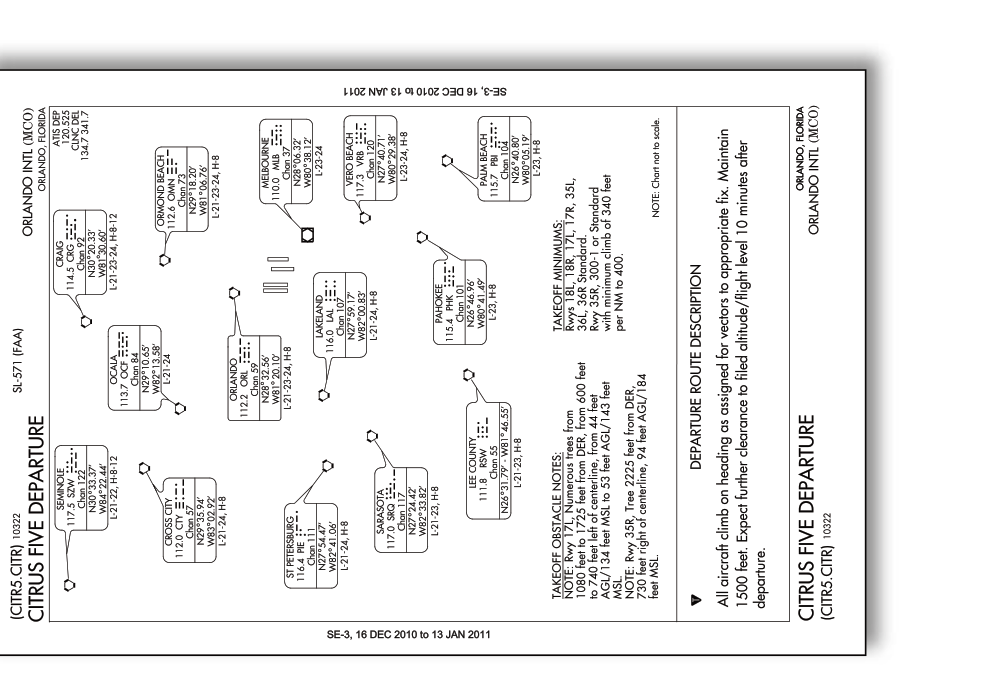
When an instrument-rated pilot departs an airport under IFR, the runway environment is often the most dangerous phase of flight — engines are near maximum power, airspeed is low, and the aircraft is transitioning from ground to sky with limited time to react to terrain or obstructions. To address this risk, the FAA developed Obstacle Departure Procedures (ODPs), a foundational element of the U.S. National Airspace System's departure procedure framework. Understanding how ODPs are designed, where to find them, and when they apply is essential knowledge for the instrument rating knowledge test and, more importantly, for safe IFR operations in the real world.
ODPs are one of two categories of published departure procedures in the United States — the other being Standard Instrument Departures (SIDs). While SIDs are ATC-assigned routing tools with traffic management value, ODPs exist purely for obstacle clearance. They represent the minimum acceptable action a pilot must take to remain clear of terrain and man-made obstructions during the initial climb from a given runway.
The Design Standard Behind Every ODP
The FAA designs ODPs using specific obstacle clearance criteria derived from the TERPS (Terminal Instrument Procedures) standards. At the core of ODP design is the concept of the Obstacle Clearance Surface (OCS) — an imaginary sloped plane that begins at the departure end of the runway (DER) and rises at a specific gradient as distance increases. The OCS itself rises at 152 feet per nautical mile (a 40:1 slope) from the DER. Standard IFR departure design assumes that a departing aircraft can climb at a rate of 200 feet per nautical mile above the DER elevation to maintain the required clearance margin above that surface.
The procedure designer evaluates all terrain and man-made obstacles within the departure area. If all obstacles fall below the 152 ft/NM (40:1) obstacle identification surface, then no ODP is required — the standard diverse departure (straight ahead or within 15 degrees of runway heading to a minimum altitude) provides adequate protection. However, if any obstacle penetrates that surface, the designer must do one of two things: publish an ODP that routes the aircraft around or above the penetrating obstacle, or increase the required climb gradient to clear it.
When an increased climb gradient is specified in an ODP, it is stated explicitly — for example, "Climb to 3,500 ft via heading 245° at or above 340 ft/NM before proceeding on course." This gradient requirement is a critical piece of information, because an aircraft that cannot meet it must not depart under IFR unless an alternative procedure or ATC routing provides equivalent protection. The published gradient must be achievable by your specific aircraft on that day, accounting for aircraft performance, density altitude, weight, and any inoperative equipment.
Where ODPs Are Found
ODPs can be presented in two different formats, and a student pilot preparing for the instrument knowledge test must know both. The first format is a textual ODP, which appears in the front matter of the instrument approach procedure chart booklet (published by the FAA in the digital Terminal Procedures Publication, or TPP). These text-based ODPs are often brief — for example, "Rwys 18/36: Climb runway heading to 2,500 ft before turning." The second format is a graphic ODP, which looks similar to a SID chart and is published as a separate named procedure when the routing is too complex to describe in plain text. Graphic ODPs may include waypoints, headings, altitudes, and fixes that together depict a specific routing away from the airport.
Importantly, ODPs are not assigned by ATC. Unlike SIDs, which are issued as part of a clearance ("Cleared to XYZ airport via the METRO3 departure..."), an ODP is the pilot's default protection and must be flown on the pilot's initiative when IFR conditions or obstacle proximity make it necessary. If ATC issues a clearance that conflicts with an ODP (for example, by assigning a heading that would not provide obstacle clearance), the pilot is responsible for identifying and resolving that conflict before departure.
Diverse Departures and When an ODP Is Not Required
The FAA recognizes a concept called the diverse departure, which is the default assumption for airports that have no published ODP and no penetrating obstacles. A diverse departure allows the aircraft to turn in any direction after reaching 400 feet above the DER elevation, provided the pilot maintains the 200 ft/NM climb gradient. At airports where diverse departures are authorized, no special procedure is required — the pilot simply climbs straight ahead (or within 15 degrees of runway heading) to 400 feet AGL before initiating any turns, and the obstacle environment has been confirmed to be clear.
However, at airports surrounded by hills, mountains, towers, or dense urban obstructions, the diverse departure assumption may not hold. That is precisely when you will find a published ODP in the TPP. Pilots operating IFR from airports with published ODPs should review those procedures during preflight planning even if ATC does not specifically mention them.
Why ODPs Matter for Safety and the Knowledge Test
A significant number of controlled flight into terrain (CFIT) accidents occur during the departure phase, often when pilots depart IFR or IMC without reviewing — or without being able to meet — the published climb gradient. The ODP is the regulatory and procedural backstop that prevents this category of accident when used correctly.
For the FAA instrument knowledge test, you should understand that compliance with an ODP is not technically required by regulation for Part 91 pilots unless ATC specifically assigns it or unless the operator's procedures require it. However, the Instrument Procedures Handbook and AIM make clear that flying an ODP is the strongly recommended practice and represents the baseline for obstacle protection. Failing to fly one when your route of flight requires climbing through an obstacle-laden environment creates unacceptable risk, even if it is not a regulatory violation.
The practical lesson: treat any published ODP for your departure runway as mandatory unless ATC has given you a clearance that demonstrably provides equivalent or better obstacle clearance, and you have confirmed your aircraft performance meets any gradient requirement stated in the procedure.
Key Numbers and Rules
- Standard climb gradient: 200 feet per nautical mile (approximately 3.3%) above the DER elevation — the baseline used in all ODP and diverse departure design.
- Turn initiation altitude: 400 feet above the DER elevation before any turns during a diverse departure.
- 15-degree corridor: A diverse departure protects within 15 degrees of the runway centerline extended.
- Obstacle Clearance Surface (OCS): Rises at 152 ft/NM (approximately 40:1 slope) from the DER; obstacles penetrating this surface trigger an ODP requirement.
- Where to find textual ODPs: Front section of the FAA Terminal Procedures Publication (TPP), organized by state and city.
- Where to find graphic ODPs: Published as named departure charts in the TPP, similar in format to SID charts.
- Part 91 regulatory requirement: ODPs are not legally mandated for Part 91 operations unless assigned by ATC, but their use is strongly recommended in the AIM and IPH as the standard of care.
Common Test Traps
- Confusing ODPs with SIDs: SIDs are ATC routing procedures assigned in your clearance. ODPs are pilot-initiated obstacle clearance procedures. An ODP will never appear in your IFR clearance the way a SID does — you must look for it yourself and fly it on your own initiative.
- Assuming no ODP means no obstacles: Some airports have complex obstacle environments but no published ODP because a diverse departure still provides adequate clearance. Always check the TPP front matter and consider the local terrain — absence of a published ODP is not a guarantee of a benign departure environment in all directions.
- Forgetting the climb gradient check: If an ODP specifies a non-standard climb gradient (anything above 200 ft/NM), you must verify your aircraft can actually achieve it before departure. Many test questions present scenarios where a pilot departs without confirming performance — this is a safety trap in real life and a knowledge trap on the exam.
- Mixing up textual vs. graphic ODP formats: Test questions may describe an ODP as appearing "in the front of the chart booklet" (textual) or as a "named departure chart" (graphic). Know that both are ODPs and serve the same purpose.
- Confusing the 400-foot turn altitude with the 200 ft/NM gradient: The 400-foot AGL restriction governs when you may begin a turn during a diverse departure; the 200 ft/NM gradient governs the climb rate throughout the departure. These are two separate, simultaneous requirements — passing 400 feet does not mean you can reduce your climb rate.