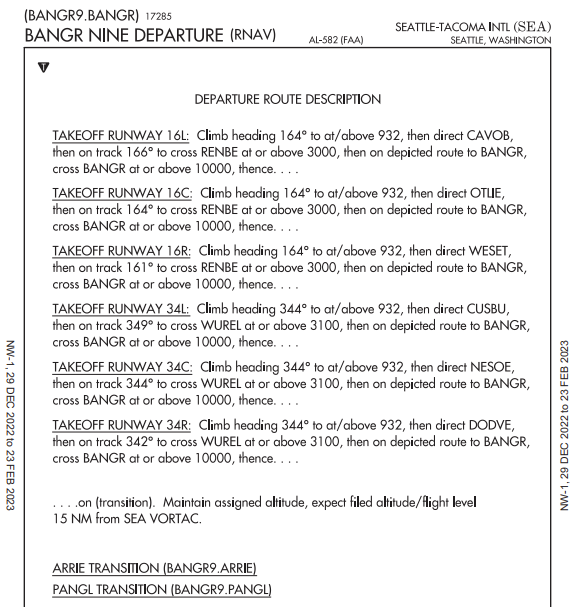
When you receive an IFR clearance that includes a Standard Instrument Departure (SID) procedure, you are accepting a set of instructions that go far beyond a simple heading. Embedded in every SID chart are crossing restrictions — altitude and speed requirements that must be met at precisely defined waypoints along the departure route. For the instrument-rated pilot, reading these restrictions correctly is not an academic exercise; it is a legal and safety obligation that begins the moment the wheels leave the runway.
This article walks you through how crossing restrictions work, how to decode the notation on a SID chart, and why ATC and airspace design depend on pilots honoring these numbers. You will also find the commonly tested traps that trip up instrument candidates on the FAA knowledge exam.
What SIDs Are and Why They Contain Restrictions
A Standard Instrument Departure procedure is a published ATC routing that transitions an IFR departure from the airport environment to the en route structure. SIDs are designed to reduce frequency congestion, improve traffic flow, and provide obstacle clearance in areas where departing aircraft must climb through complex terrain, converging airways, or busy terminal airspace. Because ATC must sequence dozens of aircraft through the same airspace slice, crossing restrictions are the tool that keeps everyone predictably separated. A restriction at a fix tells ATC exactly where you will be — and at what altitude and speed — so they can safely vector the next aircraft behind you.
How to Read Crossing Restriction Notation
SID charts are published by the FAA and distributed through official sources. Crossing restrictions appear directly on the plan view and, in detail, in the textual route description. Learning to decode the notation is the first skill the exam tests.
Altitude Restrictions
Altitude restrictions on a SID are expressed with one of three conventions:
- At or above (minimum altitude): Shown as an altitude with an underline, or textually as "AT OR ABOVE [altitude]." You must be at or above that altitude when crossing the fix. Climbing through the restriction is acceptable, as long as you have reached the floor by the time you hit the waypoint.
- At or below (maximum altitude): Shown as an altitude with an overline, or textually as "AT OR BELOW [altitude]." You must not exceed that altitude at the fix. This is common where a SID passes beneath an overlying arrival stream or special-use airspace.
- At (mandatory altitude): Shown with both an underline and overline, or simply as "AT [altitude]." This is the most demanding restriction — you must cross the fix at exactly that altitude, no higher and no lower. These appear where vertical separation from other traffic is critical.
On some charts you will also encounter window restrictions, where a fix has both an at-or-above and an at-or-below value simultaneously — for example, "cross ABCDE at or above 5,000 and at or below 9,000." The aircraft must be within that altitude band at the fix.
Speed Restrictions
Speed restrictions on SID charts are written as "AT OR BELOW [knots] KIAS" and appear either adjacent to the waypoint symbol or in the textual description. These limits exist to keep departure traffic within a manageable speed envelope, protect traffic pattern airspace, and maintain sequencing. A speed restriction stated on a SID chart is just as mandatory as one assigned verbally by ATC. The most common values you will encounter are 200 KIAS or 250 KIAS, mirroring the regulatory speed limits in 14 CFR 91.117, but SID-specific restrictions may be more restrictive than the regulatory baseline.
The Textual Route Description
Every SID has a written route description section at the bottom of the chart. This text is authoritative — when there is any ambiguity between the graphic and the text, the text takes precedence. The route description spells out each fix by name, the course to fly, and any crossing restriction in plain language. Instrument candidates frequently focus only on the graphic and miss a restriction buried in the textual section; this is one of the most common exam traps.
Types of Waypoints on a SID
Not every point on a SID has crossing restrictions; understanding the types of waypoints helps you know where restrictions are likely to exist.
- Fly-over waypoints: Depicted as a shaded/filled circle with a circle around it; the aircraft must fly directly over the fix before turning. A crossing restriction at a fly-over fix must be met at the overhead position.
- Fly-by waypoints: Depicted as a four-pointed star; the standard waypoint type, allowing a lead turn so the aircraft intercepts the next course smoothly. A restriction must still be met as the aircraft crosses the fix latitude/longitude, even if a turn has already begun.
- Transition fixes: Many SIDs offer multiple transitions — routes that connect the core SID to different en route airways or fixes. Each transition may carry its own set of restrictions, separate from the core SID. Your clearance specifies which transition you are assigned, and only the restrictions on that transition apply to you.
Climb Gradients and Their Relationship to Crossing Restrictions
SIDs often publish a minimum climb gradient expressed in feet per nautical mile (ft/NM). The standard gradient assumed in obstacle clearance design is 200 ft/NM, but many SIDs require significantly more — 300, 400, or even higher — especially at airports surrounded by rising terrain. This gradient requirement is directly connected to crossing restrictions: if a SID requires you to be at or above 6,000 feet at a fix 15 NM from the departure end of the runway, the gradient needed to achieve that is calculable, and you must verify your aircraft can comply before accepting the clearance.
To convert a required gradient to an approximate climb rate: multiply the gradient (ft/NM) by your groundspeed in knots, then divide by 60. For example, a 300 ft/NM gradient at 120 knots groundspeed requires a climb rate of 600 feet per minute (300 × 120 ÷ 60 = 600 fpm). If your aircraft cannot achieve that rate, you must notify ATC and may need an alternate departure procedure.
Why Crossing Restrictions Matter for Safety and Separation
Controllers build their traffic picture around the assumption that IFR pilots will comply with published restrictions. When a pilot levels off early to comply with an at-or-below restriction, or climbs aggressively to meet an at-or-above restriction, the controller has a predictable vertical profile to work with. Deviation from that profile — even a few hundred feet — can invalidate the separation standards the controller has applied between your aircraft and another. In terminal airspace, where aircraft are close together and altimeter errors are compounded by rapidly changing altitudes, an unexpected altitude deviation can close the separation margin dangerously fast.
Additionally, the obstacle clearance guarantee built into a SID is only valid when the pilot flies the procedure as published. An at-or-above restriction at an early fix guarantees you are clear of rising terrain ahead. If you fail to meet that minimum altitude, the terrain clearance published for the subsequent segment of the SID may no longer apply.
Key Numbers and Rules
- The standard minimum obstacle clearance gradient on a SID is 200 ft/NM; any higher requirement is explicitly published on the chart.
- An at-or-above restriction is depicted by an underline; at-or-below by an overline; mandatory (at) by both.
- Speed restrictions on SID charts are mandatory; they do not require a separate ATC verbal instruction to be in effect.
- The textual route description is the authoritative source when graphic and text conflict.
- Climb gradient requirements apply from the departure end of the runway (or a specified point) to the restriction fix, not just at the fix itself.
- If ATC issues a clearance with a crossing restriction different from the published SID restriction, the ATC clearance takes precedence; however, the pilot must inform ATC if compliance is not possible.
Common Test Traps
- Confusing at-or-above with at-or-below symbols. The underline feels like it is "under" the altitude, meaning you are below it — that misreading leads students to think the underline means a ceiling. Remember: the underline is a floor; the overline is a ceiling.
- Ignoring the textual route description. FAA knowledge test questions frequently base the correct answer on a restriction that appears only in the text portion of the SID, not the graphic. Always read both.
- Assuming the standard 200 ft/NM gradient. Test questions will give you a SID that explicitly publishes a higher gradient and ask whether a specific aircraft can comply. Always check the published gradient against aircraft performance data.
- Treating speed restrictions as advisory. Some students assume speed restrictions on charts are merely suggestions unless ATC explicitly repeats them. They are mandatory as published.
- Misidentifying which transition restrictions apply. A SID with multiple transitions may show different crossing restrictions on different branches. If you apply the restrictions from a transition you were not assigned, your answers — and your flying — will be wrong.