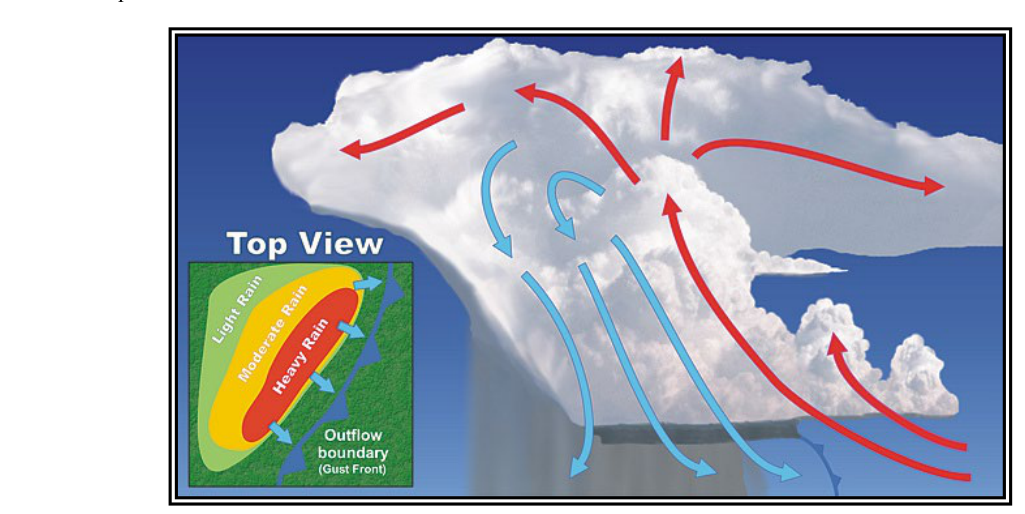
Of all the weather hazards a pilot can encounter, thunderstorms are among the most violent and least forgiving. The FAA Aviation Weather Handbook (FAA-H-8083-28B) dedicates an entire chapter to them because no amount of aircraft capability substitutes for a thorough understanding of how thunderstorms form, grow, and behave. Before diving into the four principal types, it helps to understand what every thunderstorm has in common: the three necessary ingredients and the basic cell life cycle that underlies them all.
Every thunderstorm cell requires sufficient water vapor (commonly measured by dewpoint), unstable air (virtually all thunderstorms form in conditionally unstable air masses), and a lifting mechanism strong enough to release that instability. Lifting mechanisms include converging winds around surface lows and troughs, fronts, upslope flow, drylines, outflow boundaries from prior storms, and local circulations such as sea breezes and valley breezes. Remove any one of these three ingredients and the storm cannot sustain itself.
The Thunderstorm Cell Life Cycle
Before distinguishing types, every pilot should internalize the three-stage life cycle of a single convective cell, because all thunderstorm types are built from these same building blocks—just in different numbers and organizational patterns.
- Towering Cumulus Stage: Dominated by a strong convective updraft that can exceed 3,000 feet per minute (fpm). Warm, buoyant air rises rapidly near the cloud top. No precipitation reaches the surface yet, so there is no downdraft. The cloud grows explosively upward.
- Mature Stage: Begins the moment precipitation reaches the surface. Falling precipitation drags adjacent air downward, creating a strong downdraft that coexists alongside the updraft. The downdraft spreads out at the surface as a mass of cool, gusty air with an arc-shaped leading edge called a gust front—essentially a miniature cold front. Uplift along the gust front can trigger new cells, sometimes well ahead of the parent storm. The cloud top frequently penetrates the lower stratosphere as an overshooting top, and upper-level winds shape it into the classic anvil. Weather hazards peak toward the end of this stage.
- Dissipating Stage: A strong downdraft now dominates the entire cell. Subsiding air cuts off the moisture supply from below, precipitation tapers off, and the cloud gradually evaporates from the bottom up. Only a remnant anvil may remain. The total life cycle of a single cell is typically about 30 minutes.
The Four Principal Thunderstorm Types
Single-Cell (Ordinary-Cell) Thunderstorm
A single-cell thunderstorm, sometimes called a common or ordinary-cell thunderstorm, consists of exactly one convective cell moving through the three-stage life cycle described above. These storms most often develop on warm, humid summer afternoons when surface heating provides the lifting mechanism. Although they are short-lived—lasting roughly 30 minutes in total—they are not trivial: single-cell storms can still produce hail and microburst winds. Because they are isolated and relatively compact, they are the easiest thunderstorm type for pilots to circumnavigate—provided they are visible. At night or when embedded within stratiform cloud layers, even a single-cell storm becomes extremely dangerous because the pilot may not see it in time to deviate. Importantly, the FAA notes that single-cell thunderstorms are actually rare; the vast majority of thunderstorm activity is multicell in nature.
Multicell Cluster Thunderstorm
A multicell cluster consists of a group of cells at various stages of their life cycle, all in close proximity. The organized multicell cluster has a predictable internal rhythm: as the first (oldest) cell matures and is carried downwind, a new cell forms upwind to replace it. This relay-race structure gives the multicell cluster a lifetime of several hours or more—far longer than any individual cell within it. As long as the three necessary ingredients continue to be supplied, new cells keep forming.
One operationally critical characteristic is that individual cells within the cluster may move in a different direction than the overall system. A pilot tracking cell motion on radar may misjudge the system's net displacement. The coverage and persistence of a multicell cluster makes it considerably harder to circumnavigate than a single-cell storm. The FAA aptly compares an area of multicell cluster activity to a minefield for air traffic—deviations may lead into another developing cell.
Squall Line (Multicell Line) Thunderstorm
A squall line is a narrow band of thunderstorms that can extend laterally for hundreds of miles. It most commonly develops on or ahead of a cold front in moist, unstable air, but it can also form in unstable air well removed from any frontal boundary. New cells continuously re-form at the leading edge of the system, with rain and sometimes hail following behind. The individual storms that make up a squall line can themselves be supercells, compounding the hazard. Like the multicell cluster, the squall line persists for many hours as long as the three ingredients remain in place.
The FAA identifies the squall line as the thunderstorm type that presents the most effective barrier to air traffic. The reasoning is straightforward: the line is typically too tall to fly over (tops frequently reach the lower stratosphere), too dangerous to fly through or under, and its lateral extent makes circumnavigation a significant logistical challenge. Squall lines also carry a significant tornado threat—approximately 25 percent of all U.S. tornadoes are spawned by squall lines.
Supercell Thunderstorm
The supercell is in a category of its own. Rather than being composed of multiple cells cycling through their life stages, the supercell is built around a single, quasi-steady, rotating updraft called a mesocyclone that can persist for an extended period—often many hours. This highly organized internal structure is what distinguishes the supercell and what makes it so exceptionally dangerous.
Updraft speeds in a supercell can reach 9,000 fpm (approximately 100 knots)—three times the maximum updraft speed found in an ordinary single-cell storm. At those speeds, hailstones are lofted repeatedly, growing to extremely large sizes before finally falling out. The FAA states that nearly all supercells produce severe weather (large hail with diameter of 1 inch or greater, or convective winds of 50 knots or more), and approximately 25 percent of supercells produce a tornado. Multicell clusters and squall lines may incorporate supercells as part of their structure, meaning a line of storms that appears routine on radar could contain an embedded supercell.
A supercell's size, intensity, and longevity make circumnavigation more difficult than with a single-cell storm. Pilots must also be aware that the storm's rotating updraft region and associated hazards (large hail, extreme turbulence, tornadoes) can extend well away from the visible cloud boundary.
Thunderstorm Motion: Advection and Propagation
Understanding how thunderstorms move is just as important as knowing their type. Storm motion is the combined result of two components: advection (individual cells being carried along by the mean wind through the depth of the cumulonimbus—the wind at approximately FL180/500 mb is a common approximation) and propagation (the net effect of old cells dissipating and new cells forming in a preferred location, often along the gust front). Because propagation can cause a storm system to move in a direction quite different from the motion of its individual cells, a pilot who relies solely on tracking individual radar echoes may be surprised by the system's actual track. The FAA emphasizes that a thunderstorm is a process, not a fixed solid object.
Why These Distinctions Matter for Pilots
All thunderstorms are hazardous to aircraft—the FAA makes this unambiguous. But the type determines the strategic options available to a pilot. A single isolated cell on a clear afternoon may be easily sidestepped with a few miles of deviation. A squall line stretching from Canada to the Gulf of Mexico may require diverting to an alternate or delaying departure by hours. A supercell embedded within a seemingly ordinary line of echoes may ambush a crew that assumes all cells are equally manageable. Knowing the type means knowing the scope of the threat.
Key Numbers and Rules
- Three required ingredients: sufficient water vapor, unstable air (conditionally unstable), and a lifting mechanism.
- Single-cell life cycle: approximately 30 minutes total.
- Towering cumulus stage updraft: can exceed 3,000 fpm.
- Supercell updraft: can reach 9,000 fpm (≈100 kt).
- Nearly all supercells produce severe weather; about 25% produce a tornado.
- About 25% of U.S. tornadoes are spawned by squall lines.
- Severe thunderstorm definition: hail ≥ 1 inch diameter, convective winds ≥ 50 kt, and/or tornado.
- Squall lines: the most effective barrier to air traffic—too tall to overfly, too dangerous to penetrate, difficult to circumnavigate.
- Single-cell thunderstorms are rare; almost all thunderstorms are multicell.
Common Test Traps
- Confusing cell motion with system motion. On exams, remember that individual cells within a multicell cluster may move in a different direction than the overall system—advection moves cells, propagation moves the system.
- Assuming single-cell storms are always benign. Single-cell storms can still produce hail and microburst winds; they are just easier to circumnavigate when visible.
- Misidentifying which type is the greatest barrier to air traffic. The answer is the squall line—not the supercell—because of its lateral extent combined with dangerous conditions that make flying through, over, or around it extremely difficult.
- Forgetting that supercells can be embedded. Multicell clusters and squall lines can incorporate supercells, so you cannot assume a line of storms is composed entirely of ordinary cells.
- Mixing up the 25-percent tornado statistics. Both squall lines and supercells carry a 25-percent tornado association—but for different reasons: 25% of U.S. tornadoes come from squall lines, while 25% of supercells themselves produce a tornado.