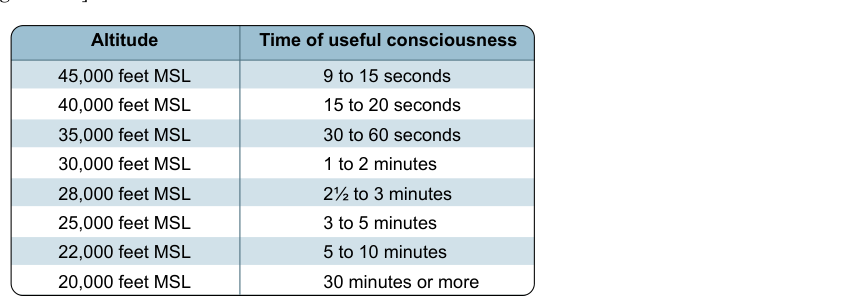
Time of Useful Consciousness (TUC) — also called Effective Performance Time (EPT) — defines the narrow window after a sudden loss of supplemental oxygen or rapid cabin decompression during which a pilot retains the cognitive and physical ability to take meaningful, corrective action. Understanding TUC is not merely an academic exercise for the commercial pilot knowledge test; it is a concrete survival timeline that determines whether a crew lives or dies in the seconds following a high-altitude decompression event. The critical distinction, emphasized throughout the FAA's Pilot's Handbook of Aeronautical Knowledge (PHAK, FAA-H-8083-25), is that TUC ends well before unconsciousness — a pilot can feel perfectly normal, or even pleasantly euphoric from hypoxia, at the precise moment they have already lost the ability to perform useful tasks.
What TUC Is — and Is Not
TUC is commonly misread as the time until a pilot passes out. That misunderstanding is dangerous. The PHAK explains that hypoxic hypoxia — the form caused by reduced oxygen partial pressure at altitude — degrades cognitive performance in a smooth, insidious curve. Judgment, short-term memory, and fine motor coordination deteriorate first, often without any subjective sense of impairment. By the time TUC has expired, the pilot may still be conscious in the ordinary sense of the word — eyes open, appearing alert — yet completely incapable of correctly reading an instrument, selecting the right switch, or executing an emergency checklist. Actual loss of consciousness arrives later, after TUC has already stolen the opportunity to self-rescue.
This subtlety is reinforced in the PHAK's aeromedical chapter: hypoxia is particularly dangerous because its early symptoms — mild euphoria, a warm sense of well-being, tingling in the extremities, and impaired judgment — can feel indistinguishable from normal wellness. Pilots who have not received altitude chamber or reduced-oxygen training frequently report that they felt fine right up to the moment a trained observer told them to stop writing or performing tasks. That subjective sense of well-being is itself a textbook hypoxia symptom, not evidence that supplemental oxygen can wait.
TUC Values at Specific Altitudes
The PHAK provides a representative set of TUC values for a healthy, resting individual breathing ambient air following a sudden oxygen interruption. These numbers are essential knowledge for any commercial pilot operating pressurized aircraft:
- 18,000 feet MSL: approximately 20 to 30 minutes of useful consciousness.
- 25,000 feet MSL: approximately 3 to 5 minutes — a sharp, non-linear drop.
- 28,000 feet MSL: approximately 2 to 3 minutes.
- 30,000 feet MSL: approximately 1 to 2 minutes.
- 35,000 feet MSL (FL350): approximately 30 to 60 seconds — typical cruise altitude for turbine aircraft.
- Above 40,000 feet MSL: as little as 9 to 15 seconds, which may be less time than is needed to locate, retrieve, and properly don an oxygen mask.
Notice the non-linear, exponential-style collapse. Moving from 18,000 to 25,000 feet — just 7,000 feet — shrinks TUC from roughly 20–30 minutes to only 3–5 minutes. Moving from 25,000 to 40,000 feet shrinks it further to a matter of seconds. This non-linearity surprises many students who intuitively assume the relationship is gradual.
How Physical Activity Affects TUC
The PHAK is explicit that the values above apply to a resting individual. Physical exertion significantly accelerates oxygen depletion in the tissues and can reduce TUC by roughly half compared to the sedentary baseline. Consider the real-world implications: a flight crew member who just completed a rapid run-through of emergency checklists, moved through the cockpit, or experienced the adrenaline surge of a sudden explosive decompression is not resting. That person's effective TUC at FL350 may be 15 to 30 seconds rather than the listed 30 to 60. Stress, anxiety, and rapid breathing (hyperventilation) can compound this further. The PHAK specifically notes that hyperventilation — often a stress response — can mimic and mask hypoxia symptoms, complicating the crew's self-assessment at the worst possible moment.
Regulatory Framework and TUC in Context
14 CFR Part 91.211 establishes the minimum regulatory requirements for supplemental oxygen. Pilots flying unpressurized aircraft must use supplemental oxygen for flights above 12,500 feet MSL lasting more than 30 minutes, and at all times above 14,000 feet MSL. All occupants must be provided oxygen above 15,000 feet MSL. For pressurized aircraft operations, 14 CFR Part 91.211(b) requires that above FL350 up to and including FL410, at least one required pilot must wear and use an oxygen mask any time the other pilot leaves the controls unattended, and above FL410, at least one required pilot must wear and use an oxygen mask at all times.
Regulations, however, set a legal floor — not an operational ceiling. At FL350, where TUC can be as short as 30 to 60 seconds at rest and half that with exertion, a pilot who waits to confirm a decompression event, then reaches for an oxygen mask, then attempts to stabilize the aircraft before beginning an emergency descent may already be incapacitated before completing the first task. The correct priority sequence, consistent with FAA guidance, is: don oxygen immediately, then descend, then troubleshoot. Reversing this sequence — attempting to troubleshoot or communicate before donning oxygen — risks losing the only crew member capable of flying the airplane.
Hypoxia Recognition and Individual Variation
One of the most important points in the PHAK's aeromedical section is that hypoxia symptoms vary significantly between individuals, and even from one flight to another in the same person. Common early symptoms include: increased breathing rate, headache, apprehension, decreased reaction time, impaired judgment and memory, and the characteristic sense of well-being or mild euphoria. Cyanosis (a bluish tint to the fingernails or lips) is a late-stage sign and should never be used as a primary indicator.
Because symptoms are personal and variable, the FAA strongly encourages pilots to undergo altitude chamber training (such as programs historically offered through the FAA Civil Aerospace Medical Institute) or approved reduced-oxygen training devices. These environments allow a pilot to identify their own unique early hypoxia symptoms under controlled, supervised conditions — before encountering hypoxia in flight when self-correction may no longer be possible.
Key Numbers and Rules
- TUC ends before unconsciousness — incapacitation for practical purposes precedes loss of consciousness.
- At 18,000 ft: ~20–30 minutes; at 25,000 ft: ~3–5 minutes; at 30,000 ft: ~1–2 minutes; above 40,000 ft: 9–15 seconds.
- Physical activity or stress can cut TUC approximately in half relative to the resting baseline.
- 14 CFR 91.211 mandates crew oxygen above 14,000 ft MSL; passenger oxygen above 15,000 ft MSL.
- Correct decompression response: don oxygen first, then begin emergency descent.
- Hyperventilation can mask or mimic hypoxia symptoms — both cause light-headedness and tingling.
Common Test Traps
- TUC equals time until unconscious — FALSE. TUC is the time until useful task performance is lost, which happens significantly before actual loss of consciousness. Exam scenarios are designed to exploit this confusion.
- A pilot who feels fine is not hypoxic — FALSE. Euphoria and a subjective sense of wellness are classic early-stage hypoxia symptoms. Feeling good at altitude is never a reason to delay oxygen use.
- TUC decreases linearly with altitude — FALSE. The relationship is non-linear; the drop from 25,000 to 40,000 feet is far more dramatic than the equivalent altitude gain lower in the atmosphere.
- Descend first, then use oxygen — FALSE. At high altitude the TUC may be too short to accomplish a descent before incapacitation. Oxygen must be donned first.
- Exertion does not change TUC — FALSE. Physical activity, adrenaline, and hyperventilation can reduce TUC by roughly half. Test scenarios involving an active or stressed pilot should trigger this knowledge.
- Hyperventilation is harmless — FALSE. Hyperventilation reduces carbon dioxide levels, causing its own set of symptoms (dizziness, tingling) that overlap with hypoxia and can cause a pilot to misidentify the problem.
Memory Aid
Use the altitude-to-time ladder as a quick mental anchor: 18,000 → minutes (20–30) / 25,000 → few minutes (3–5) / 30,000 → one or two minutes / 40,000+ → seconds. The phrase "The higher you go, the faster the clock runs out — and activity winds it down faster still" captures both the altitude effect and the exertion penalty in one memorable sentence. Pair it with the rule: Mask first, descent second, checklist third — in that rigid order regardless of the temptation to troubleshoot immediately.