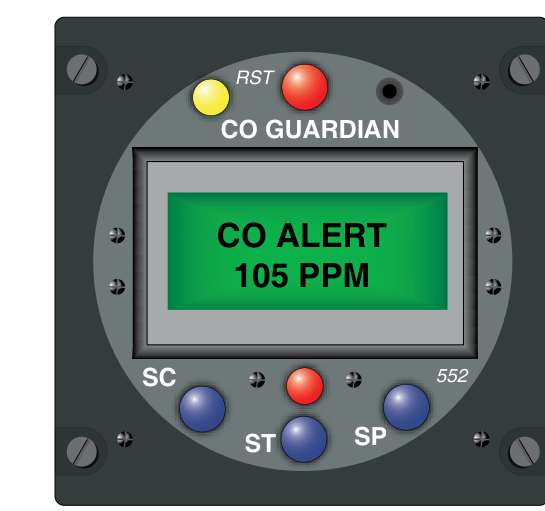
Carbon monoxide (CO) poisoning is one of the most insidious aeromedical threats a pilot can face, precisely because the gas gives no sensory warning whatsoever. It is colorless, odorless, and tasteless, yet it can incapacitate a crew within minutes under the right conditions. The FAA Pilot's Handbook of Aeronautical Knowledge (PHAK, FAA-H-8083-25) identifies CO poisoning as a significant physiological hazard, and the Aeronautical Information Manual (AIM) reinforces the message that carbon monoxide exposure is a genuine in-flight emergency — not a theoretical risk. For commercial pilots operating extended duty periods, often with cabin heat continuously engaged, understanding the full picture of CO physiology, recognition, and response is a fundamental airmanship requirement.
Where Carbon Monoxide Comes From
In virtually every reciprocating-engine aircraft, the primary CO risk is the cabin heating system. Most light and general aviation aircraft heat the cabin by routing outside air through a shroud or jacket wrapped around the exhaust muffler or manifold. Engine combustion gases pass through the muffler on the inside; ram air passes around the outside, picking up heat before entering the cabin. This is an efficient and weight-effective design — but it depends entirely on the exhaust system being perfectly sealed. A crack as small as a hairline fracture in the muffler wall or a loose exhaust gasket allows hot combustion gases, rich with CO, to mix directly with cabin air.
CO is produced whenever combustion is incomplete — that is, when there is insufficient oxygen to convert all carbon in the fuel to carbon dioxide. Slightly rich mixture settings, cold starts, and engine wear all promote incomplete combustion and elevated CO in exhaust gases. Concentrations in raw exhaust can be very high, often cited in the range of several thousand to over 100,000 parts per million (ppm) depending on engine and mixture. Even after significant dilution through a cracked shroud, cabin CO levels can quickly exceed the 50 ppm threshold at which physiological effects begin, and higher concentrations can cause serious symptoms to develop rapidly. It is also worth noting that other sources exist: an idling aircraft parked downwind of its own exhaust, or a cabin heater that burns fuel directly (a combustion heater), can also generate CO if malfunctioning.
Physiology: Why CO Is So Dangerous
To understand why CO is so hazardous, it helps to understand normal oxygen transport. Red blood cells carry oxygen bound to hemoglobin. When CO is inhaled, it competes for the same binding sites on hemoglobin — and it wins decisively. The PHAK notes that CO binds to hemoglobin approximately 200 times more readily than oxygen does. The resulting compound, carboxyhemoglobin (COHb), is functionally useless for oxygen delivery. A pilot with even 20–30% of their hemoglobin tied up as COHb has significantly reduced oxygen-carrying capacity, yet their blood oxygen saturation as measured by a standard pulse oximeter may still read in a range that appears acceptable. Standard pulse oximeters cannot reliably distinguish oxyhemoglobin from carboxyhemoglobin — a critical point for any pilot relying on a personal pulse oximeter for physiological monitoring.
The brain is the organ most sensitive to oxygen deprivation. As COHb levels rise, the progression of symptoms follows a predictable but dangerously subtle path. Mild exposure (COHb roughly 10–20%, as an approximate range) produces a dull, frontal headache — often described as a tension-type headache — along with a sense of fatigue, slight dizziness, and nausea. At moderate levels (COHb roughly 20–40%), symptoms escalate to throbbing headache, confusion, impaired judgment, weakness, and visual disturbances. At severe levels (COHb above 40–50%), loss of consciousness, convulsions, and death can occur. The cruel reality is that the same impairment of judgment that defines moderate CO poisoning makes it progressively harder for a pilot to recognize what is happening and take corrective action.
Distinguishing CO Poisoning from Hypoxia
Hypoxia and CO poisoning share a common outcome — insufficient oxygen reaching brain tissue — but their mechanisms, presentations, and treatments differ in important ways that show up on FAA knowledge tests. Classic altitude-induced hypoxia occurs when the partial pressure of oxygen in the atmosphere is too low; CO poisoning can occur at any altitude because the hemoglobin is chemically blocked rather than simply undersupplied. Symptom-wise, headache tends to be more prominent and earlier in CO poisoning than in the euphoric, almost pleasant onset of hypoxia. Altitude hypoxia is addressed by descending and/or applying supplemental oxygen; CO poisoning requires first eliminating the source before oxygen therapy can be fully effective. A pilot who suspects hypoxia at altitude but whose symptoms began at a lower altitude with the heat on should immediately consider CO as the cause.
Immediate Pilot Response
A structured response is essential because CO poisoning degrades the very cognitive abilities needed to respond effectively. The actions below should be rehearsed on the ground so they become nearly automatic:
- Close the cabin heat valve immediately. This is the single highest-priority action. In most light aircraft the cabin heat draws directly from the exhaust shroud; closing the heat valve cuts off the primary CO entry path. Do not leave it on while trying other remedies first.
- Open all fresh-air vents and, where the aircraft type permits, windows. Flushing the cabin with outside air dilutes and removes accumulated CO. Ram-air vents that bypass the heat system are your friend here.
- Apply supplemental oxygen at 100% concentration if available. Breathing pure oxygen dramatically accelerates CO elimination. The half-life of COHb breathing room air is roughly four to five hours; breathing 100% oxygen reduces that half-life to approximately 60–90 minutes. If the aircraft is equipped with an oxygen system, use it immediately.
- Declare an emergency and divert. Squawk 7700, advise ATC of the nature of the emergency, and land as soon as practicable. Do not attempt to continue to destination. Even if you feel better after steps one through three, the underlying exhaust defect remains, and you require post-flight medical evaluation.
Memory Aid
The phrase "Heat OFF — Air ON — O2 ON — GET DOWN" captures all four actions in the correct sequence. It is short enough to recall when cognition is already partially degraded and should be practiced aloud during preflight briefings or ground training until it is automatic.
Detection: CO Detectors in the Cockpit
Because CO provides no sensory warning, an independent detector is the only reliable early-warning tool. Two types are common in general aviation. Chemical spot detectors are inexpensive cards or tabs that change color — typically from tan to dark gray or black — in the presence of CO. They must be replaced regularly per manufacturer guidance because they degrade over time and lose sensitivity. Electronic detectors provide a numerical ppm readout and audible alarms, offering more precise information. Neither type is required by regulation for most operations, but their use is strongly consistent with sound Aeronautical Decision Making (ADM) principles described in the PHAK and in FAA-H-8083-2 (Risk Management Handbook). A detector should be mounted within the pilot's normal scan, not tucked in a bag where a color change would go unnoticed.
Critically, a CO detector is a safety net — not a substitute for maintenance. The exhaust system should be inspected carefully at every 100-hour and annual inspection specifically for cracks, loose connections, and deterioration of exhaust gaskets and muffler integrity. Early detection of exhaust system defects is far preferable to relying on a detector to catch the consequences of deferred maintenance.
Key Numbers and Rules
- ~200×: CO binds to hemoglobin approximately 200 times more readily than oxygen (PHAK).
- 50 ppm: Generally recognized threshold at which physiological effects may begin with prolonged exposure.
- COHb half-life on room air: approximately 4–5 hours; on 100% oxygen: approximately 60–90 minutes.
- Standard pulse oximeters cannot reliably detect CO poisoning — they may show normal-appearing SpO2 even with significant COHb levels.
- Primary source in light aircraft: cracked or leaking exhaust muffler or manifold in the cabin heat shroud system.
- 14 CFR 91.3 establishes that the pilot-in-command is directly responsible for, and is the final authority as to, the operation of the aircraft — including recognition of and response to aeromedical emergencies.
Common Test Traps
- Assuming symptoms will be obvious or dramatic. Early CO poisoning feels like a mild headache or fatigue — symptoms easily dismissed as a long duty day, dehydration, or motion discomfort. This subtle onset is precisely what makes the hazard so serious.
- Treating CO poisoning like pure hypoxia. Applying oxygen without first eliminating the source may slow symptom progression but does not remove ongoing CO exposure. The heat must be shut off first.
- Believing that opening fresh-air vents is sufficient. Adding fresh air without closing the heat valve may still allow CO to enter if the shroud is cracked. Turning off the heat is non-negotiable.
- Trusting a pulse oximeter to rule out CO poisoning. Standard finger-clip pulse oximeters read COHb and oxyhemoglobin as the same; a normal SpO2 reading does not rule out significant carboxyhemoglobin levels.
- Treating a CO detector as a maintenance substitute. Detection is a last line of defense; proper exhaust system inspection is the proactive defense.