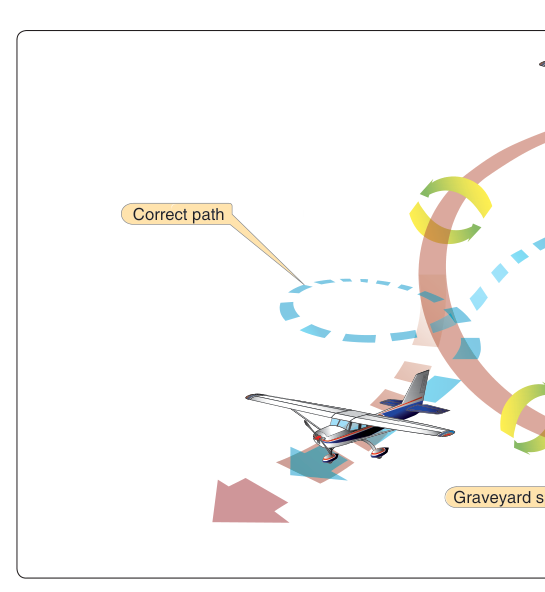
Spatial disorientation claims a disproportionate share of fatal general aviation accidents, and two vestibular illusions sit at the center of that grim statistic: the leans and the graveyard spiral. Both are products of the same physiological limitation—your semicircular canals sense only changes in angular motion, not sustained rotation—and both can overwhelm even competent, instrument-rated pilots when visual references disappear. Understanding the neuroscience behind these illusions, how they progress in the cockpit, and the correct response to each is not merely exam knowledge; it is the kind of understanding that keeps you alive in IMC.
The Physiology: Why Your Inner Ear Lies to You
The vestibular system consists of three semicircular canals oriented in mutually perpendicular planes, plus the otolith organs (the utricle and saccule) that sense linear acceleration and gravity. Each semicircular canal is filled with fluid called endolymph. When your head—and by extension the aircraft—rotates, inertia causes the endolymph to lag behind, deflecting a hair-cell structure called the cupula. That deflection produces a neural signal your brain reads as rotation. The critical flaw for aviators is this: the cupula is spring-loaded. If the rotation continues at a constant rate, the endolymph catches up with the canal walls in approximately 10 to 20 seconds, the cupula returns to its neutral position, and the sensation of rotation disappears entirely. Your brain now reports wings-level—even if the aircraft is in a 30-degree bank.
This is the root cause of both the leans and the graveyard spiral. The otolith organs compound the problem by interpreting centrifugal force in a prolonged banked turn as a component of gravity, reinforcing the false sense that the banked attitude is actually upright. The Pilot's Handbook of Aeronautical Knowledge (PHAK, FAA-H-8083-25) describes these mechanisms in detail and identifies spatial disorientation as a leading aeromedical hazard in instrument meteorological conditions.
The Leans: Definition, Mechanism, and Persistence
The leans are the most frequently reported vestibular illusion in flight. They arise through a specific sequence of events. A pilot enters a bank gradually—perhaps at a rate below the vestibular threshold of roughly 2 degrees per second—so the semicircular canals never generate a perceptible rotation signal. The pilot's brain records no bank; the subjective experience is wings-level. When the pilot eventually notices the actual bank on the attitude indicator and applies corrective aileron to return to level flight, that correction is a detectable rate of change, and the canals signal it faithfully. The brain now perceives the correction as a bank in the direction opposite to the original turn. The result: the pilot feels banked in the wrong direction even while the aircraft is genuinely wings-level.
Faced with this uncomfortable conflict between what the instruments show and what the body feels, pilots respond in one of two ways. Some comply with the false sensation and re-bank—putting the aircraft right back into the attitude they just corrected. Others maintain the correct wings-level attitude as shown on instruments but physically lean their torso toward the perceived upright—hence the leans. The name describes the pilot's body position, not the aircraft's attitude. The aircraft may be in perfect coordinated level flight while the pilot is sitting sideways in the seat.
What makes the leans insidious is their persistence. Unlike many perceptual illusions that fade quickly, the leans can continue for minutes—sometimes for an entire flight segment—even while a pilot is correctly cross-checking and following instruments. The continuous muscular effort to resist the false lean sensation adds to workload and fatigue, degrading overall performance at exactly the moment precise flying is most critical.
The Graveyard Spiral: From Illusion to Emergency
The graveyard spiral is what happens when the leans go uncorrected, or when a pilot in IMC or at night enters a prolonged banked turn and loses situational awareness. The sequence is well-documented in accident reports and in the PHAK:
- Undetected bank entry. The pilot—distracted by cockpit tasks, weather, or a radio call—allows the aircraft to drift into a bank. If the entry is gradual, no vestibular signal is produced.
- Canal adaptation. Within approximately 10 to 20 seconds of constant-rate turning, the endolymph catches up with the rotating canal and the cupula returns to neutral. The pilot now has a full, convincing sensation of wings-level flight while the aircraft is in a sustained bank.
- Lift vector displacement and descent. A banked aircraft redirects lift away from vertical. The vertical component of lift no longer fully supports the aircraft's weight, and the airplane begins to descend. The pilot notices the altimeter and VSI indicating a loss of altitude.
- The fatal instinct: pull back. Because the pilot perceives wings-level flight and senses only a descent, the intuitive response is to apply back-pressure on the controls to arrest the sink rate. But pulling back in a banked turn does not arrest the descent—it tightens the turn, increases load factor, and causes airspeed to build further as the nose is pulled around the arc rather than upward.
- Spiral tightening. As the turn radius decreases and airspeed increases, centrifugal force presses the pilot into the seat, mimicking the feel of a normal pull-up and reinforcing the illusion of upright flight. The pilot pulls harder. The spiral tightens until structural limits are exceeded or the aircraft strikes terrain—often at high speed with little or no warning.
This is not a spin. The aircraft is in coordinated flight throughout. There are no autorotation forces, and spin recovery technique is completely wrong here. Treating a graveyard spiral as a spin by applying opposite rudder and pushing forward can make the situation catastrophic. The correct recovery is unambiguous: level the wings first using the attitude indicator, then apply back-pressure to arrest the descent. Reversing that order—pulling before leveling—increases load factor and tightens the spiral.
Key Numbers, Rules, and Regulations
- Vestibular threshold: The semicircular canals typically cannot detect rotation rates below approximately 2 degrees per second. Banks entered below this rate produce no initial sensation of turning.
- Canal adaptation time: Approximately 10 to 20 seconds of sustained constant-rate rotation is sufficient for the endolymph to equalize and the sensation of turning to disappear entirely.
- Load factor in a 60-degree bank: Load factor reaches 2 Gs in a 60-degree banked level turn. In a spiral, the combination of bank angle and back-pressure can rapidly exceed the aircraft's maneuvering speed and design limits.
- IMC currency requirement: 14 CFR 61.57(c) requires recent instrument experience (six approaches, holding, and intercepting/tracking courses within the preceding six calendar months) to act as pilot in command under IFR—a regulation directly tied to maintaining the proficiency necessary to trust instruments over sensations.
- Recovery priority: Level wings with the attitude indicator first; then neutralize back-pressure and apply gentle back-pressure to arrest descent. Do not pull before leveling.
Common Test Traps
- The aircraft may be wings-level during the leans. The illusion is entirely perceptual. A question that states the pilot feels banked does not mean the aircraft is banked—read carefully.
- The graveyard spiral is not a spin. It is a coordinated, high-speed, steeply banked descending turn. Spin recovery inputs are incorrect and dangerous.
- Back-pressure alone cannot stop a graveyard spiral. Pulling without leveling increases load factor and tightens the turn—this is frequently the correct answer to questions asking what makes the spiral worse.
- A slow bank entry is more dangerous than an abrupt one. An abrupt bank exceeds the vestibular threshold and is actually detected; a gradual bank may never be sensed at all.
- Centrifugal force mimics gravity in a sustained turn. The otolith organs interpret the centripetal acceleration pressing the pilot into the seat as a normal gravity vector, powerfully reinforcing the illusion of upright flight even in a steep bank.
- Spatial disorientation can affect instrument-rated pilots. Proficiency and ratings do not make a pilot immune; they only provide the training to recognize and override the illusions with disciplined instrument cross-check.
Memory Aid
The recovery priority for a graveyard spiral is remembered as "Level, then Pull"—a phrase endorsed by the FAA's discussion of unusual attitude recovery in the Instrument Flying Handbook (FAA-H-8083-15). Roll wings-level on the attitude indicator first; only then apply back-pressure to climb. This mirrors the broader FAA principle found in the Risk Management Handbook (FAA-H-8083-2): recognize hazardous attitudes (such as the Invulnerability attitude—"It won't happen to me") and apply the corresponding antidote. For spatial disorientation, the antidote is active, disciplined trust in flight instruments over bodily sensation.