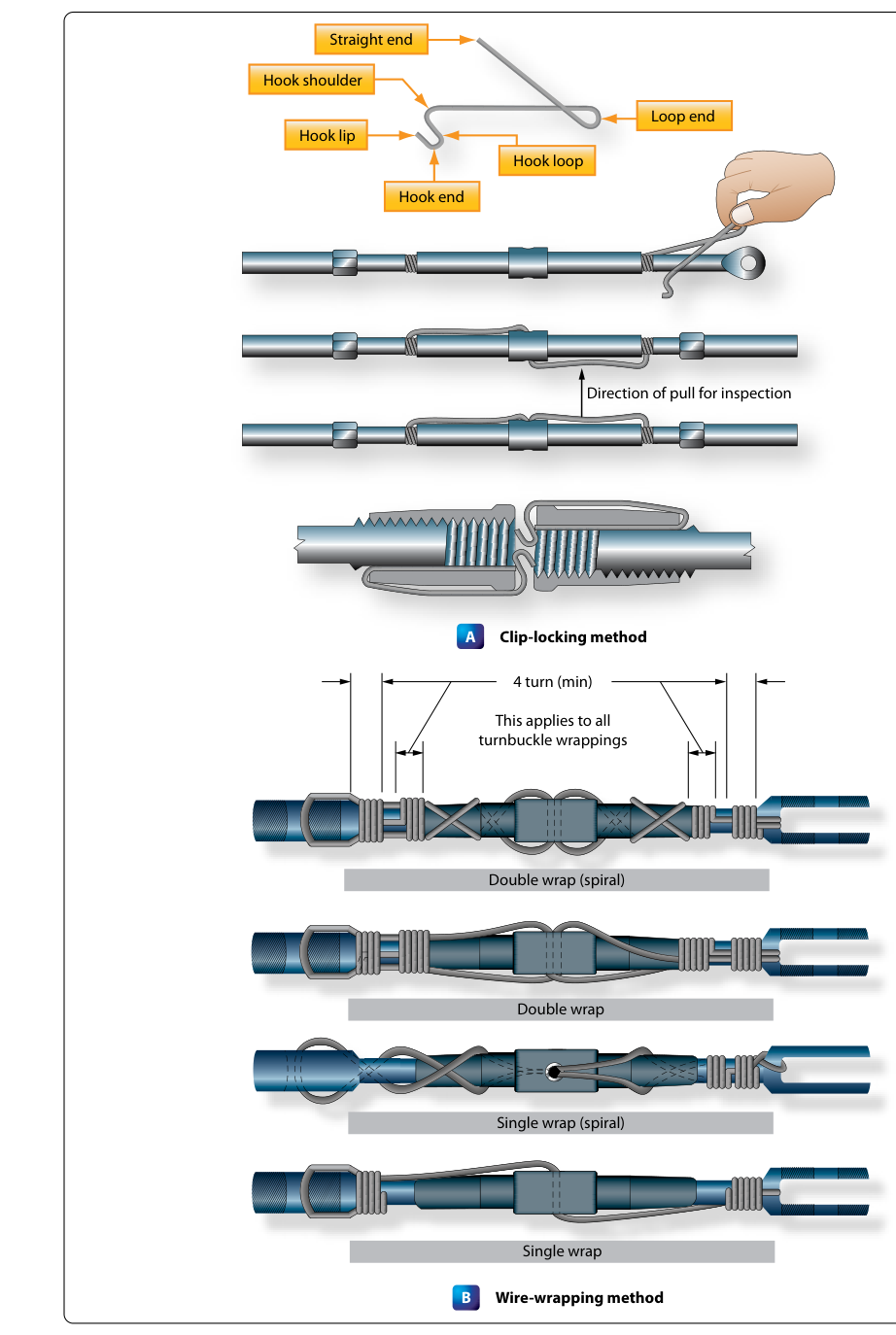
Turnbuckles are simple but safety-critical hardware items found throughout an aircraft's cable-operated flight control systems. Their job is straightforward: provide a means of adjusting the tension in a control cable and then locking that adjustment in place so it cannot change in flight. Despite their simplicity, the FAA places strict requirements on how turnbuckles are installed, inspected, and safetied. An improperly locked turnbuckle can back off under vibration, reducing cable tension to the point where the pilot loses effective control authority. For any AMT working on airframe assembly and rigging, mastering turnbuckle safety methods is not optional — it is a fundamental airworthiness responsibility.
This article covers the anatomy of a standard aircraft turnbuckle, the FAA-accepted locking methods, the precise wire-wrapping techniques for the most common method, and the inspection criteria used to confirm a properly safetied installation. All information is grounded in FAA Advisory Circulars and the Aircraft Maintenance Technician Handbook – Airframe (FAA-H-8083-31).
Anatomy of a Turnbuckle
A standard aircraft turnbuckle assembly consists of three parts: the barrel (also called the body), and two threaded terminal ends — one with right-hand threads and one with left-hand threads. The opposing thread directions mean that rotating the barrel in one direction simultaneously draws both terminals inward, increasing cable tension. Rotating it the other way extends the terminals outward and decreases tension. The barrel typically has a small hole or inspection hole at its center that serves an important purpose during inspection.
The terminal ends may be threaded directly onto cable terminals such as swaged end fittings, fork ends, eye ends, or pin-end cable terminals. The entire assembly is typically made from carbon steel or corrosion-resistant steel and must conform to applicable Military Standards (MS) or National Aircraft Standards (NAS) to ensure strength and thread compatibility. Turnbuckle forks, eyes, and pins are not interchangeable among different manufacturers without verifying compatibility and load ratings.
Thread Engagement — The Starting Point for Safety
Before any safety method can be applied, the turnbuckle must be properly tensioned and the thread engagement must meet FAA standards. The basic rule is that no more than three threads may be visible outside the barrel on either end when the assembly is properly tensioned. Most barrels have inspection holes drilled through the center of the body: when a wire or pin placed in the inspection hole cannot pass through — meaning a terminal shank is blocking it — sufficient thread engagement has been achieved. This is a quick field-check that technicians use to verify that neither terminal has backed out too far.
Cable tension itself is measured with a calibrated tensiometer and compared against the aircraft manufacturer's rigging chart, which typically specifies tension as a function of cable diameter and ambient temperature. Temperature compensation is necessary because steel cables contract in cold air and expand in warmth, changing tension without any movement of the turnbuckle.
FAA-Accepted Locking Methods
Once the correct tension is set and thread engagement is confirmed, the turnbuckle must be safetied. The FAA recognizes two primary categories of locking methods: wire locking (safety wire) and clip-type locking devices. Both prevent the barrel from rotating and the terminals from backing out.
Wire Locking Methods
Wire locking is the traditional and most widely used method. The FAA specifies two distinct wire-wrap techniques: the single-wrap method and the double-wrap method. Both use soft, annealed stainless steel or soft steel safety wire — typically 0.040-inch diameter wire for most turnbuckle sizes. The wire is threaded through the inspection hole of the barrel and wrapped around the terminal shanks in a manner that opposes any tendency of the barrel to rotate and unscrew.
Double-wrap method: Two separate lengths of wire are used. Each wire is passed through the inspection hole of the barrel, and each wire is wrapped a minimum of four times around its respective terminal shank before being twisted together and bent back. The double-wrap method provides the highest level of security and is required for any turnbuckle that is difficult to inspect routinely or is located in a critical area. Because it uses two independent wires, failure of one does not immediately remove all locking action.
Single-wrap method: A single length of wire is used. It passes through the barrel inspection hole, and each free end is wrapped around the adjacent terminal shank a minimum of four times, then twisted. While accepted by the FAA, the single-wrap method provides slightly less redundancy than the double-wrap technique. Some aircraft maintenance manuals and FAA guidance prefer the double-wrap for primary flight controls.
In both methods, the wraps must be tight and in the correct direction. The wire must be wrapped so that any tendency of the turnbuckle barrel to rotate in the unscrewing direction would tighten — not loosen — the wire. After wrapping, the free ends of the safety wire are twisted together, trimmed, and bent inward so they will not snag cables, fabric, or the technician's hands during future maintenance.
Clip-Type Locking Devices
An alternative to wire locking is the use of pre-formed locking clips, often called turnbuckle safety clips or MS21256 clips. These spring-steel clips are designed to snap into grooves machined into the turnbuckle barrel and terminal shanks. When properly installed, the clip's legs engage the groove on one terminal and the groove on the barrel, preventing relative rotation between those parts. A separate clip locks the opposite terminal to the barrel.
Clip-type devices are faster to install than wire wrapping and are reusable if undamaged, making them popular in production environments. However, they must only be used on turnbuckle assemblies specifically designed with the matching grooves — they cannot be retrofitted to old-style smooth-shank terminals. The technician must verify that the clip is fully seated in its groove and is not sprung, cracked, or deformed before approving the installation.
Why This Matters — Safety Implications
Flight control cable systems transmit the pilot's inputs directly to control surfaces. Most light aircraft use cable-and-pulley systems for ailerons, elevators, and rudders. If a turnbuckle barrel backs off even one full rotation under vibration, cable tension drops substantially. In a worst case, a cable can go completely slack, leaving the pilot with no ability to deflect that control surface. Inflight loss of flight control is classified as a catastrophic failure mode. This is precisely why the FAA does not permit any improvised safety method — only FAA-accepted techniques provide the proven vibration resistance needed for an airworthy installation.
Additionally, a turnbuckle that was correctly safety-wired at one maintenance interval can develop problems if wires are not replaced when disturbed. Safety wire must never be reused. Any time a turnbuckle is disturbed — even to re-check tension — the safety wire must be removed and new wire installed after the adjustment is complete.
Key Numbers and Rules
- Thread engagement: No more than three threads visible outside the barrel on either end after tensioning.
- Inspection hole check: A wire or probe inserted in the barrel's center inspection hole should be blocked by the terminal shank, confirming adequate thread engagement.
- Wire diameter: Typically 0.040-inch (No. 40) annealed stainless steel safety wire for standard turnbuckles; always verify the applicable maintenance manual or AC for specific diameter requirements.
- Minimum wraps: At least four wraps around each terminal shank in both single-wrap and double-wrap methods.
- Wire reuse: Safety wire is never reused — install fresh wire every time a turnbuckle is adjusted.
- Clip devices: Only used on turnbuckle assemblies with machined locking grooves specifically designed for that clip type.
- Tension verification: Use a calibrated tensiometer and compare to the manufacturer's temperature-corrected rigging chart.
- Direction of wraps: Wraps must resist barrel rotation in the loosening direction; incorrect wrap direction negates the safety function.
Common Test Traps
- Counting threads vs. the three-thread rule: The FAA knowledge test often asks how many threads may be exposed outside the barrel. The correct answer is no more than three threads on each end — students sometimes confuse this with the total number of threads in the barrel.
- Single vs. double wrap preference: Some students assume both methods are always interchangeable. The double-wrap method is preferred — and sometimes specifically required — for primary flight controls or difficult-to-inspect locations.
- Reusing safety wire: A common wrong answer is that undamaged safety wire can be reused if the technician is careful. FAA standards are unambiguous: safety wire is never reused once removed.
- Clip compatibility: Students may think clip-type locking devices can be used on any turnbuckle. They can only be used on assemblies designed with the appropriate machined grooves; using clips on incompatible hardware is not airworthy.
- Wrap direction: The test may describe a wire wrap and ask whether it is correctly installed. If the wrap direction would allow the barrel to loosen the wire as it unscrewd, the installation is incorrect — wraps must oppose loosening rotation, not assist it.