Welding is one of the most demanding skills in aircraft maintenance. When metal structural components are joined or repaired by fusion, the integrity of the airframe depends entirely on the quality of the weld. Because aviation demands precise, repeatable, and inspectable results, the FAA and aircraft manufacturers specify exactly which welding processes are acceptable for a given repair, and AMTs are expected to understand the fundamentals of each. Three processes dominate certificated aircraft repair work: Oxyfuel (Oxyacetylene) Welding (OAW), Gas Tungsten Arc Welding (GTAW, commonly called TIG), and Gas Metal Arc Welding (GMAW, commonly called MIG). Understanding how each works, when to use it, and where it falls short is essential knowledge for the AMT General written test and for safe shop practice.
Oxyfuel (Oxyacetylene) Welding — OAW
Oxyacetylene welding uses the combustion of acetylene gas mixed with pure oxygen to produce a flame capable of reaching approximately 5,850–6,300 °F at the inner cone — the hottest part of a properly adjusted neutral flame (the exact figure varies slightly by handbook edition and source). This extreme temperature is sufficient to melt most ferrous and non-ferrous metals used in light aircraft construction, including 4130 chromoly steel tubing, aluminum, and some stainless alloys.
The OAW outfit consists of high-pressure oxygen and acetylene cylinders, regulators to reduce working pressure, flexible hoses, a torch body, and interchangeable tips. Tip size is selected based on metal thickness — heavier stock requires a larger tip orifice to deliver more heat. The technician adjusts the oxygen-to-fuel ratio to produce one of three flame types:
- Neutral flame: Equal volumes of oxygen and acetylene; characterized by a clearly defined inner cone and no excess feather. This is the standard setting for welding most aircraft steels and aluminum.
- Carburizing (reducing) flame: Excess acetylene; produces an intermediate feather between the inner cone and outer envelope. Used for welding some high-carbon steels and for hard-facing operations where carbon addition is desired.
- Oxidizing flame: Excess oxygen; the inner cone shortens and the flame makes a harsh sound. Used for welding brass and bronze, but harmful to steel because the excess oxygen combines with iron to form scale and porosity.
OAW excels for welding thin-wall 4130 steel tubing found in many certificated aircraft fuselage structures because the heat input can be controlled precisely by torch angle and tip distance. The process requires no electricity, making it usable in remote field conditions. Filler rod is added manually, giving the welder direct control over bead shape and penetration.
The primary disadvantages are the relatively large heat-affected zone (HAZ) compared to arc processes, slower travel speed, and the requirement for careful post-weld stress-relief or normalization on many aircraft structures. Acetylene cylinders must be stored and handled carefully — acetylene is considered unstable above 15 PSI in free gas form, and common shop practice calls for withdrawing acetylene from a cylinder no faster than one-seventh of its total capacity per hour.
Gas Tungsten Arc Welding — TIG (GTAW)
TIG welding uses a non-consumable tungsten electrode to establish an electric arc between the electrode and the base metal. The arc melts the work; filler rod is added separately by hand, much like OAW. The entire weld pool, tungsten electrode, and adjacent base metal are shielded from atmospheric contamination by a continuous flow of inert shielding gas — typically argon, or an argon-helium mixture for higher heat input.
Because the electrode does not melt into the weld, the process gives the technician exceptional control over heat input, bead geometry, and contamination. TIG produces the cleanest, highest-quality welds of any common process, with minimal spatter and excellent fusion. This makes it the preferred method in aircraft work for:
- Stainless steel exhaust stacks and structural components
- Aluminum airframe and fuel system repairs
- Titanium fittings and firewall structures
- Thin-section chromoly steel in situations where OAW heat control is insufficient
TIG machines operate in two polarity modes. Direct Current Electrode Negative (DCEN) concentrates heat in the base metal, maximizing penetration, and is used for steel, stainless, and titanium. Alternating Current (AC) is used for aluminum because the electrode-positive half-cycle provides a cleaning action that removes the tenacious aluminum oxide layer, allowing proper fusion. Without this oxide removal, aluminum welds are porous and weak.
Tungsten electrodes are available in several formulations: pure tungsten (used with AC on aluminum), 2% thoriated (DCEN on steel and stainless — mildly radioactive, requiring ventilation and dust precautions when grinding), ceriated, and lanthanated varieties. Ceriated and lanthanated electrodes are increasingly used as substitutes for thoriated tungsten because they avoid these radioactivity concerns while offering similar arc performance. The electrode tip must be properly prepared — balled for AC aluminum welding, ground to a point for DCEN work. An incorrectly prepared electrode causes arc instability and weld defects.
TIG is slower than MIG and demands a high level of hand coordination, but its precision and cleanliness make it indispensable in aviation, particularly for turbine engine components and primary structure repairs, where a repair station's specific equipment and capability requirements are established under its FAA-approved operations specifications per 14 CFR Part 145.
Gas Metal Arc Welding — MIG (GMAW)
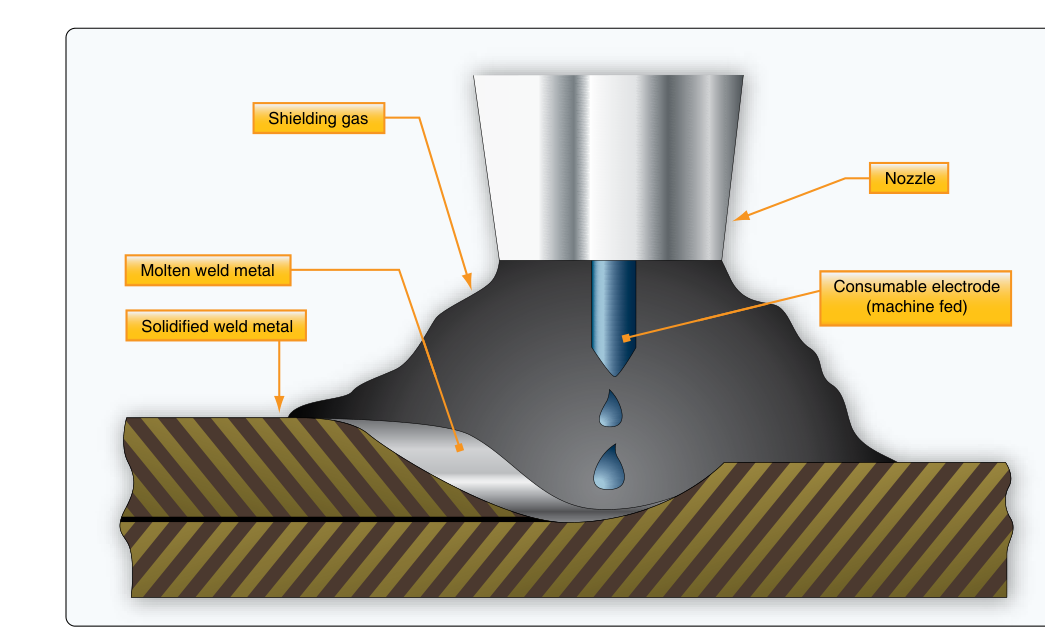
MIG welding feeds a continuous consumable wire electrode from a spool through a gun assembly. The arc is established between the wire tip and the base metal, melting both simultaneously. Shielding gas — commonly pure argon, argon-CO₂ mixtures, or pure CO₂ — flows from a nozzle surrounding the wire to protect the weld pool from oxygen and nitrogen contamination.
MIG's primary advantage is speed and ease of operation. Because the wire feeds automatically, the welder's free hand is not occupied managing a separate filler rod. This allows faster travel speeds and higher deposition rates. For thicker aluminum sections, structural aircraft assemblies in production environments, and heavier steel weldments, MIG is efficient and cost-effective.
However, MIG has important limitations that restrict its use in certificated aircraft repair compared to TIG:
- Heat input is harder to modulate on the fly compared to TIG, making it less suitable for very thin material or complex joint geometries.
- The continuous wire feed can cause cold lap (incomplete fusion at the toe of the weld) if travel speed or parameters are not precisely set.
- Spatter must be cleaned carefully to avoid masking surface defects during inspection.
- On aluminum, specialized push technique and spool guns or push-pull systems are required to prevent the soft aluminum wire from buckling in the liner.
MIG is widely used in aircraft manufacturing — particularly for heavier aluminum structures and non-critical steel weldments — but for most field repair of certificated aircraft primary structure, TIG remains the preferred process because of superior quality and control.
Why These Processes Matter in Aviation
Improper welding is one of the most consequential errors an AMT can make. A weld that looks acceptable on the surface may harbor internal porosity, lack of fusion, cracks, or excessive heat-affected zone degradation that reduces fatigue life. The FAA requires that any welding performed on certificated aircraft be accomplished per approved data — whether that is the aircraft manufacturer's maintenance manual, a Structural Repair Manual (SRM), or an FAA-approved repair specification. The Aviation Maintenance Technician Handbook — General (FAA-H-8083-30) describes acceptable processes, weld quality standards, and inspection methods including visual inspection, dye penetrant, magnetic particle, and radiographic examination.
Key Numbers and Rules
- Oxyacetylene neutral flame inner cone temperature: approximately 5,850–6,300 °F (varies by source; testable as hottest part of neutral flame).
- Acetylene working pressure: considered unstable above 15 PSI in its free state.
- Acetylene withdrawal rate: common shop practice limits withdrawal to no faster than 1/7 of the cylinder capacity per hour to prevent acetone carryover.
- TIG shielding gas for most metals: argon; argon-helium for higher heat; CO₂ is not used for TIG welding of aluminum or titanium because it does not provide adequate arc characteristics or oxide-cleaning action for these metals.
- TIG polarity for steel/stainless/titanium: DCEN; for aluminum: AC.
- MIG aluminum requires spool gun or push-pull system due to soft wire buckling.
- All welding repairs on certificated aircraft primary structure require approved data per 14 CFR Part 43.
Common Test Traps
- Flame type confusion: Students frequently confuse carburizing and oxidizing flames. Remember — carburizing has excess acetylene (a feather extends beyond the inner cone); oxidizing has excess oxygen (short, harsh-sounding cone). The oxidizing flame damages steel.
- TIG polarity for aluminum: The test may suggest DCEN for aluminum — incorrect. Aluminum requires AC to achieve the cleaning action that breaks up the oxide layer.
- Acetylene pressure limit: 15 PSI is treated as a firm shop limit, not a guideline. The test sometimes presents this as a range or asks why — the answer is chemical instability (dissociation into carbon and hydrogen, which can be explosive).
- MIG vs. TIG superiority: MIG is faster, but TIG produces higher-quality, cleaner welds — this is the key tradeoff. Do not confuse speed with quality in aviation context.
- Approved data requirement: Students sometimes assume a licensed A&P can weld any aircraft part using any acceptable technique. In reality, the specific process, filler material, and preheat/post-heat requirements must be per approved data — the process choice is not left to the technician's preference alone.