Airframe vs. Powerplant: What Each AMT Rating Covers

Airframe vs. Powerplant: Understanding the Two AMT Ratings
If you're exploring a career as an Aviation Maintenance Technician (AMT), one of the first questions you'll encounter is: what's the difference between the Airframe and Powerplant ratings? Together, these two ratings form the coveted A&P certificate — the gold standard in aviation maintenance. But each rating is distinct, covering a different domain of aircraft systems, and understanding what each one entails will help you plan your training, target your studies, and ultimately decide whether you want to pursue one or both. In this guide, we break down exactly what the Airframe and Powerplant ratings cover, how you earn them, and why the combination is so valuable in today's aviation industry.
What Is an AMT Certificate?
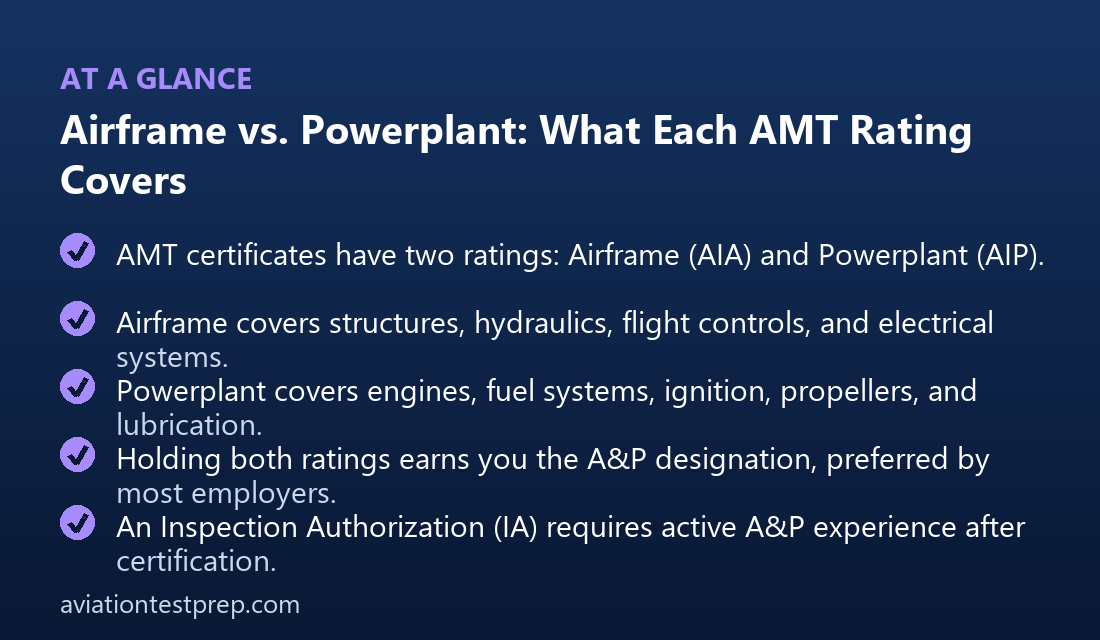
An Aviation Maintenance Technician (AMT) certificate is issued by the FAA and authorizes the holder to perform approved maintenance on aircraft. The certificate can be issued with an Airframe rating, a Powerplant rating, or both. A technician who holds both is commonly called an A&P mechanic — a phrase you'll hear constantly on the flight line and in maintenance hangars around the world.
Each rating requires separate testing, and the FAA evaluates candidates through written knowledge tests, oral exams, and practical skill tests. The knowledge tests are administered at FAA-approved testing centers and cover a wide range of technical subject areas specific to each rating.
The Airframe Rating: What It Covers
The Airframe rating focuses on the structural and non-propulsion systems of an aircraft — essentially everything except the engine. If it keeps the plane together, keeps you inside the plane, or helps you control the plane, it likely falls under the Airframe domain. Here is a breakdown of the major subject areas covered:
- Aircraft Structures: Wood, fabric, metal, and composite construction methods; inspection, repair, and alteration techniques for fuselages, wings, and control surfaces.
- Aircraft Systems & Components: Hydraulic systems, landing gear, brakes, fuel systems (airframe side), environmental systems (cabin pressurization, heating, cooling), and ice/rain protection.
- Electrical Systems: Aircraft wiring, circuit protection, lighting systems, and avionics installation basics.
- Flight Controls: Rigging and adjusting primary and secondary flight control surfaces, balance checks, and cable tension.
- Aircraft Instruments: Pitot-static systems, gyroscopic instruments, and compass systems.
- Communication & Navigation Systems: Installation and inspection of radios, transponders, and navigation antennas.
- Assembly & Rigging: Proper rigging of fixed-wing and rotor-wing aircraft components.
Earning the Airframe rating means you're qualified to inspect, repair, and sign off on airframe-related maintenance items. You'll spend a lot of time with sheet metal, composites, and hydraulic lines — the skeleton and nervous system of the aircraft.
The Powerplant Rating: What It Covers
The Powerplant rating shifts the focus to what makes the aircraft go: the engines and everything directly related to producing and managing thrust or power. Whether you're working on piston engines in a Cessna 172 or turbine engines on a regional jet, this rating is your authorization. Key subject areas include:
- Reciprocating Engines: Construction, operation, inspection, troubleshooting, and overhaul of piston engines; carburetion and fuel injection systems.
- Turbine Engines: Turbojets, turbofans, turboprops, and turboshafts — theory of operation, inspection, troubleshooting, and maintenance.
- Engine Fuel and Fuel Metering Systems: Float-type carburetors, pressure carburetors, continuous-flow and direct fuel injection, and turbine engine fuel control units.
- Engine Ignition and Electrical Systems: Magnetos, spark plugs, harnesses, turbine ignition systems, and timing procedures.
- Engine Induction and Cooling Systems: Induction manifolds, turbochargers, intercoolers, and engine cooling baffles.
- Lubrication Systems: Wet- and dry-sump systems, oil types, filters, and servicing procedures.
- Propellers: Fixed-pitch, constant-speed, and feathering propellers — inspection, repair, and track/balance procedures.
- Engine Exhaust and Thrust Reversal Systems: Mufflers, heat exchangers, and turbine thrust reversers.
The Powerplant rating is where you develop a deep mechanical intuition. Engine run-ups, borescope inspections, and propeller track checks become part of your everyday vocabulary.
How Do the Written Tests Differ?
Each rating requires its own FAA knowledge test. The Airframe (AIA) written test and the Powerplant (AIP) written test each draw from their respective subject areas, as outlined in the FAA's Airman Certification Standards (ACS) and the Aviation Mechanic Handbook. Questions cover theory, regulations, mathematics, and practical application.
Preparing for these tests requires a structured approach. Our 5-step study method — Learn, Practice, Review, Identify Weak Areas, and Retest — is designed to help you work through the material efficiently rather than just memorizing answers. You can explore all available AMT practice exams on our exam browser to find the right test for your rating.
Our AI tutor, Ace, is also available to explain difficult concepts in plain language — whether you're puzzling over a question about reciprocating engine timing or trying to visualize how a hydraulic actuator works. Ace provides instant, personalized explanations so you can understand the why behind every answer, not just the what.
For a deeper look at the specific knowledge areas tied to each test, visit our ACS codes reference page, which maps practice questions directly to FAA Airman Certification Standards.
Eligibility Requirements for the AMT Certificate
To be eligible for an AMT certificate with Airframe and/or Powerplant ratings, you generally must meet the following FAA requirements (always verify current specifics at faa.gov/mechanics):
- Be at least 18 years of age at the time of certificate issuance.
- Be able to read, write, speak, and understand English.
- Have either completed an FAA-approved Aviation Maintenance Technician School (AMTS) program, or accumulated the required practical experience (typically 18 months for one rating, 30 months for both).
- Pass all applicable written knowledge tests, oral exams, and practical skill tests.
The practical tests are administered by FAA-designated mechanic examiners (DMEs) and are separate from the written knowledge tests — so studying for the written is just the first step in a larger certification journey.
Airframe vs. Powerplant: Which Should You Pursue First?
Most aviation maintenance training programs lead students through both ratings sequentially, typically starting with General subjects that apply to both, then moving into Airframe and Powerplant-specific coursework. If you attend an FAA-approved AMTS, the curriculum is already structured to cover both.
That said, it's worth thinking about your career goals:
- If you're interested in structural repair, composites, or avionics, the Airframe rating is your foundation.
- If you're drawn to engines, turbine systems, or propulsion, starting with Powerplant makes sense.
- For the broadest career opportunities — especially at commercial airlines, MRO facilities, and charter operators — holding both ratings (A&P) is almost universally expected.
Salary figures for A&P mechanics vary widely based on employer type, location, experience, and specialization. For current compensation data, refer to the Bureau of Labor Statistics Occupational Outlook Handbook under Aircraft and Avionics Equipment Mechanics and Technicians.
Why the A&P Combination Opens More Doors
Holding both ratings doesn't just double your authorization — it significantly expands the scope of maintenance you can perform and sign off on. Airlines, regional carriers, corporate flight departments, and MRO (Maintenance, Repair & Overhaul) shops strongly prefer technicians with both ratings because it provides scheduling flexibility and operational efficiency. Many technicians also eventually pursue an Inspection Authorization (IA), which requires holding the full A&P and at least two years of active experience — another reason to earn both ratings early in your career.
As the aviation industry continues to grow and the demand for qualified maintenance professionals remains strong, the A&P certificate represents a durable, portable credential with applications ranging from general aviation shops to major airline maintenance facilities.
Start Preparing for Your AMT Written Tests Today
Whether you're tackling Airframe, Powerplant, or both, a solid study strategy makes a measurable difference in how prepared and confident you feel on test day. Aviation Test Prep offers ACS-aligned practice questions, detailed explanations, AI-powered tutoring with Ace, and performance tracking to help you focus your energy where it matters most. Browse our study resources and explore sample questions on the Aviation Test Prep blog, or jump straight into practice with a free practice test to see where you stand.
The A&P certificate is within reach — start your free account today at aviationtestprep.com/signup and take the first step toward your aviation maintenance career.
Ready to pass your FAA written exam?