Every aircraft is certified to fly with its center of gravity (CG) within a specific range — called the CG envelope — and the pilot or mechanic must verify that the CG will remain inside that envelope for every flight. The adverse loading CG check is a structured procedure used to determine whether any realistic, extreme combination of passengers, baggage, and fuel will push the CG outside its forward or aft limits. Understanding this check is essential for Aviation Maintenance Technicians (AMTs) because they are responsible for ensuring the aircraft's weight and balance documentation is accurate, complete, and legally valid before the aircraft returns to service.
Unlike a standard weight and balance calculation that checks one specific loading scenario, the adverse loading check deliberately seeks out the worst-case combinations — the ones most likely to violate limits. If the aircraft passes the adverse loading check, operators can have confidence that normal, day-to-day loadings will stay safely within the envelope. If it fails, structural modifications, equipment relocation, or operational limitations may be required.
Why the CG Envelope Matters
The CG envelope defines the forward and aft limits within which the aircraft's center of gravity must fall at all operating weights, from maximum gross weight down to minimum fuel conditions. These limits are not arbitrary: they are established during flight testing and reflect the aircraft's actual handling characteristics and structural integrity.
An aft CG beyond the aft limit reduces pitch stability, can make recovery from upsets more difficult, and may reduce the elevator's authority to trim or control pitch. A forward CG beyond the forward limit increases the stick force required to raise the nose and, in extreme cases, may prevent the pilot from flaring for landing. Both conditions represent genuine flight safety hazards, which is why the adverse loading check is a required part of the weight and balance analysis whenever the basic empty weight or the CG of an aircraft changes — such as after major repairs, alterations, or equipment changes.
What Adverse Loading Means
The word adverse in this context means the loading condition that produces the most extreme CG shift — either as far forward or as far aft as realistically possible. Because passenger, baggage, and fuel compartments are located at different arm distances from the datum, filling certain compartments while leaving others empty will move the CG dramatically. The adverse loading check identifies these extreme cases and verifies that even they remain within the certified limits.
For most light aircraft, two adverse cases must be checked:
- Most aft CG condition: Typically achieved by loading the rearmost seats and baggage compartments to maximum capacity while loading forward compartments as lightly as possible. Fuel load may be at minimum (tabs or required reserve only) if the fuel tanks are located forward of the CG, which would make a light fuel load shift the CG further aft.
- Most forward CG condition: Typically achieved by loading the front seats to maximum capacity while leaving rear seats, rear baggage, and aft fuel tanks empty. Maximum fuel in forward tanks further shifts the CG forward.
The exact loading that produces the worst case depends on the specific aircraft type and the location of all load-carrying compartments relative to the datum. The AMT must consult the aircraft's Type Certificate Data Sheet (TCDS) and the FAA-approved Airplane Flight Manual (AFM) or Pilot's Operating Handbook (POH) to determine the allowable seat, baggage, and fuel loads for each compartment.
Step-by-Step Procedure
The adverse loading CG check follows the same mathematical framework as any weight and balance calculation, but it is performed twice — once for the most forward CG condition and once for the most aft CG condition. Here is the general procedure:
- Start with the current basic empty weight and CG. These values come from the aircraft's weight and balance record, which must be current and FAA-accepted. The basic empty weight includes the airframe, powerplant, fixed equipment, and unusable fuel.
- Identify all variable load stations. List every compartment that can hold variable loads: front seats, rear seats, baggage areas, and fuel tanks. Record the arm (distance from the datum) and the maximum allowable weight for each station from the TCDS or AFM/POH.
- Build the most aft CG scenario. Fill aft stations to their maximums and leave forward variable stations empty (or at minimum required fuel). Calculate the total weight and total moment, then divide total moment by total weight to find the CG location.
- Compare the aft CG result to the aft limit. If the computed CG arm is at or forward of the published aft limit at that total weight, the aircraft passes the aft check. If the CG falls beyond the aft limit, the aircraft has a problem that must be corrected before flight.
- Build the most forward CG scenario. Fill forward stations to their maximums and leave aft stations empty. Again compute total weight, total moment, and resulting CG arm.
- Compare the forward CG result to the forward limit. If the computed CG arm is at or aft of the published forward limit at that total weight, the aircraft passes the forward check.
- Check gross weight. Regardless of CG, the total weight in each scenario must not exceed the aircraft's maximum certificated gross weight. Both the weight limit and the CG limit must be satisfied simultaneously.
Key Numbers and Rules
- CG limits are always expressed as an arm in inches from the datum (or sometimes as a percentage of mean aerodynamic chord for larger aircraft).
- The adverse loading check must account for the weight of occupants, baggage, and usable fuel — not just structural maximums from a placard.
- Minimum fuel for the adverse loading check is typically the manufacturer-specified minimum fuel for weight and balance purposes — generally unusable fuel plus enough usable fuel to permit safe completion of a flight to a point where fuel can be replenished — not a full tank, unless a full tank shifts the CG in the adverse direction being tested.
- The FAA Weight and Balance Handbook (FAA-H-8083-1) specifies that the adverse CG check must be reaccomplished any time a major alteration changes the aircraft's empty weight or empty CG.
- All weight and balance data must be recorded in the aircraft's permanent weight and balance record, signed by the responsible AMT or repairman.
- If the adverse loading check reveals an out-of-limits condition, the aircraft may not be returned to service until the problem is corrected through ballast, equipment relocation, or an approved limitation on loading.
Practical Example
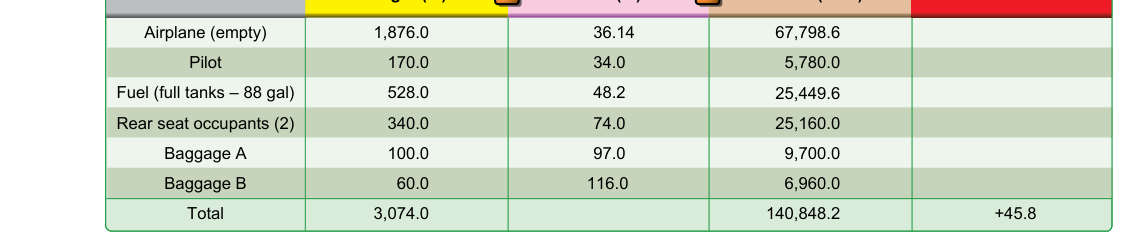
Consider a four-seat light airplane with a datum at the firewall. The front seats are located at a positive arm of 37 inches, the rear seats at 73 inches, and the aft baggage compartment at 95 inches. The fuel tanks are located at an arm of 48 inches. The basic empty weight is 1,480 lb with a CG at 39.5 inches. Maximum gross weight is 2,400 lb. For the aft CG check, load two rear occupants at 170 lb each (moment: 2 × 170 × 73 = 24,820 in-lb), 100 lb of baggage in the aft compartment (100 × 95 = 9,500 in-lb), and minimum fuel of 6 gallons (36 lb at 48 inches = 1,728 in-lb), with front seats empty. Empty weight moment: 1,480 × 39.5 = 58,460 in-lb. Total weight: 1,480 + 340 + 100 + 36 = 1,956 lb. Total moment: 58,460 + 24,820 + 9,500 + 1,728 = 94,508 in-lb. CG: 94,508 ÷ 1,956 = 48.3 inches. Compare this to the aft limit for this example aircraft (assumed here to be 47.3 inches for illustration; always use the actual limit published in the aircraft's TCDS and AFM/POH). The computed CG of 48.3 inches exceeds this assumed aft limit — this aircraft would fail the aft adverse loading check and could not legally be operated in that configuration without corrective action.
Common Test Traps
- Confusing empty weight CG with operating CG. The empty weight CG is the starting point of the calculation, not the final answer. You must add all variable loads and recompute.
- Using maximum fuel for the aft CG check when tanks are forward of the CG. Maximum fuel in a forward tank actually shifts the CG forward, which is wrong for the aft adverse check. Use minimum fuel in that scenario.
- Ignoring the weight limit. A loading scenario may keep the CG in range but still exceed maximum gross weight. Both conditions must be satisfied.
- Mixing up forward and aft limits. The forward CG limit is the smaller arm number (closer to the datum); the aft limit is the larger number. A CG that is too far aft has an arm greater than the aft limit.
- Assuming only one adverse check is needed. Both the most forward and the most aft CG conditions must be verified independently; passing one does not imply passing the other.